


The Illustrator Who Built a Career on the One Thing Most Pet Portraits Miss
Andrea Cáceres went from civil engineering to 40,000 followers by drawing the small, specific details that make a dog unmistakably itself. That same eye is a quietly useful lesson for any pet owner.

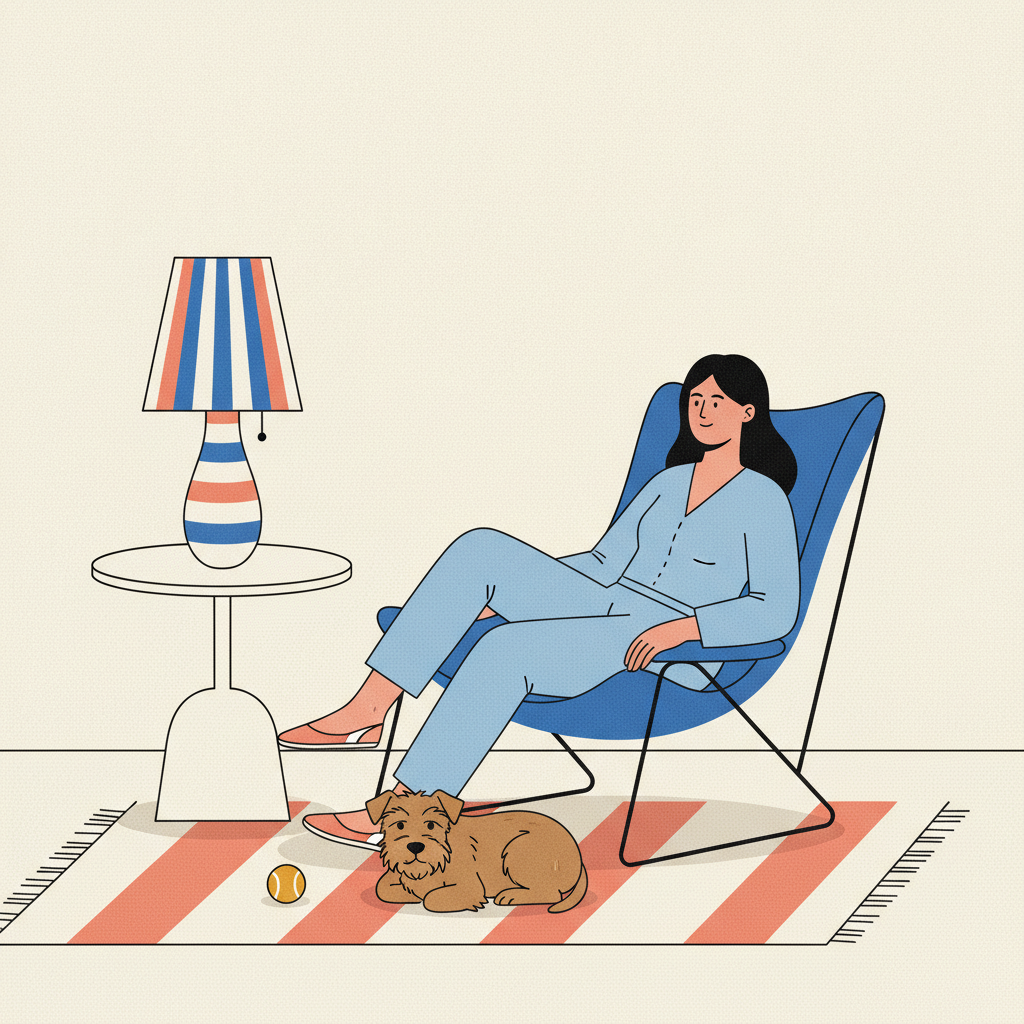
Ask Andrea Cáceres what makes a pet portrait actually look like the pet, and she does not say “the breed.” She says the opposite. “It’s not just about what breed they are. They don’t all look the same,” she says. “You have to really have an eye for the little details, how they sit, if they have an overbite, do they always stick their tongue out, how do they usually hold their ears. If you get those details, nothing else matters. I can do whatever and you’ll be like, ‘Yeah, that’s my dog.’”
That sentence is the key to her whole career, and it is also, quietly, a lesson for the rest of us. The thing that makes Cáceres’s work resonate is the same thing that makes us recognize our own animals: not the category they belong to, but the handful of specific quirks that belong only to them. Her art is a master class in noticing, and noticing is a skill worth borrowing.
From civil engineering to 365 dogs
Cáceres was never supposed to draw for a living. Back home in Venezuela, she studied to be a civil engineer. A side gig painting mugs with a friend got her noticed by a textile design company, one thing led to another, and she landed in New York in 2016 working as a textile designer for a baby-clothing company. The office had a perk that quietly redirected her life: people brought their dogs in constantly.
So she set herself a project, purely for herself. “A dog a day keeps the stress away.” She illustrated one dog every single day for a year, 365 of them, and posted each to social media. The discipline of it mattered more than any single drawing. Drawing a different dog daily forced her to do the exact thing she now preaches, find the one detail that makes each animal unmistakable, and do it fast.
The audience changed under her. “Little by little, I could see my followers starting to change, there were more dog people.” Then came the request that turned a habit into a business: people whose dogs hadn’t made the 365 started asking to commission portraits. Boris & Horton, a dog-friendly New York coffee shop, offered her a wall to paint, then invited her to paint dogs live at an event. She did free portraits at Pet Con, the pet-influencer conference, and the exposure tipped pet illustration into a full-time career. Today she has nearly 40,000 Instagram followers, brand partnerships with Snapchat, Kiehl’s, and The Farmer’s Dog, and a children’s book, My Dog Just Speaks Spanish.
A self-taught style that refuses to sell you anything
Cáceres is entirely self-taught, and she treats that as a feature, not a gap. “My art is very instinctual. I never took any classes; I learned everything by myself. And because of that, I kind of created my own style that is just how I like it.” Her references are other illustrators rather than other pet artists, a shelf of children’s books by Jon Klassen, Carson Ellis, and Marc Martin, her three biggest inspirations.
What is striking is how she guards her own feed. Despite all the brand work, she resists turning her personal account into a storefront. “My partnership manager isn’t so happy with that, because I don’t really promote products. But I feel like there’s no reason for people to follow me if I’m not giving them something.” So she makes work people see themselves in, the small comedies and tendernesses of pet ownership, from the mental-health lessons her dogs taught her to the specific shame of running out of poop bags. The relatability is the strategy, and it is the same instinct as the overbite: notice the true, particular thing, and people recognize it instantly.
Her plan from here leans away from commissions. She wants at least half her career to be children’s books, with the rest split between wholesaling her own merch and making work for herself. “I don’t think I’ll do commissioned artwork forever.”
Toby and Sherlock, and the introduction that took real work
Her two dogs are the recurring stars of her feed, and proof that she practices the detail-spotting she preaches. Toby, a Silky Terrier, has been with her since she was 17 and moved with her from Venezuela; he is 11 now. “He might look like a Yorkie, but he’s very muscular, very athletic. When you see him standing, it’s like he has abs. I feel like Toby is like an old man in Miami who’s always going to the gym.” Sherlock, an almost-two-year-old Weimaraner adopted from the D.C. Weimaraner Rescue, is “a little bit insecure, but at the same time very smart.” He opens doors, including the fridge, which is why the household runs baby locks on it.
The part of her story most useful to readers is how she got a one-dog home to a peaceful two-dog one, because Toby does not like to play with other dogs. Her approach was hands-on: a lot of positive-reinforcement training, and Sherlock on a leash indoors for the first month, with a gentle redirect every time he crowded Toby’s space. It worked, they now sleep together, and it lines up well with what behaviorists actually recommend, with one addition worth knowing for anyone in the same spot.
“The single biggest predictor of a smooth multi-dog home is where the first meeting happens,” says Dr. Priya Nair, a veterinarian who handles behavior consults. “Introduce the dogs on neutral ground, a quiet street or trailhead neither one owns, with a parallel walk twenty feet apart before any nose-to-nose contact. Reward calm glances at each other with high-value treats, then close the distance over several short sessions. Doing the first introduction at home, on the resident dog’s turf, is how you get exactly the territorial friction you’re trying to avoid.”
Cáceres’s leash-and-redirect month was a sound way to manage the early weeks at home; a neutral-territory first meeting is the front-end step that makes that month easier. Together they are close to the full protocol, and the result, two very different dogs curled up asleep, is the kind of specific, true detail she would be the first to draw.
References
- “How to Successfully Introduce Two Dogs.” Animal Humane Society, animalhumanesociety.org.
- “Introducing Dogs at Home.” San Diego Humane Society, sdhumane.org.
- Cáceres, Andrea. Instagram, @andrecaceresg.
Claire Sutton writes about life with pets, from the first days home to the small daily routines that make a household work. Her reporting spans people-and-pet relationships, training basics, and the practical side of bringing a new animal into the family.
Meet our experts ↗Keep reading
 LivingThis Illustrator Doesn't Draw Pets. She Draws Familiars.Leila Torres · 7 min
 LivingHer Anxious Dog Became the Best Mental-Health Teacher She Ever HadClaire Sutton · 6 min
 LivingInside the 'Soho House for Dogs,' Where a Dog Park Costs $1,400 a YearSasha Ford · 6 min
 LivingYour Dog Isn't Why You're Not Dating. It's Just Your Best Excuse.Claire Sutton · 6 min
 LivingCelebrate the Holidays With Your Dog Without Landing in the ERNina Vasquez · 5 min
 LivingThey Came to Shoot a TV Show. They Left Having Saved 14 Dogs.Sara Lim · 6 min