


Your Cat Eats Organic. You Eat Standing Over the Sink.
There's a whole quiet economy of people who buy their pets ceramide skincare, acupuncture, and personal chefs while using the cheapest shampoo on the shelf for themselves. Is that love, or a warning sign? A look at the numbers, the psychology, and a three-question gut check.

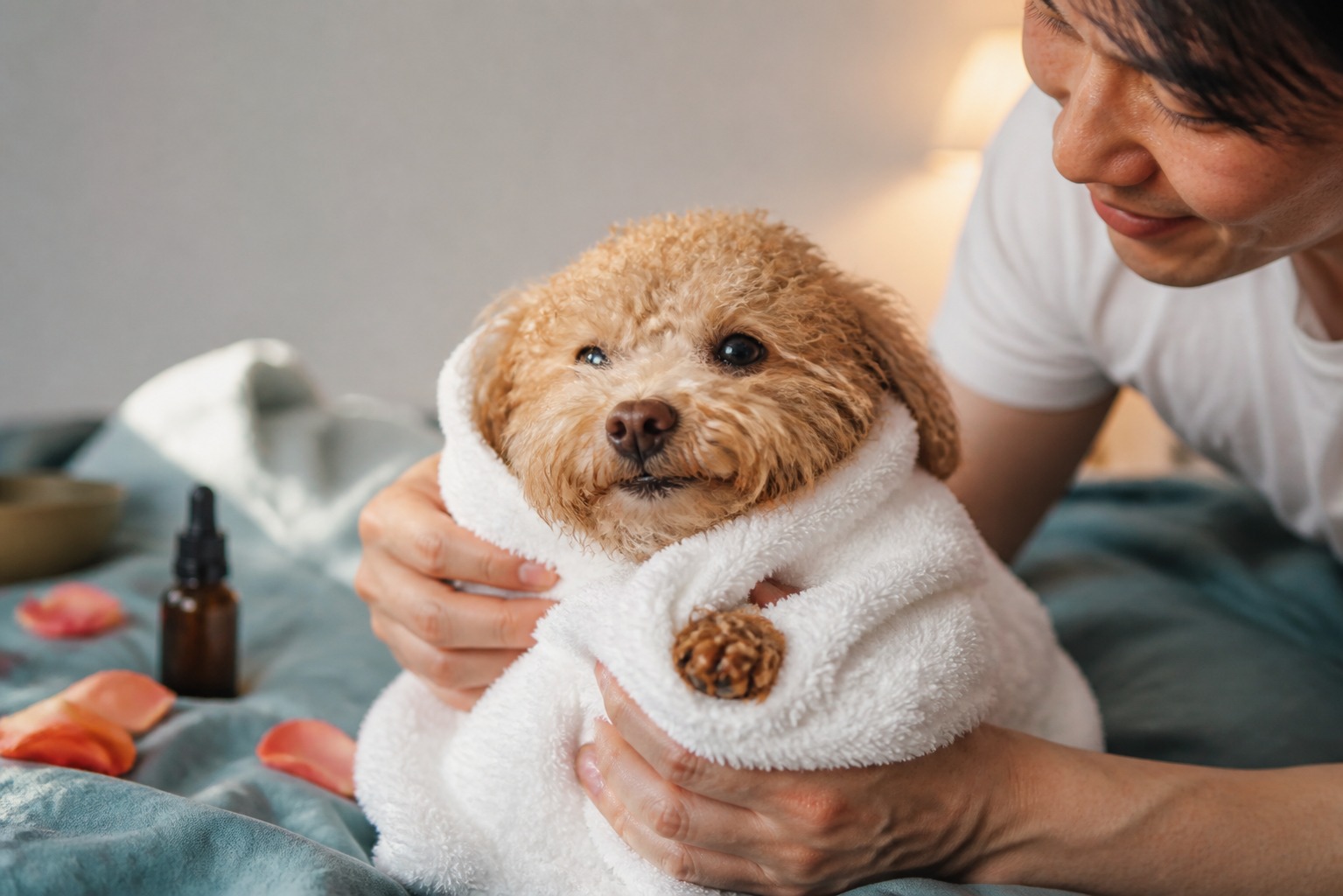
Somewhere right now, a person is smoothing ceramide moisturizer onto their senior cat while their own skincare routine is whatever bar of soap was on sale. Someone is booking their dog a physiotherapy session and learning the exercises by hand, and they haven’t seen their own doctor in years. Scroll any pet forum and you’ll find people cheerfully admitting they feed their dog better than they feed themselves, and a few admitting they’ve made real sacrifices, skipped medical care, dipped into retirement savings, to give an animal the best of everything.
It’s easy to laugh at, and also worth taking seriously, because the line between devoted and self-erasing is thinner than it looks. So: is out-pampering yourself a charming quirk, or a flag?
First, you are extremely not alone
The instinct to put a pet first is close to universal among people who have them. In a 2022 survey of 2,000 pet owners, 71 percent said they put their pet’s needs ahead of their own. That’s not a fringe of eccentrics. That’s the clear majority quietly deciding the animal gets what it needs first.
The money follows the feeling. Americans now pour an enormous amount into their pets: U.S. pet-industry spending reached about $158 billion in 2025 and is projected to climb toward $165 billion in 2026, with roughly 94 million households owning at least one pet. Health care and quality time top owners’ spending priorities, and most say even a rocky economy hasn’t changed how they provide for their animals. Younger owners lean in hardest; Gen Z is the most likely generation to run a multi-pet household. In other words, the person spending more on their dog’s diet than their own groceries has a lot of company.
The psychology of the spoil
Why does caring for a pet so often outrun caring for ourselves? Part of it is that it feels good in a way self-care rarely does. Spending on a pet, choosing the best food, the nicer bed, the extra vet workup, can deliver a real sense of agency and control in a world that offers precious little of either. You can’t fix the economy or your own tangled to-do list, but you can absolutely make sure the dog has everything. There’s also a moral pull: an animal didn’t choose to be dependent on you, and a lot of owners feel a genuine obligation to make that dependence worth it.
None of that is unhealthy on its own. The trouble starts only when the giving quietly hollows out the giver.
“I see the healthy version and the worrying version in the same exam room,” says Dr. Lena Park. “The healthy version is a person happily spending on their pet’s care and living a full life themselves. The worrying version is someone apologizing for their own untreated health while handing me a credit card for every test I mention. When caring for the animal is coming out of your own basic needs, that’s not devotion anymore, that’s something to gently look at.”
That’s the real dividing line, and it isn’t the dollar amount. Indulging a pet more than yourself is only a problem when it starts costing you your health, your financial stability, or your relationships. A well-off person who spoils their cat rotten and still lives comfortably is fine. A person selling plasma or skipping their own medication to fund a pet’s care is describing a red flag, however loving the impulse behind it.
A three-question gut check
If you suspect you might be tipping from generous into self-neglecting, you don’t need to swear off spoiling your pet. You need a moment of honesty. Next time you’re about to spend big on your animal, try running the purchase past three questions.
First, what am I telling myself this purchase means about me as an owner, and what do I fear it would mean if I didn’t do it? Guilt is a powerful, often irrational engine here, and naming it defuses some of its force.
Second, can I actually afford this comfortably, and what would I have to give up to make it happen? “The dog deserves it” is true and also not a budget.
Third, do I invest anything close to this much love, effort, and money in myself? If the honest answer is no, sit with why, and consider what it would take to even the scales a little. You’re allowed to be on your own list of dependents.
The part your pet actually wants
Here’s the reassuring truth underneath all the spending. The dog spa, the designer bed, the commissioned pet portrait, the acupuncture, none of it is what your animal is actually asking for. What a pet wants most, above every premium upgrade, is your time and your presence. The walk. The lap. The attention. That’s the one thing on the menu that’s free, and it’s the thing they’d choose every time.
So spoil your pet if you can and it brings you joy. Go as big as your life genuinely allows, and don’t feel bad if that’s smaller than someone else’s blowout. Just make sure you’re somewhere in the picture too. The goal isn’t to love your pet less. It’s to remember that the person doing all this loving deserves a little of it back.
References
Jordan Ellis is a certified professional dog trainer with a decade of experience working with rescue organisations and private clients. They specialise in anxiety, reactivity, and positive reinforcement methods, and review all training and behaviour content at The Pet Times.
Meet our experts ↗Keep reading
 LivingThe 'Rainbow Bridge' Feels Ancient. A Grieving 19-Year-Old Wrote It in 1959.Claire Sutton · 6 min
 LivingYou Can Learn a Lot About Someone From the Voice They Use on the DogSasha Ford · 4 min
 Product PicksSkip the Pride-Washing: 5 Queer-Owned Pet Brands That Actually DeliverSasha Ford · 5 min
 LivingThe Pet Portrait Artist Who's Allergic to Every Animal He PaintsSasha Ford · 7 min
 LivingThose Pet Spa ASMR Videos Are Harmless. The Lesson They Teach You Isn't.Dr. Nina Kohl · 4 min
 LivingYou Can't Write Off Your Dog. Here Are 7 Times You Can Anyway.Sara Lim · 8 min