


A 13-Year-Old Dog Lay Down in the Road So a Deputy Would Follow Her Home
Gita didn't bark for help or run in circles. She planted herself where a patrol car couldn't miss her, then led the deputy to her 84-year-old owner, who had been down for hours.

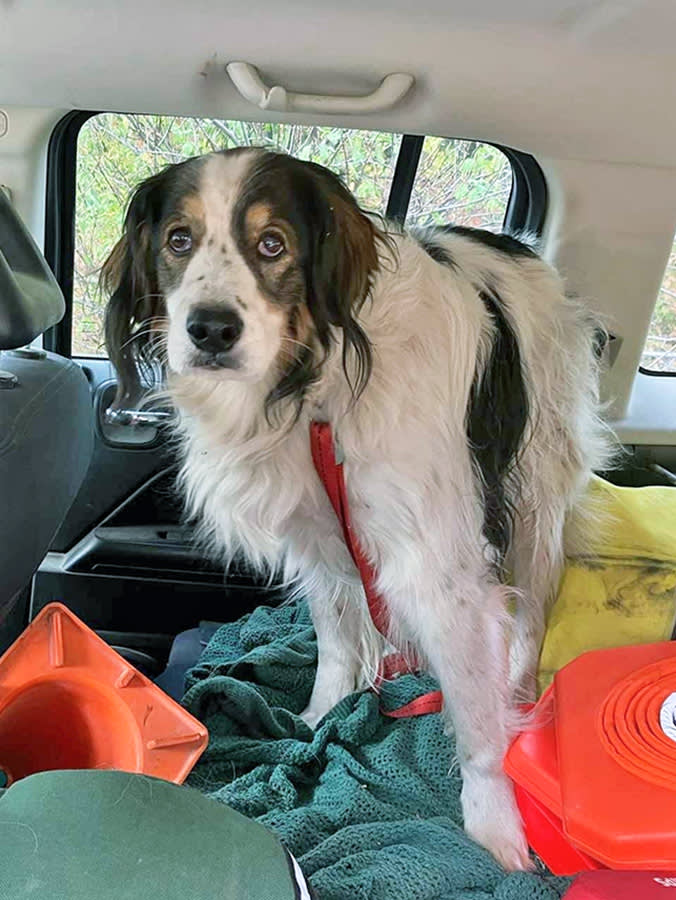
In the fall of 2024, a sheriff’s deputy in rural Stevens County, Washington came around a bend outside Colville and found a dog sitting in the middle of the road. The obvious read was a loose pet who had wandered off. The deputy, named Wright, tried to coax her into his patrol vehicle so he could track down an owner. She refused to get in. He drove the nearby properties within about a mile looking for someone who was missing a dog. Nobody was.
That should have been the end of it. Instead, when the deputy came back and tried again to move the dog off the road, she took off down a faint, unmarked track. He followed. The trail ended at a small cabin, and from somewhere close by, a man was calling out.
The dog’s name, he would learn, was Gita. She was thirteen years old, a rescue, and she had not been lost at all. She had been waiting for exactly this.
What the deputy found
Near the cabin, an 84-year-old man was on the ground where he had fallen and hurt his leg. He also lived with other medical conditions that required regular medication, which made the situation more dangerous than a bad fall alone. By the time the deputy reached him, he had been down for hours. The Stevens County Sheriff’s Office later said that without someone finding him, the outcome could have been far worse.
The office was blunt about who deserved the credit. Gita, they said, was the reason the man was found that day, and they thanked her for it in plain terms: a thirteen-year-old rescue dog and her person’s best friend, who went looking for help the moment he could not get up.
Why this story is rarer than it sounds
It is tempting to file “loyal dog saves owner” under things dogs simply do. The research says otherwise, and that is what makes Gita worth paying attention to.
Dogs are extraordinary at noticing when something is wrong with us. They read our posture, our voice, even the chemical signature of our stress. What they are generally not wired to do is translate that alarm into a plan, leave the person in trouble, find a stranger, and physically lead that stranger back. Studies that have staged emergencies to see whether pet dogs will fetch help have mostly come up empty. Most dogs stay, or fret, or do nothing a rescuer could use.
Gita did the uncommon thing. She left her person, positioned herself where a vehicle could not drive past, held her ground when a stranger tried to remove her, and then guided him down a path he never would have taken on his own. Whether that was training, temperament, or thirteen years of knowing one human better than anyone else knew him, the sequence worked.
The quiet argument for the older dog
Stories like this also push back on a bias that fills shelters with overlooked animals: the assumption that a senior dog is a lesser adoption. Gita was thirteen, an age when many dogs get passed over at the kennel in favor of puppies.
“A bond that deep doesn’t come standard, it gets built over years,” says Dr. Lena Park, a Pet Times veterinarian. “An older dog who has lived alongside one person for a long time often reads that person with a precision a young dog simply hasn’t had time to develop. That is not a consolation prize. In a moment like this, it is the whole thing.”
Nobody should adopt a senior dog expecting a rescue mission. But the loyalty that showed up on that road did not appear despite Gita’s age. It was made of it.
The man was found. The deputy went home with a story he will tell for the rest of his career. And a gray-muzzled dog who would not get out of the road turned out to be doing her most important job.
Leila Torres leads our Living coverage, from home life and travel to the products and rescue stories that come with sharing a life with animals. She edits and writes across the section, with a soft spot for pieces about the bond between people and their pets.
Meet our experts ↗Keep reading
 LivingAn 8-Pound Rescue Chihuahua Yanked Her Down a Side Street. She Found a Fashion Brand.Nina Vasquez · 6 min
 LivingThe 90-Day Rule for Adopting a Dog With Someone NewClaire Sutton · 6 min
 Living"I'm Too Busy for a Dog" Is Almost Never TrueLeila Torres · 6 min
 LivingYou Want a Lapdog, Your Partner Wants a Mount. The Dog You Fight Over Is Rarely the One You GetLeila Torres · 8 min
 LivingThe Artist Who Couldn't Draw Herself Found a Workaround: an 8-Pound ChihuahuaLeila Torres · 5 min
 LivingThere's No Right Time for Another Dog. Ask This Instead.Leila Torres · 6 min