


Puppy Milestone Cards Are a Photo Prop. Yours Should Be a Deadline.
Pawness's 20-card set is charming, sustainable, and gives back. But the sneaky reason to buy it is that a puppy's first year has real developmental windows, and a card in your hand is a much better reminder than a calendar you'll ignore.

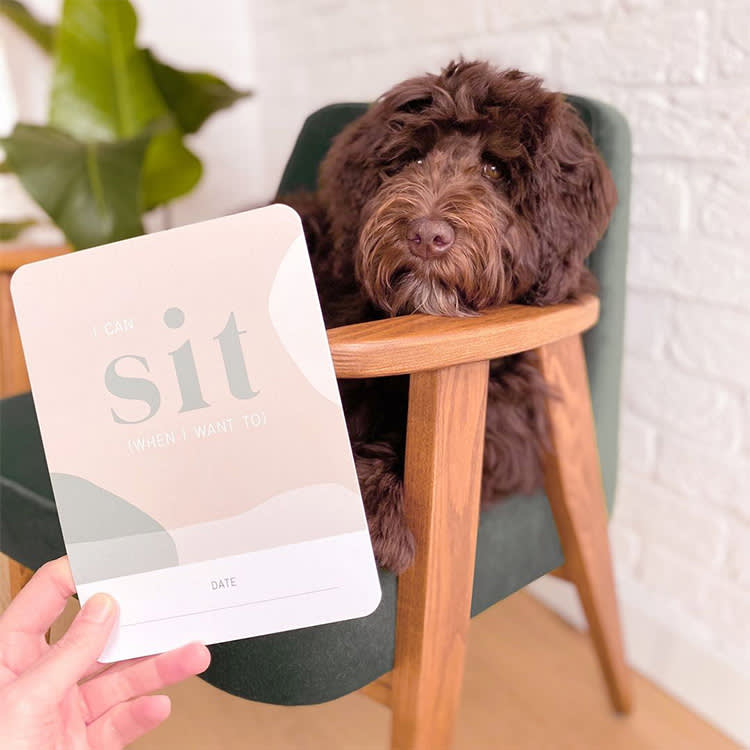
Here’s the case against milestone cards, and I want to make it honestly before I make the case for them. They are a piece of cardstock. You hold one up next to a puppy, you take a picture, and the internet gets slightly more crowded. It is, on its face, the pet version of the thing your friends do to their infants on Instagram, and if you find that faintly ridiculous, you are not wrong.
Here’s why I bought them anyway.
A puppy’s first year is not a soft, sentimental blur. It is a series of biological windows that open and close on a schedule, and most of them close quietly, without telling you. The socialization window. The teething timeline. The vaccine series that only works if you finish it. New puppy parents miss these constantly, not through carelessness but because the whole period is a fog of sleep deprivation and chewed shoes, and nobody hands you a calendar.
A deck of cards sitting on your counter is a calendar you’ll actually look at. That’s the real product.
What you’re actually buying
Pawness makes a 20-card set built around a puppy’s first year. Each card is printed with a bright, first-person announcement of whatever just happened, written from the dog’s point of view. One is about losing a first puppy tooth. Another is about meeting the groomer. The cards run about 135 by 180 millimeters, which is big enough to read in a photo and small enough that a squirming puppy doesn’t knock it out of frame.
The set is organized in three tiers. It starts with the basics: gotcha day, then the three-month, six-month, and nine-month marks, then the first birthday. Next come the big outings, meaning the first grooming appointment, the first vet visit, and the first training class. Last are the new skills, with cards for the day your dog learns to sit, to give paw, and to play fetch.
Every card is double-sided, and the back carries a writing prompt about that particular accomplishment. That detail is the one that separates the set from a generic photo prop, and it is the one that turns a stack of cute pictures into something closer to a record. If you are a journaler rather than a scrapbooker, the back of the card is where the product actually lives.
For those of us who flunked arts and crafts, the low barrier is the point. You do not have to assemble anything, laminate anything, or maintain a system. You hold the card next to the dog after something happens, and you press a button.
Puppy Milestone Cards, from Pawness
The part that makes it more than cute
Now overlay the cards on what is actually happening inside your puppy during that same year.
Gotcha day through 14 weeks: the socialization window. This is the single most consequential period in your dog’s life, and it is short. During roughly the first three to four months, a puppy’s brain is unusually willing to file new experiences as normal rather than as threats. Sounds, surfaces, hats, umbrellas, men with beards, wheelchairs, vacuum cleaners, other dogs, children. What they meet calmly in this stretch tends to stay unremarkable. What they don’t meet becomes a candidate for fear later. There is no card in the deck labeled “socialization window is closing,” but the gotcha-day card and the three-month card are sitting on either side of it, and that visual is worth more than any reminder app.
The first vet visit and the vaccine series. The vet-visit card gets photographed once. The series behind it runs for weeks, with shots roughly every two to four weeks until at least 16 weeks old, because nobody can tell you exactly when a puppy’s maternal antibodies fade enough for a vaccine to take. This is the deadline people miss most often, and they miss it because puppy nine weeks looks healthy and the appointment feels optional.
“I lost my first puppy tooth.” Deciduous teeth generally start dropping out around four months, and the adult set is usually in by six or seven months. If a puppy tooth is still hanging on next to its adult replacement past that, it’s worth flagging to your vet, because a retained tooth crowds the bite and traps plaque. So the card is cute. The observation the card forces you to make is genuinely useful.
The first training class, and the day they learn to sit. These land in adolescence, which is the phase where the sweet compliant puppy of month four decides, around month seven or eight, that they have never met you before. The cards for the tricks are worth taking then, not because the trick matters, but because you will want photographic evidence that this dog could once follow an instruction.
“Owners think of the first year as a personality reveal, and it isn’t, it’s a construction project,” says Dr. Nina Kohl. “The socialization window closes whether or not you used it. Anything that gets a new owner to notice the dates instead of the cuteness is doing real work, even if it looks like a scrapbook.”
The brand behind it
The manufacturing story here is unusually clean, and it’s a fair part of the price.
The cards are printed on FSC-certified paper, meaning the wood fiber is traceable to responsibly managed forests. The pouch they arrive in is organic cotton certified to the Global Organic Textile Standard, which audits the whole production chain for worker treatment, consumer safety, and environmental practice rather than just the fiber at the front end. That’s a real certification with teeth, not a marketing sticker.
And the give-back is specific rather than vague. Ten percent of the profits from anything you buy goes to Perro & Co, a dog rescue based in the Netherlands, which uses it to fund preventive healthcare support for shelters in Portugal and to underwrite fostering and adoption there. It is not a “portion of proceeds go to animals” gesture; it’s a named organization doing a named thing.
Who this is actually for
Buy it if you are the person who will not otherwise make a record. That’s most first-time puppy parents. The year goes by in a haze, and the photos you take at random end up as 4,000 indistinguishable pictures of a sleeping dog, none of which are dated in a way you can reconstruct later.
Buy it as a gift if a friend just got a puppy and you want to give them something they will not immediately shove in a drawer. It is one of the few new-puppy gifts that is not a toy the dog will destroy or a gadget they already own.
Skip it if you already keep a puppy journal, or if you have a second dog and know from experience that you photographed everything the first time and nothing the second. That is not a character flaw. It is just what happens.
What’s new since this was written
The category has filled out a lot since these first showed up, and the practical advice now is to check what’s printed on the cards before you buy, not just how they look.
The strongest sets are the ones whose milestones map to something real: the end of the vaccine series, the first full night in the crate, the last puppy tooth, the first successful recall off leash. The weakest sets are pure content, a stack of “I’m 1 week old!” cards that photograph well and record nothing. Pawness’s deck leans toward the useful end, because its milestones are anchored to events that happen in a vet’s office, a groomer’s chair, or a training class rather than to arbitrary weeks.
If you’re buying any brand, the one question worth asking is whether you’ll still know what the photo meant in five years. A card that says “first vet visit” answers that. A card that says “I’m so cute!” does not.
Affiliate note
The Pawness set is sold directly by the brand and through a handful of independent pet boutiques. We did not find the same product on Amazon, so the link above points to the maker.
References
- American Veterinary Society of Animal Behavior. “Position statement on puppy socialization.” Link
- American Animal Hospital Association. “AAHA canine vaccination guidelines.” Link
- American Veterinary Dental College. “Retained deciduous teeth.” Link
- Global Organic Textile Standard. “The standard.” Link
- Forest Stewardship Council. “FSC certification.” Link
Sasha Ford is a certified cat behaviour consultant who has worked with shelters, catteries, and private clients across the country. They review all feline behaviour content at The Pet Times, with expertise in multi-cat households, indoor enrichment, and stress-related disorders.
Meet our experts ↗Keep reading
 Product PicksHow to Pick the Right Custom Pet Gift, Not Just the FlashiestSara Lim · 4 min
 Product PicksYour Pet Already Runs the House. Give Them the Christmas Tree, Too.Jordan Ellis · 6 min
 Product PicksCustom Pet Gifts That Don't Look Like JunkSasha Ford · 6 min
 Health & WellnessPuppy Breath Doesn't Go Bad. It Goes on Schedule.Dr. Mara Chen · 6 min
 First DaysThe Simple Math That Ends Puppy Potty AccidentsDr. Lena Park · 6 min
 First DaysTwo Puppies Sound Twice as Sweet. Trainers Beg You to Reconsider.Dr. Mara Chen · 8 min