


A Puppy Ate 24 Socks and Survived. Your Laundry Pile Was the Warning.
Surgeons pulled 44 objects out of a young Bernese Mountain Dog named Luna, including 24 socks and a onesie. What her case teaches about fabric-eating dogs, warning signs, and the real cost of waiting.

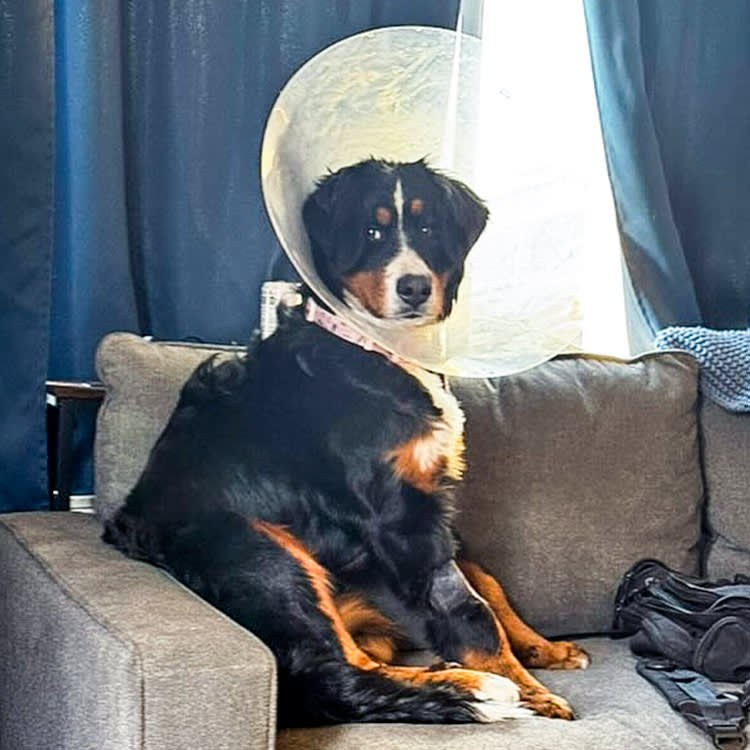
When Luna’s family brought the seven-month-old Bernese Mountain Dog to Corona Animal Emergency Center in early 2025, they knew two things: she was vomiting, and her belly looked swollen. What they could not have known was the inventory. Surgeons operating to clear an intestinal obstruction removed 44 objects from the young dog’s stomach, including 24 socks, a scrunchie, two hair ties, a shoe insert, a small onesie, and assorted other pieces of clothing.
Luna recovered at home afterward, cone on, family reportedly puppy-proofing the house and starting work with a trainer. The clinic, sharing her story on Instagram, called her one tough pup and urged owners to trust their instincts when something seems off.
Every part of that story is more common than it sounds, except the number.
Why laundry, specifically
Fabric-swallowing is a puppy specialty with a logic to it. Socks and underwear smell intensely like the dog’s favorite people, they are soft enough to chew and small enough to gulp, especially when a game of keep-away convinces the dog to swallow the evidence. Some dogs eat inedible objects out of boredom or under-stimulation, and a few develop true pica, a compulsive drive to eat non-food items that deserves its own veterinary workup.
The problem is that fabric does not pass the way a pilfered hot dog does. Cloth wads up, lodges, and can act like a slow drawstring on the intestines. An object that sits quietly in the stomach for weeks can move and obstruct without warning, which is likely how Luna accumulated a collection before the crisis hit.
“The dangerous window is the quiet one. A sock can sit in the stomach for days looking like nothing. The moment vomiting starts and the belly firms up, you are no longer in wait-and-see territory,” says Dr. Priya Nair.
The signs that should end any waiting: repeated vomiting, a distended or firm abdomen, lethargy, refusing food, straining without producing stool, or a dog who cannot get comfortable. Any of those after a known or suspected swallowing means an emergency vet, now. Obstructions cut off blood supply to the gut, and hours matter.
What the fix costs
Luna’s family paid for an emergency surgery, and this is the part of the story worth internalizing before it is your dog. Nationally, surgery for an intestinal blockage runs roughly $3,500 to $8,000, with averages around $4,400 and complicated cases climbing past $10,000. When an object is still in the stomach and reachable, endoscopy can sometimes retrieve it for $1,500 to $2,500 without an incision, which is one more argument for going in early rather than waiting for the object to travel somewhere worse.
Prevention, by comparison, is nearly free. Lidded hampers, closed closet doors, and a laundry routine that never leaves socks at dog height remove the most-swallowed items in the house. For the dog who targets one object type, management beats willpower: the sock-eater simply never gets access to socks. Boredom is the other lever, since a dog with enough exercise, chew toys, and puzzle feeders has fewer vacancies in the schedule for scavenging. And a solidly trained “leave it” and “drop it,” taught early with generous trades rather than chase games, converts near-misses into non-events.
If your dog does swallow something, skip the home remedies. Do not induce vomiting without veterinary guidance, since some objects do more damage coming back up. Call your vet or an emergency clinic, describe the object, and let them make the call between watchful waiting, endoscopy, and surgery.
Luna’s case ended as a story her family will tell at parties. The version that ends differently usually differs by only one variable: how long somebody waited.
References
Not a substitute for your vet. Our guidance is educational. For urgent symptoms, contact a vet or emergency clinic right away. Editorial standards
Sara Lim leads our Product Picks coverage, testing and comparing the things pets and their owners actually use. From everyday essentials to home-and-style finds, she focuses on honest, useful recommendations rather than hype.
Meet our experts ↗Keep reading
 Health & WellnessYour Dog Ate Your Weed. The THC Probably Won't Kill It. The Cover-Up Might.Dr. Amara Solis · 7 min
 Health & WellnessPut Down the Neosporin. Your Dog Is Just Going to Eat It.Dr. Ravi Mehta · 7 min
 Health & WellnessYour Dog Broke Out in Hives. The Bumps Aren't the Scary PartDr. Ravi Mehta · 6 min
 Health & WellnessYour Dog Is Not a Carbon Monoxide Detector. Don't Treat Them Like One.Dr. Priya Nair · 6 min
 Health & WellnessPoisoned Bait Killed 3 Dogs and 51 Coyotes in Tucson. No One Was CaughtJames Okafor · 5 min
 Health & WellnessTylenol Is the 'Gentle' Painkiller That Quietly Wrecks a Dog's LiverDr. Amara Solis · 8 min