


"You're Spoiling Your Dog" Is Aimed at the Wrong Thing
The panic over childless millennials loving their pets too much gets the risk exactly backwards. It is not the couch or the road trips that hurt a dog. It is the four things nobody put in the headline.

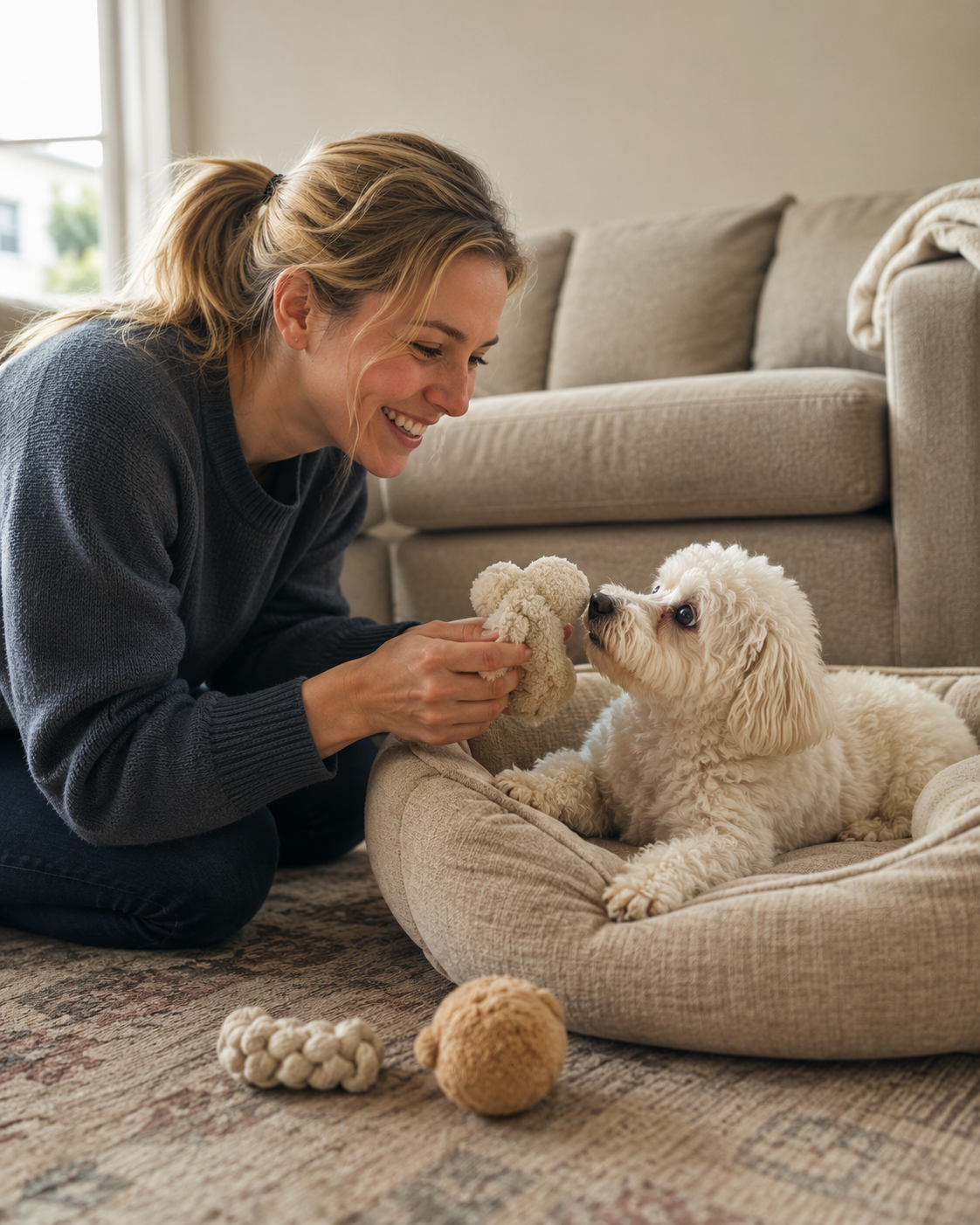
Every so often a headline decides that loving your pet is a public health problem. The most recent version aimed at childless millennials, arguing that a generation raising pets instead of kids is quietly harming those animals by treating them like children. The cheery framing was that we are “raising pets instead of kids, and it is not going well for the pets.”
Here is the thing the panic gets backwards. The behaviors it flags as “spoiling,” the road trips, the free run of the furniture, the birthday cake, are almost entirely harmless. The behaviors that genuinely hurt a dog are real, but they are a different list, and headlines about spoiled millennials almost never name them. So instead of asking whether you love your pet too much, the useful question is narrower and more answerable: of everything filed under “spoiling,” which handful actually carries risk, and which is just a dog on a couch? We put that question to behavior and veterinary experts, and the answer sorts cleanly into two piles.
The pile that is actually fine (and it is most of the pile)
Start here, because it is the bigger pile and the one people needlessly agonize over. Letting your dog on the couch or into your bed has no established behavioral or health downside. It is a preference, not a risk factor. Taking your dog along on trips, sharing the occasional bit of food, doting on them, and making decisions as though they were family: none of it has been shown to produce behavior problems. If anything, the older research on the subject points the other way. Studies from the 1990s on anthropomorphism and from 2001 on separation anxiety looked for a link between “spoiling” activities and behavioral trouble and did not find one.
Words like ‘entitled’ and ‘disrespectful’ describe people; a dog has no access to those categories. Behavior that pays off gets repeated, and behavior that doesn’t fades out. That’s reinforcement doing its ordinary job, not a corrupted character, and affection isn’t what causes it.
The bond itself is not the hazard. Dogs are social animals, and the fear that closeness “spoils” them mostly does damage in one direction: it makes good owners feel guilty, and in the worst case it pushes them to withhold affection to toughen a dog up. That is the move that backfires.
The pile that actually matters: four things worth watching
Now the smaller, real list. These are the failure modes worth your attention, and notice that not one of them is “loves the dog too much.”
1. Weight. This is the big one, and it is not a millennial problem. It is a human one. The Association for Pet Obesity Prevention’s most recent full prevalence survey found roughly 59 percent of dogs and 61 percent of cats in the U.S. are overweight or have obesity. Those animals belong to owners of every age. Excess weight is not cosmetic. It shortens lifespan and drives chronic disease, including type 2 diabetes and osteoarthritis, which is why the American Animal Hospital Association now recommends a body condition score at every single vet visit, not just an annual weigh-in.
“Treats should be no more than about 10 percent of a pet’s daily calories,” says Dr. Nina Kohl. “A typical cat needs roughly 250 to 300 calories a day, and a dog’s need scales with weight. The trouble is almost never one indulgent day. It is a small daily overage that no one notices until the number on the scale does.”
Encouragingly, awareness is catching up. In the 2024 owner survey, 35 percent of dog owners and 33 percent of cat owners correctly identified their pet as overweight, a sharp jump from 17 percent and 28 percent the year before. The panic frames doting owners as the problem; the data suggests engaged owners are actually the ones starting to notice and act.
2. Diet fads that outrun the science. Raw diets carry a real risk of foodborne illness for both the pet and the humans preparing the food. Boutique and specialized foods can be fine, but only if they actually meet a pet’s full nutritional needs, which is worth confirming with a vet before you commit rather than after.
3. Anxiety treated with “tough love.” Separation anxiety is serious and can lead to self-injury; dogs have jumped through windows and torn their paws digging out of crates. But it usually has genetic and medical roots, and the idea that less attention will cure it is not just wrong, it is harmful. Withholding affection to fix anxiety prolongs the suffering and delays real treatment. If your dog is struggling, the first stop is a veterinarian, not a stricter regimen.
4. Sleep and unmet species needs. Here is the one legitimate way attention can tip into a problem: if constant closeness chronically disrupts a dog’s sleep, that deprivation can itself cause behavior issues. And a dog whose exercise, enrichment, chewing, sniffing, and other species-specific needs go unmet will struggle, no matter how loved they are. The failure there is not too much love. It is treating a dog so much like a small human that its actual dog needs get skipped.
The birth-rate red herring
One more thing, because it props up the whole “spoiling” narrative. These pieces love to pair pet devotion with falling birth rates, as if doting on a Labrador were nudging the global population down. The research on declining fertility does not mention pets anywhere. The drivers are contraception access, expanded education and careers, and pressures like the cost of living, housing, and paid-leave gaps. Your dog is not on the list. You can stop carrying that particular guilt.
The actual test
So run the real diagnostic, not the vibes-based one. Is your dog a healthy weight? Are they eating a diet that meets their needs? Are they getting enough sleep, exercise, and dog-specific outlets? Can you read their body language, the panting, yawning, whale eye, ears back, or tucked tail that tell you in real time how they feel? If yes, then the couch, the road trips, and the birthday cake are not a problem to solve. They are just a good life. Our pets spend their whole lives fitting themselves into a world that was not built for them. Meeting the four things that matter, and letting the rest go, is how you love them well.
References
- Association for Pet Obesity Prevention. “2022 Pet Obesity Prevalence Survey.” https://www.petobesityprevention.org/2022
- Association for Pet Obesity Prevention. “2024 Pet Obesity & Nutrition Opinion Survey Results.” https://www.petobesityprevention.org/2024-survey
- American Animal Hospital Association. “2021 AAHA Nutrition and Weight Management Guidelines for Dogs and Cats.” https://www.aaha.org/resources/2021-aaha-nutrition-and-weight-management-guidelines/home/
- Voith, Victoria L., et al. “Is There a Relationship Between Canine Behavior Problems and Spoiling Activities, Anthropomorphism, and Obedience Training?” Applied Animal Behaviour Science, vol. 34, no. 3, 1992, pp. 263–272. https://doi.org/10.1016/S0168-1591(05)80121-2
- Flannigan, Gerrard, and Nicholas H. Dodman. “Risk Factors and Behaviors Associated With Separation Anxiety in Dogs.” Journal of the American Veterinary Medical Association, vol. 219, no. 4, 2001, pp. 460–466. https://doi.org/10.2460/javma.2001.219.460
- GBD 2021 Fertility and Forecasting Collaborators. “Global Fertility in 204 Countries and Territories, 1950–2021, with Forecasts to 2100.” The Lancet, vol. 403, 2024. https://doi.org/10.1016/S0140-6736(24)00550-6
Dr. Chen is a small-animal veterinarian who leads health and safety coverage at The Pet Times. She writes and reviews the bulk of our illness, condition, and safety content, translating clinical guidance into clear, practical advice owners can act on at home.
Meet our experts ↗Keep reading
 LivingLibra Season Is the Fairest Time to Be a Pet at the Dog ParkSasha Ford · 5 min
 LivingVirgo Season Is Basically a Holiday for Type-A Pet ParentsNina Vasquez · 5 min
 LivingShoot Your Pet Like a Cover Star: 7 Phone-Portrait Rules From a ProSasha Ford · 4 min
 LivingTom Brady Cloned His Dog for $50,000. Most of Gen Z Says They'd Do It Too.Jordan Ellis · 9 min
 LivingYour Cat Ruins Your Meditation by Sitting on Your Chest. That's the Practice.Jordan Ellis · 5 min
 Living35% of Gen Z Has a 'Pet-Nup.' The Law Hasn't Caught Up.Sara Lim · 6 min