


You're Not Allergic to Your Dog. You're Allergic to a Protein, and That Changes Everything
Most pet-allergy advice skips the one step that decides whether anything else works: finding out what you actually react to. Here's the layered fix, from free to clinical.

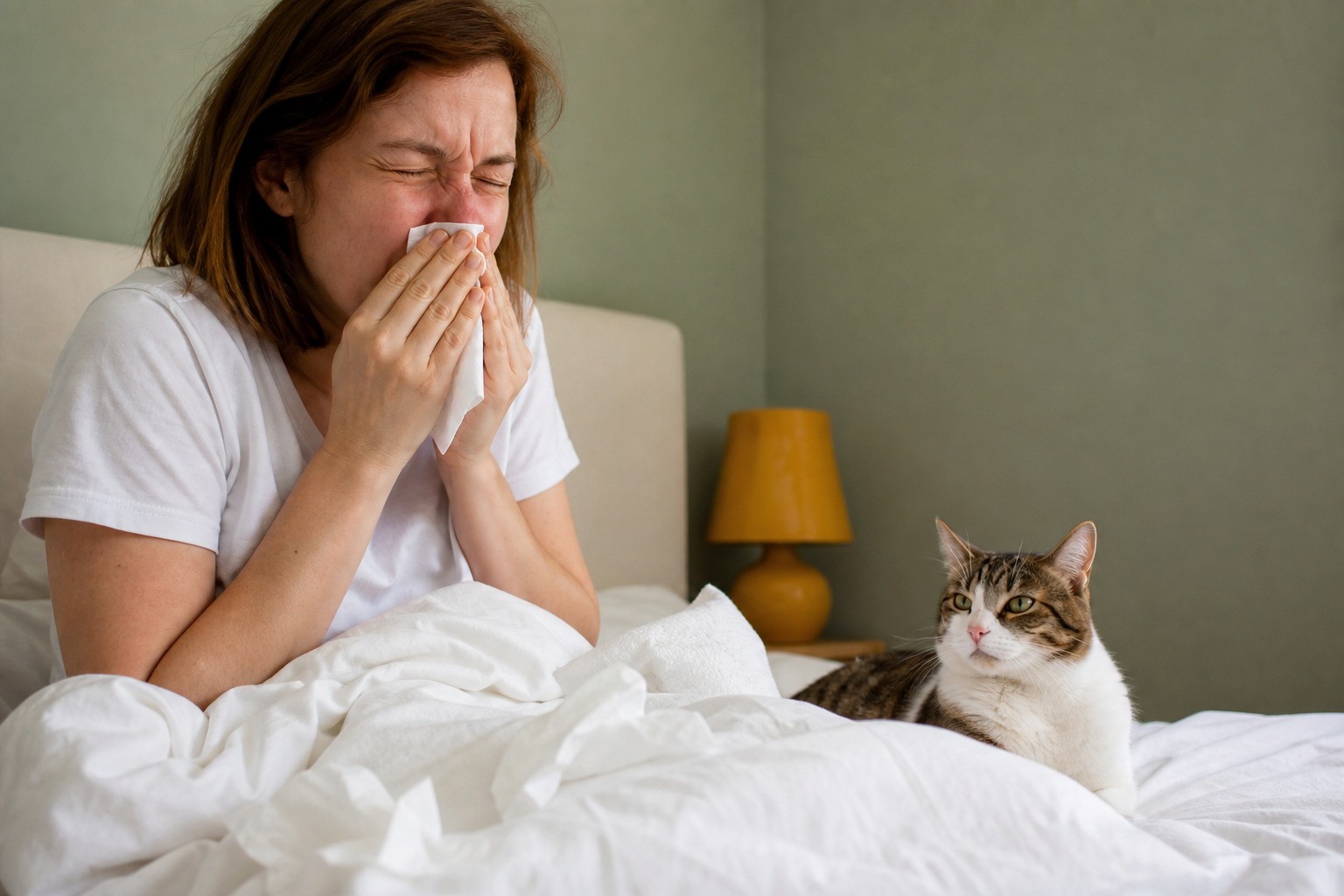
Here is the reframe that makes pet allergies manageable: you are not allergic to your dog or your cat. You are allergic to a specific protein they produce, and your whole strategy should follow from knowing exactly which one. People skip straight to air purifiers and antihistamines and then wonder why they are still miserable, because they never confirmed what they react to or how heavily their home is loaded with it. Treat this as an engineering problem, lower the allergen faster than it accumulates, and start by measuring it, and living comfortably with your pet stops being a wish and becomes a plan.
“If symptoms are eroding someone’s day-to-day quality of life, they deserve a proper workup and a treatment plan,” says Dr. Priya Nair, an allergist who works with pet owners. “The therapies we have actually work, so suffering isn’t necessary, and it’s exceedingly rare that anyone has to part with their pet.”
First, find out what you’re actually allergic to
This is the step everyone skips, and it is the one that determines whether the rest works. You may sneeze around your pet without their dander being the culprit at all. Dogs and cats are superb at ferrying outdoor allergens, pollen, mold, dust, indoors on their fur, so the thing setting you off might be hitchhiking, not the animal itself.
An allergy test settles it. An allergist exposes your skin to a panel of triggers and watches what flares, naming your specific enemies instead of leaving you to guess. The result also tells you how hard to fight. Allergy to cats is common, affecting somewhere between 7 and 25 percent of people, and it tends to be more prevalent than dog allergy. The overwhelming majority of cat-allergic people, roughly 90 to 96 percent, react to a single protein called Fel d 1, produced in cat saliva and skin and spread everywhere a cat grooms. Knowing it is Fel d 1 specifically matters, because some of the newest interventions target that exact protein.
The free and cheap layer: control the dander load
Before you spend a dollar, change the math on how much allergen lives in your space.
Build a pet-free zone. You cannot realistically limit exposure to an animal that follows you room to room, but you can wall off one space. Make it the bedroom, where you spend roughly a third of your life, and keep it off-limits to the pet. Wash pillowcases and bedding frequently, on hot when you can, since dander drifts in regardless.
Bathe and wipe the source. Bathing your pet about once a week measurably cuts the dander they shed. For cats, who often resist baths, regular wipe-downs with a damp cloth and frequent washing of their bedding lower the Fel d 1 burden without the wrestling match. Check with your veterinarian about a gentle shampoo you can use weekly without drying out the skin.
Attack the soft surfaces. Dander clings to fabric. Wash couch covers, throw blankets, and pet beds on a schedule, vacuum carpets and rugs often, and consider trading heavy fabric curtains for materials that don’t act like dander magnets.
The hardware layer: out-filter the air
A true HEPA air purifier in the rooms you use most pulls dander, and pollen, mold, and dust, out of circulation, which is a real help when more than one allergen is ganging up on you. Pair it with a vacuum that has a sealed HEPA filtration system, because a leaky vacuum just relaunches dander into the air it pretends to remove. This is the layer where the “faster than it accumulates” framing earns its keep: filtration is what keeps the load down between cleanings.
The medication layer: from drugstore to prescription
If symptoms are mild, the pharmacy aisle may carry you. Antihistamines quiet sneezing, itching, and a runny nose; nasal corticosteroids like Flonase and Nasonex tamp down the inflammation allergens trigger. Nasal irrigation with a saline rinse can clear your sinuses, just use only distilled, sterile, or previously boiled-and-cooled water, never straight from the tap, and rinse the device after each use.
When the over-the-counter stack stops cutting it, an allergist earns their title. “A lot of my job is simply showing people how to use the medicines already sitting in their cabinet correctly,” Dr. Nair says. “That said, once allergies bring on asthma, over-the-counter won’t cut it, you’ll need something prescription-strength to keep it in check.” That asthma caveat is not a footnote, allergic asthma is the point at which self-treatment becomes genuinely risky, and a reason to see a professional rather than stack more drugstore products.
The clinical layer: retrain the immune system
For severe, stubborn symptoms, immunotherapy, allergy shots, aims at the root rather than the symptoms. Given weekly or biweekly, the injections expose you to tiny, escalating doses of your allergen to teach your immune system to stop overreacting. It is slow: relief often takes months, and once it works you taper to maintenance shots every few weeks. The payoff can be substantial. One longtime sufferer who started shots after testing positive to her dogs’ dander saw a dramatic drop in bad days after about eight months, on top of the basics, running a good vacuum on a regular schedule, laundering her sheets in hot water far more often, and retreating to a dog-free bedroom whenever she needed to.
The newest angle: neutralize the allergen at the source
For cat owners specifically, the science has moved. Because Fel d 1 is so dominant a trigger, researchers have developed approaches that reduce the protein itself rather than just filtering what the cat produces, including a cat food formulated with an anti-Fel d 1 antibody that binds the allergen in the cat’s saliva before it spreads to the coat. It is not a cure and it does not replace the layers above, but it represents a shift worth knowing about: instead of only managing your reaction, you may be able to lower the dose at the source. Ask your veterinarian whether it fits your situation.
The throughline is the same at every level: beating a pet allergy is almost always a stacked, layered effort, never a single fix. Your exact combination will be yours alone. Giving up your animal does not have to be one of the ingredients.
This article covers allergy management broadly; for diagnosis, medication choices, and immunotherapy, work with your physician or allergist, and consult your veterinarian before changing your pet’s diet or grooming routine.
References
- “Human Allergy to Cats: A Review for Veterinarians on Prevalence, Causes, Symptoms and Control.” Veterinary Sciences / PMC, ncbi.nlm.nih.gov.
- Satyaraj, E., et al. “Keep the Cat, Change the Care Pathway: A Transformational Approach to Managing Fel d 1, the Major Cat Allergen.” Allergy, vol. 74, 2019, onlinelibrary.wiley.com.
- U.S. Food and Drug Administration. “Is Rinsing Your Sinuses With Neti Pots Safe?” fda.gov.
- American College of Allergy, Asthma and Immunology. “Pet Allergy.” acaai.org.
Not a substitute for your vet. Our guidance is educational. For urgent symptoms, contact a vet or emergency clinic right away. Editorial standards
Dr. Kohl is a board-certified veterinary dentist with a particular interest in preventive oral care. She reviews all dental health content at The Pet Times and contributes practical guides on home dental routines, professional cleaning, and oral disease prevention.
Meet our experts ↗Keep reading
 Health & WellnessYour Tick Meds Won't Catch Them AllDr. Lena Park · 6 min
 Health & WellnessOnly 5% of a Flea Problem Lives on Your Cat. Here's the Other 95%.Dr. Ravi Mehta · 9 min
 Health & WellnessIs That a Tick or a Skin Tag? The One Test That Tells YouDr. Amara Solis · 10 min
 Health & WellnessEveryone Blames Allergies. Check the Parasites First.Dr. Nina Kohl · 7 min
 Health & WellnessThe Fleas on Your Dog Are 5% of the Problem. The Rest Is in Your CarpetDr. Ravi Mehta · 10 min
 Health & WellnessNo Fleas, Still Scratching? 7 Culprits, Ranked by How Likely They Are.Dr. Mara Chen · 14 min