


The Litter Scoop in the Dishwasher: It Was Never About the Ick
The great litter-scoop-in-the-dishwasher debate isn't a cleanliness argument. It's a Toxoplasma one. Here's the parasite science, the expert split, and a simple rule.

Affiliate disclosure. This article contains affiliate links. We may earn a small commission if you buy through a link, at no extra cost to you. How we handle recommendations.
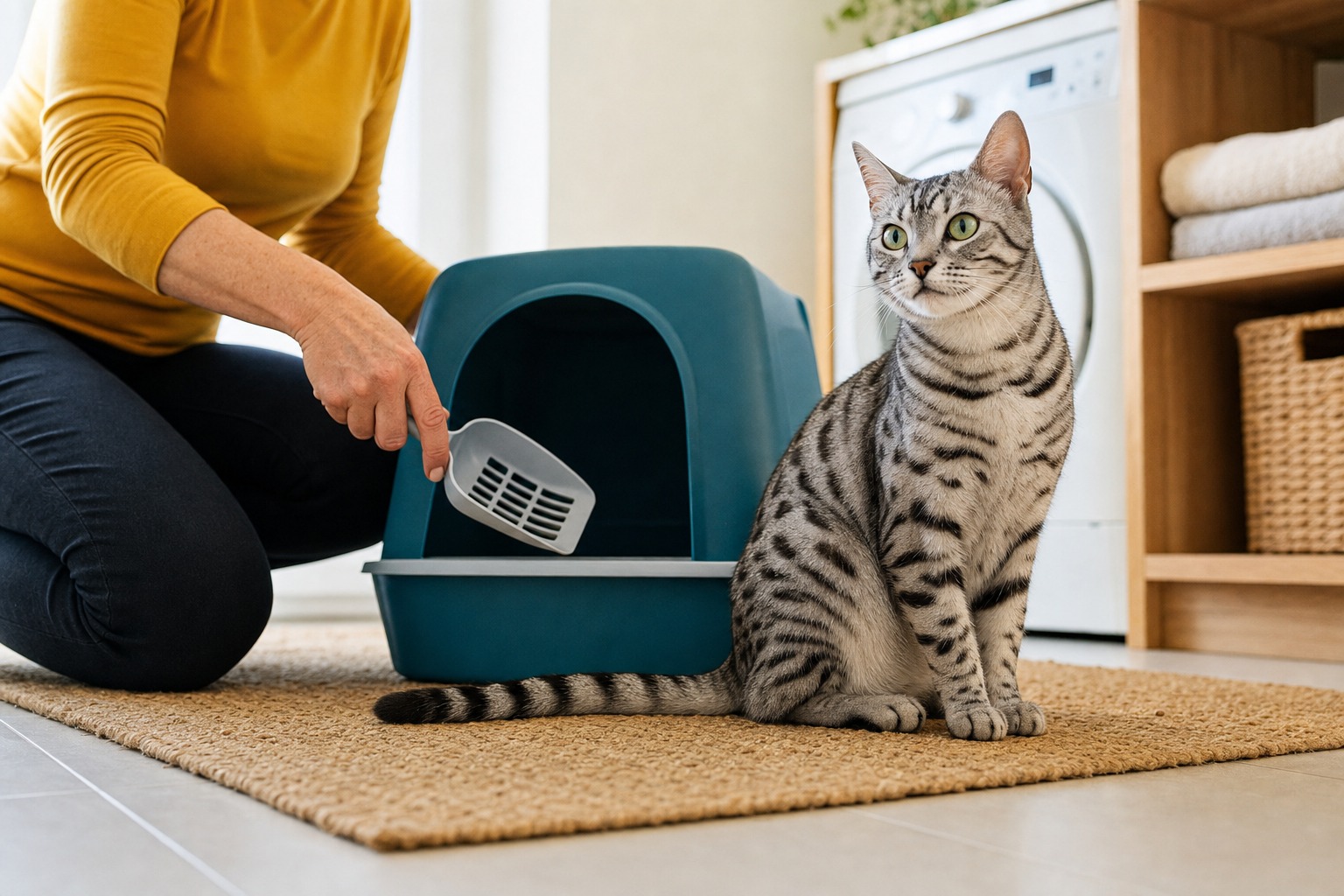
Let me save you the suspense and the shame spiral I went through: whether you can put a cat litter scoop in the dishwasher is not, at its heart, a question about how gross you are. It’s a question about a parasite called Toxoplasma gondii, and once you understand what that parasite does and does not survive, the “ick factor” everyone argues about turns out to be almost beside the point. I learned this the hard way, so let me give you the science first and the humbling story second.
The verdict, up front
The cautious, expert-majority answer is to keep the litter scoop out of the dishwasher, mainly because Toxoplasma oocysts are stubbornly resistant to cleaning and you don’t want them anywhere near the machine that cleans your dishes. If you’re determined to do it anyway, the bare minimum is a scoop that’s genuinely dishwasher-safe and scraped completely free of litter, ideally run on its own load. But the simpler, safer method that professionals actually recommend is a soak in dish soap followed by an enzyme-cleaner wipe-down. And a hard rule that overrides all of this: pregnant people should not be handling cat waste at all. Everything below is the reasoning behind that verdict.
Why this is a parasite question, not a cleanliness one
Cat feces can carry the oocysts (the hardy, egg-like infectious stage) of Toxoplasma gondii. That’s what raises the stakes far above ordinary dirty-dish squeamishness.
The dishwasher is the one appliance your litter scoop should never see. Toxoplasma oocysts shed in a cat’s waste shrug off ordinary detergents, and the infection they cause is a genuine danger in pregnancy and for anyone immunocompromised. Researchers have even probed whether chronic infection plays a role in some psychiatric conditions.
— Dr. Priya Nair, DVM
The technical crux is heat and time. In theory, a dishwasher’s high-temperature cycle could destroy Toxoplasma oocysts, but only if the machine actually reaches and holds a high enough temperature, and only if there isn’t a lot of organic material (read: cat feces) shielding them. Both are big ifs in a normal home dishwasher, which is exactly why “dishwasher safe” on a scoop’s label answers a durability question, not a food-safety one. The oocysts also aren’t uniquely fragile: research on Toxoplasma has shown the oocysts can survive in the environment for a year or more under the right conditions, which is why “just run it hot” is not the reassurance it sounds like.
Two more reasons the pros say don’t
The public-health argument is the big one, but cleaning professionals add two practical objections. First, cross-contamination: even when a scoop is labeled dishwasher-safe, the consistent advice is to keep anything that touches used litter well away from items that touch food and dishes, because you can’t verify the parasites are gone. Second, and more mundane, litter itself can wreck your machine. Clumping litter clinging to the scoop can harden and clog the dishwasher’s filter over time as it inevitably works loose during the cycle. The professional method sidesteps both problems: soak the scoop in dish soap, then wipe it down with an enzyme cleaner, which breaks down waste residue without ever introducing it to your dishware.
The dissent, because it exists
To be fair, even Dr. Nair grants the other side its strongest case.
A genuinely dishwasher-rated scoop, scraped down to bare plastic first, probably comes out of a hot cycle fine, and whatever the heat kills goes out with the wastewater. If you’ve prepped it that carefully, the squeamishness is doing more work than the microbiology. People boil pacifiers that have hit the floor; this is the same species of bet.
— Dr. Priya Nair, DVM
That’s a real position, and it’s the one that gives dishwasher-users their footing. The problem is that it leans on two conditions (“truly dishwasher-safe” and “scraped totally clean”) that are easy to assume and hard to guarantee, and it doesn’t fully answer the oocyst-resistance point. Which is why, when you weigh it all out, the majority lands on “just don’t.”
The version that ends the debate entirely
If scooping is the part of cat ownership you’d most like to outsource, the self-cleaning litter box category has matured to the point where it sidesteps this whole dilemma. Newer automatic boxes sift waste into a sealed drawer you empty every few days, and several now pair with an app that tracks each cat’s weight and bathroom habits, which can flag health changes surprisingly early. They’re a real investment, but for multi-cat homes or apartments without easy outdoor rinse access, they remove the scoop, and the temptation, from the equation. I finally went this route with a Litter-Robot, and the dishwasher question simply stopped applying to my life.
The confession, since I promised
I did it. In my defense, there were extenuating circumstances. I do not, as a rule, put things that have touched cat waste into my dishwasher. But my Litter-Robot had just arrived, I was decommissioning my old scooping-required box, and the scoop needed a wash before I stashed it in a closet. If I had a backyard and a hose, this could have happened outdoors. Instead I live in a cozy New York City apartment, the kitchen was chaos that day, and I stashed the scoop in the back of the dishwasher, bottom rack, not touching anything. What harm could it do?
Plenty, according to my boyfriend, who found it mid-pie-baking two days before Thanksgiving. “Ohhh, no,” he said, holding it aloft with unmistakable glee. I’m usually the neat freak of the two of us, so he savored the reversal. I washed the scoop in the bathtub (just as gross, honestly), told the story at Thanksgiving to mixed reviews, and then did what any reformed offender does: I put on my reporter hat and actually looked into it. The parasite science above is what I found, and it’s why I now scoop into a sealed drawer and never think about this again. As for my boyfriend, he moved in after the holiday, and litter duty is officially his. I may have lost the battle, but I won the war.
References
- CDC: About Toxoplasmosis
- American Veterinary Medical Association: Toxoplasmosis
- Dubey, J. P. Toxoplasma gondii Oocyst Survival Under Defined Temperatures
Nina Vasquez writes about life at home with pets and the relationships at the heart of it. Her work covers day-to-day living, people-and-pet stories, and the products that fit into a real household, with a warm, grounded take on everyday pet ownership.
Meet our experts ↗Keep reading
 LivingA Five-Month-Old Kitten Turned On a Faucet, Blocked a Drain, and Closed a Cat CafeSara Lim · 6 min
 Health & WellnessYou're Decorating Your Cat's World With Smells It Can't StandDr. Lena Park · 6 min
 Health & WellnessBringing an Outdoor Cat Inside Isn't Cruel. Doing It All at Once Is.Dr. Nina Kohl · 8 min
 Health & WellnessYour Indoor Cat Will Never Get Out. Until the Night She Does.Dr. Amara Solis · 6 min
 Health & WellnessThe 'Stray Cat Telegraph' Is Nonsense. It Still Beats Standing on the Porch Yelling.Dr. Nina Kohl · 7 min
 LivingYour Party's Biggest Risk Isn't the Cat Getting Scared. It's the Front Door.Dr. Amara Solis · 7 min