


Your Kitten Can Be Spayed at Eight Weeks, and Recovery Is the Part to Plan For
The age question has a short answer: sooner than most people think. The part that actually catches new cat parents off guard is the two weeks after surgery. Here's how to get both right.

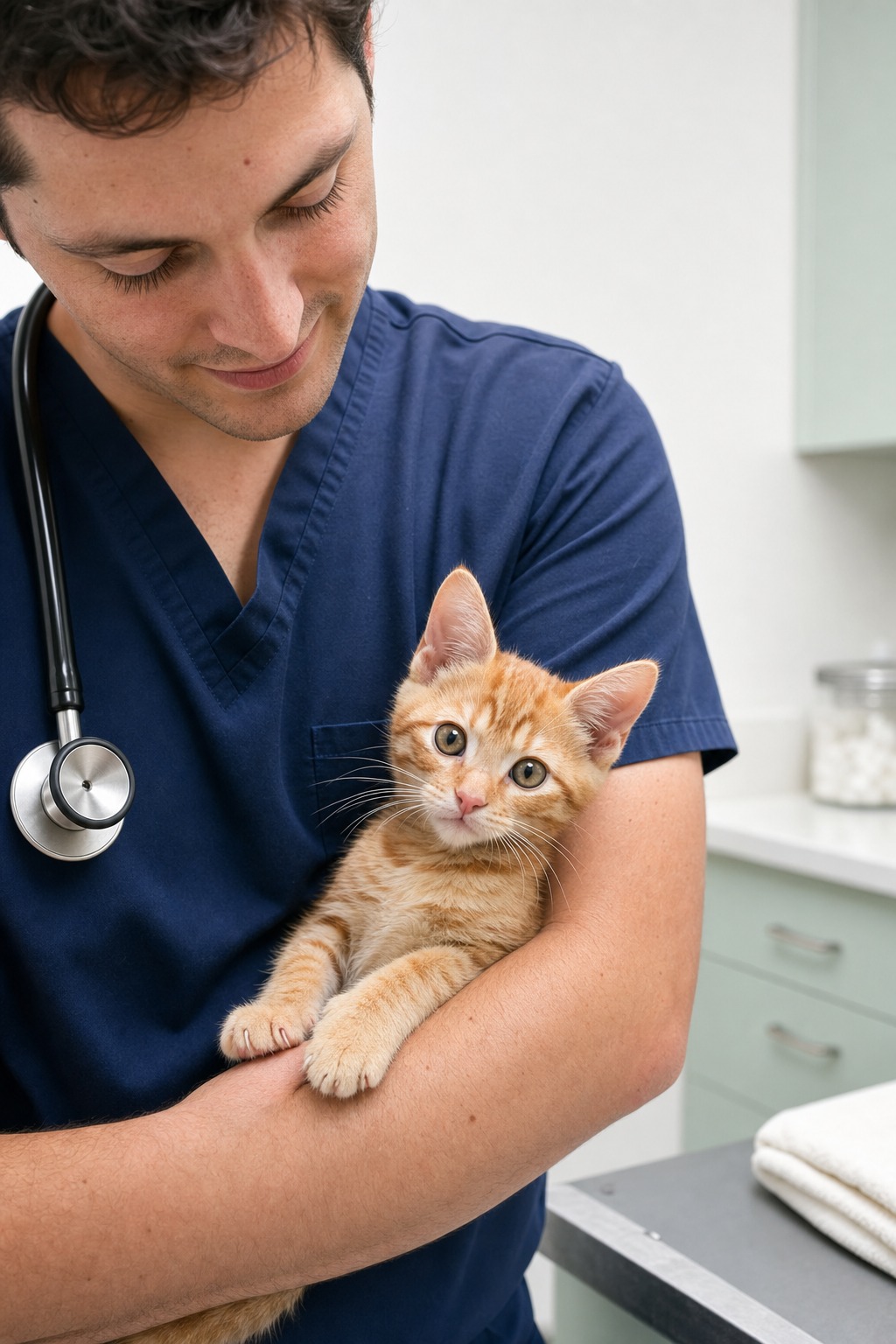
Most of the worry about spaying a kitten lands on one question: is she old enough? It’s the wrong thing to lose sleep over. The age answer is settled, it’s earlier than the old advice you may have heard, and your vet will make the call in about thirty seconds. The part that genuinely blindsides new cat parents comes after the surgery, in the two weeks of keeping a bouncy, seemingly-fine kitten from undoing her own stitches.
So let’s flip the usual order. Here is the timing, quickly and clearly, and then the recovery, in the detail it actually deserves.
The age window, settled
A spay is the everyday word for an ovariohysterectomy: a surgeon removes the ovaries and uterus so a cat can’t get pregnant or develop the reproductive problems that come with staying intact. Most people never have to time it themselves, because kittens are usually fixed at the shelter or rescue before they’re adopted out. If your kitten came to you still intact, though, the scheduling is on you.
The guidance used to be simple and, it turns out, overly cautious: wait until six months. That number came from an assumption that anesthesia and surgery were safer in a bigger, older kitten. The data didn’t hold it up. Studies comparing early spays to traditional-age spays found no higher rate of complications in the younger group, and the old worry that early surgery caused obesity or stunting didn’t pan out either.
What replaced it is a tighter target. A kitten can be spayed any time after eight weeks of age, provided she’s healthy and heavy enough for anesthesia. Vets tend to sort the timing into three loose brackets:
- Pediatric, roughly eight to twelve weeks. This is the shelter standard. Fixing kittens before adoption guarantees it actually happens, instead of relying on a promise a new owner may never keep.
- Early, up to about twenty weeks. The current sweet spot, timed to land before a kitten’s first heat.
- Traditional, six months and up. The old default, now the exception rather than the rule.
The reason “early” wins is a single biological deadline: the first heat. Cats reach sexual maturity around five months on average, sometimes as young as four. A 2016 veterinary task force reviewed the evidence and coalesced around spaying before five months, which became the “Feline Fix by Five” campaign. That timing has since been endorsed by the major veterinary bodies, including the American Association of Feline Practitioners, the AVMA, the American Animal Hospital Association, and the Association of Shelter Veterinarians. Getting ahead of that first cycle is where the health math pays off most.
What you’re actually buying with early timing
Spaying is one of those decisions where the benefits stack up for the cat, for you, and for the wider cat population all at once.
The population piece is blunt: there are millions of unwanted cats, and an unspayed female can start contributing to that number startlingly young. A kitten can become pregnant as early as four months old, which is exactly why the timing window is so tight.
The health piece is where early timing earns its reputation. Spaying dramatically lowers the risk of mammary cancer, and the earlier it happens, the bigger the drop. One study found that spaying before a cat’s first birthday cut mammary cancer risk by around 86 percent, and spaying before six months pushed that reduction to roughly 91 percent. That matters enormously in cats, because the large majority of feline mammary tumors, somewhere between 80 and 96 percent, are malignant and spread aggressively. Spaying also takes ovarian cancer and pyometra, a life-threatening uterine infection, off the table entirely, and removes the danger of a difficult pregnancy or delivery.
Then there’s the quality-of-life piece, which anyone who has lived with a cat in heat will vouch for. Spaying ends the marathon yowling, the urine spraying, the restlessness, and the frantic drive to bolt out the door to find a mate, along with the crowd of neighborhood toms that a female in heat can summon.
Owners tend to picture spaying as a population thing, something you do for the shelters. For the cat in front of me, it’s really about that first heat. Get in ahead of it and you’ve quietly bought her a much lower cancer risk and a calmer life. Miss it by a season and you haven’t ruined anything, but you’ve given up the best part of the head start.
It’s never too late, with one caveat
If your cat is already past the ideal window, you haven’t missed your chance. An adult or senior cat can be spayed at any age as long as she’s healthy enough for anesthesia, and in older cats the surgery is sometimes done as treatment when a uterine infection or reproductive tumor has already set in.
The one situation that gives vets pause is a cat who’s currently in heat. It can be done, but the surge of blood to the reproductive organs during a heat cycle makes the tissue fragile and the surgery messier and riskier, with a chance of heavy bleeding. There’s also a possibility of mammary hyperplasia, where the hormone swing after surgery leaves one or more mammary glands swollen. Because heat cycles don’t run on a predictable schedule, a cat occasionally goes into heat right before a booked surgery. If that happens, your vet will talk through whether to proceed or wait it out.
The recovery: the two weeks that surprise people
Here’s the part the age debate tends to bury. The surgery itself is routine and quick. The recovery asks more of you than most first-time cat parents expect, mostly because a kitten will feel ready to sprint days before her incision is ready for it.
The day of surgery. Most kittens come home the same day, still groggy from anesthesia. Expect her to be sleepy, glassy-eyed, slow, and maybe a little irritable, and don’t leave her unsupervised while the drugs wear off. You can usually offer food two to six hours out, but keep that first meal small, a quarter to half of what she’d normally eat, since mild nausea after anesthesia is common. If she ignores it, that’s fine.
The first 24 hours. By the next day she should perk up enough to eat, move around comfortably, and use the litter box on her own. Let her stretch her legs, but keep her confined to one small, quiet room. The goal is normal movement without the chance to leap onto anything.
Days two through fourteen. This is the stretch that catches people out. Somewhere in here a lot of kittens decide they feel completely fine and want to play at full throttle, and that’s precisely when the danger peaks. An incision, on the skin and internally, is still knitting together. A hard landing off the couch or a wrestling session can pull the sutures and cause dehiscence, the reopening of a wound, which can require a second surgery to repair. So no running, jumping, or rough play until your vet gives the all-clear, even when she’s acting like a firecracker.
Throughout, keep an eye on the incision. A thin line of redness is expected. What isn’t: swelling, oozing, a gap opening in the skin, or a kitten fixated on licking the site. Any of those earns a call to your vet, not a wait-and-see.
What newer research adds
The shift toward early spaying isn’t a fringe position anymore. It’s the mainstream veterinary consensus, and the endorsement list has only grown. The AVMA, AAHA, the Association of Shelter Veterinarians, and the American Association of Feline Practitioners all back sterilizing cats by five months of age, and the AAFP’s position statement lays out the safety data behind pediatric surgery directly.
The practical takeaway for a home-raised kitten is simple. There’s no medical reward for waiting until six months, and there’s a real, measurable cost to letting that first heat slip by. Book the surgery for the four-to-five-month window, and spend your energy planning the two calm weeks afterward rather than second-guessing the age.
Spaying is a common, well-understood procedure, but it’s still surgery, and your own vet knows your kitten’s health, weight, and situation better than any general timeline. Use these numbers to walk into that conversation informed, then let your vet set the exact date.
References
- American Association of Feline Practitioners. “Position Statement: Early Spay and Castration (Pediatric Sterilization) in Cats.” Journal of Feline Medicine and Surgery, 2020. https://journals.sagepub.com/doi/pdf/10.1177/1098612X20948325
- United Spay Alliance. “Feline Fix by Five.” https://www.unitedspayalliance.org/feline-fix-by-five/
- Veterinary Task Force on Feline Sterilization. “Feline Sterilization at 5 Months Accepted as New Normal.” dvm360. https://www.dvm360.com/view/feline-sterilization-at-5-months-accepted-as-new-normal
- Overley, B. et al. “Association Between Ovarihysterectomy and Feline Mammary Carcinoma.” Journal of Veterinary Internal Medicine, 2005. https://pubmed.ncbi.nlm.nih.gov/16095167/
Common questions
Is it better to spay before or after the first heat?
Before. Spaying before the first heat, which can arrive as early as four months, gives the biggest drop in mammary cancer risk and skips the spraying, yowling, and escape attempts that come with a cat in heat.
Can you spay a cat while she's in heat?
It's possible, but many vets prefer to wait. Blood flow to the reproductive organs spikes during heat, which makes the tissue more fragile and the surgery bloodier. Your vet will decide whether to proceed or reschedule.
How long does it take a kitten to recover from a spay?
About two weeks. Most kittens go home the same day, feel close to normal within 24 hours, and need to be kept calm for the full two weeks so the incision can heal without reopening.
Not a substitute for your vet. Our guidance is educational. For urgent symptoms, contact a vet or emergency clinic right away. Editorial standards
Dr. Solis is a board-certified veterinary dermatologist with over twelve years of clinical experience. She advises on skin conditions, allergies, and grooming practices that affect coat and skin health. All dermatology and allergy content at The Pet Times is reviewed by her team before publication.
Meet our experts ↗Keep reading
 Health & WellnessYour Vet Injects Your Kitten in the Leg for a Reason. It Isn't Convenience.Dr. Priya Nair · 9 min
 Health & WellnessYour Kitten Has Fleas. The Wrong Fix Can Be Deadlier Than the Bugs.Dr. Priya Nair · 8 min
 First DaysThe Kitten Nursing Clock Is a Lie. Watch the Milestones InsteadDr. Priya Nair · 6 min
 First DaysA Kitten Landed in Your Lap and Can't Eat on Its Own. Here's the Playbook.Dr. Priya Nair · 10 min
 First DaysYour Kitten's First Year Is a Series of Doors That CloseDr. Lena Park · 8 min
 First DaysA Kitten's Body Keeps a Calendar. Here's How to Read It.Dr. Priya Nair · 5 min