


Your Dog Ate Grapes and Was Fine. That's the Trap
The reason grapes are so dangerous isn't that they always poison dogs. It's that they sometimes don't, which teaches owners the wrong lesson. Here's the science that finally explains the randomness, and exactly what to do in the first hour.

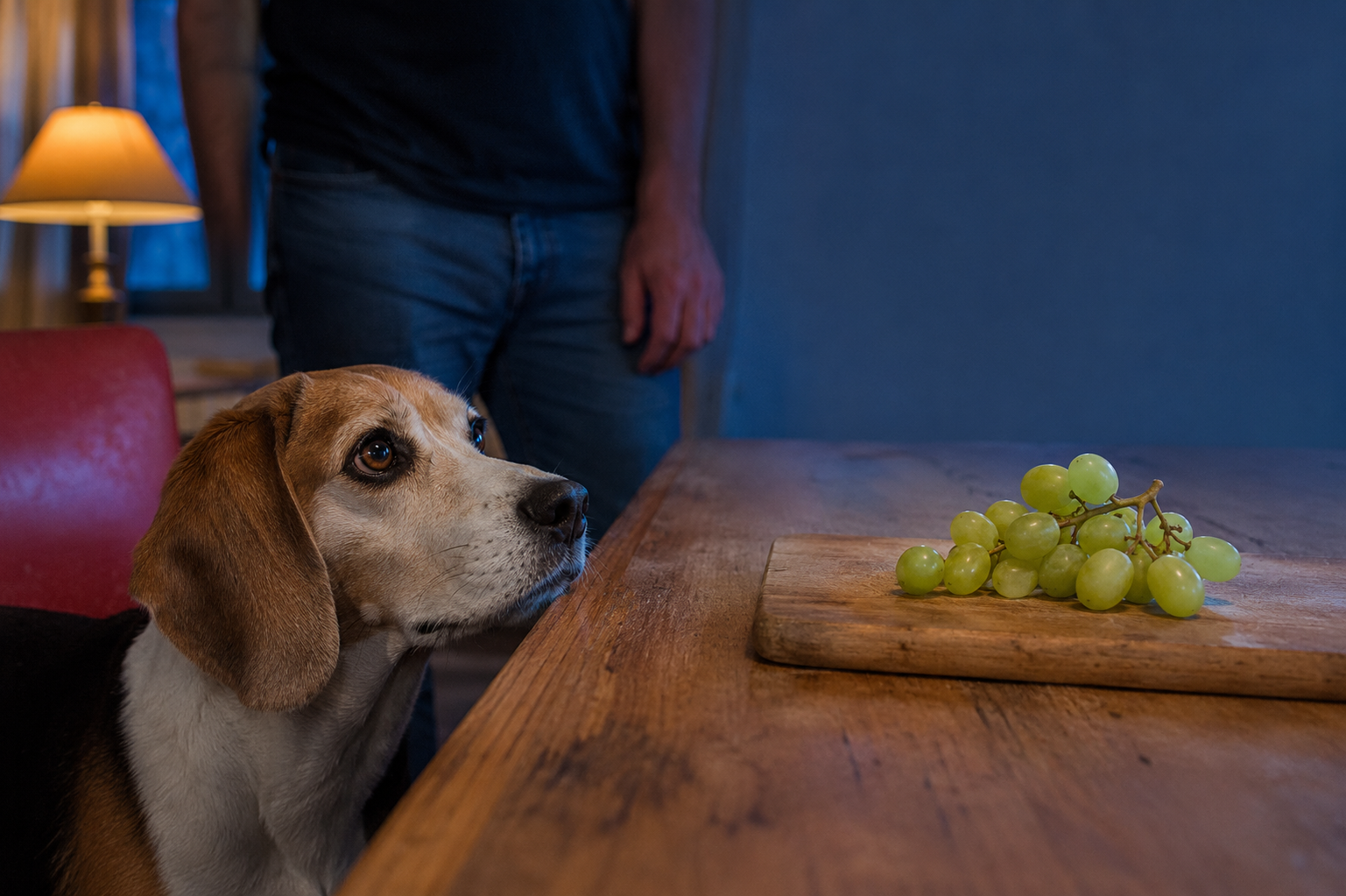
If you are reading this because your dog just got into the fruit bowl, skip everything and call your vet or an emergency line right now. Do not wait to see how your dog looks. Early treatment is the entire ballgame with grapes, and “he seems fine” is not reassurance, it is the normal appearance of a dog whose kidneys have not started failing yet.
Now, for everyone reading calmly: the most dangerous thing about grapes is not the poison itself. It is the false confidence they hand out. Plenty of dogs have eaten grapes for years without incident, and every one of those uneventful snacks teaches an owner that grapes are basically okay. They are not. Understanding why the outcome is so random is the thing that finally makes the warning stick.
Why the same grape harms one dog and not another
For decades this was a genuine mystery. Toxicologists could not explain why a Labrador might polish off a bunch and shrug it off while a terrier ate three raisins and landed in the ICU. The breakthrough came recently, and it has two parts.
The first part is the toxin. Researchers have zeroed in on tartaric acid and its salt, potassium bitartrate, as the culprit. Grapes carry more tartaric acid than almost any other fruit, but the amount swings wildly depending on the grape variety and how ripe it is. Two grapes from the same bag are not the same dose.
The second part is the dog. Work on how dogs process tartaric acid points to a missing piece of machinery: dogs lack an efficient version of the kidney transporter (called OAT4) that people use to clear organic acids like this one. Without it, tartaric acid backs up in the cells of the kidney’s filtering tubules and damages them directly. That is also why individual dogs differ, since not every dog handles the acid identically.
Put those together and the “randomness” stops being random. A toxic incident needs a high-tartaric grape and a susceptible dog on the same day. You cannot see either variable coming, which is precisely why there is no safe serving size to point to.
The frustrating part is that there’s no dose I can call safe. I’ve seen dogs eat grapes for years and then have one bad day that lands them in the hospital. Once you understand it’s the grape’s tartaric acid meeting a kidney that can’t clear it, the ‘but he’s always been fine’ argument falls apart. Every grape is a fresh roll of the dice.
The doses researchers have documented (and why they don’t make grapes safer)
Case reviews have logged toxic effects at roughly 11 grams of grapes per kilogram of body weight, and, because raisins are far more concentrated, around 2.8 grams of raisins per kilogram. For a 22-pound dog, that raisin figure is only about a heaping tablespoon.
Read those numbers the right way. They are not a permission slip that says “anything under this is fine.” They are the lowest amounts that have caused documented harm, in a toxin whose concentration you cannot measure by looking. The practical rule they support is the one poison control already gives: treat any amount as a potential emergency. This matters most with hidden raisins, in trail mix, cinnamon rolls, hot cross buns, granola, and cereal, where the dose is easy to underestimate.
What to watch for
Early signs usually appear within a few hours:
- Vomiting
- Lethargy
- Loss of appetite
- Diarrhea
If the toxin reaches the kidneys, later signs can include:
- Increased urination, then, ominously, a drop-off in urine
- Increased thirst
- Mouth ulcers
- Bad breath with a chemical edge
Grapes can also cause temporary weakness or an unsteady, wobbly gait. That neurological piece usually passes. The kidney injury is the real threat, and whether it heals depends heavily on how fast treatment starts.
The first hour, step by step
- Call before you drive. Phone your vet, an emergency clinic, or a poison line (the ASPCA Animal Poison Control Center) immediately. They will triage based on your dog’s weight and how much was eaten, and tell you where to go.
- Do not induce vomiting on your own unless a professional walks you through it. The wrong method or timing can cause its own harm.
- Bring the evidence. Note roughly how much and what kind (fresh grapes, raisins, a baked good), and bring the packaging if there is any. It shapes the treatment.
- Expect decontamination. Vets often induce vomiting even hours later, then give activated charcoal.
- Expect a hospital stay for fluids. The core treatment is aggressive IV fluid therapy (diuresis) to keep urine flowing and protect the kidneys, with bloodwork tracking kidney values over a couple of days.
Caught early, the outlook is often good. That window is the whole reason speed beats waiting.
Safe sweet treats to reach for instead
Skipping grapes does not mean skipping fruit. Safe-in-moderation options include apples (no seeds or core), bananas, blueberries and other berries, melon, cucumber, carrots, peas, and sweet potato. Wash everything, remove seeds and pits, keep portions small, and, as always, run a new food past your vet, since even safe foods have their own quirks.
The bottom line
Grapes and raisins are not a “probably fine” food that occasionally goes wrong. They are a coin flip you cannot see, backed now by a real mechanism: a variable toxin meeting a kidney that cannot clear it. A clean track record means nothing about the next handful. If your dog gets into them, the smartest thing you can do is boring and fast, which is to call for help before symptoms start.
References
- Wegenast, Colette A., et al. “Acute kidney injury in dogs following ingestion of cream of tartar and tamarinds and the connection to tartaric acid as the proposed toxic principle in grapes and raisins.” Journal of Veterinary Emergency and Critical Care, 2022. https://onlinelibrary.wiley.com/doi/10.1111/vec.13234
- “Grape, Raisin, and Tamarind Toxicosis in Dogs.” Merck Veterinary Manual. https://www.merckvetmanual.com/toxicology/food-hazards/grape-raisin-and-tamarind-vitis-spp-tamarindus-spp-toxicosis-in-dogs
- “Grape and Raisin Toxicity.” Cornell Riney Canine Health Center, Cornell University College of Veterinary Medicine. https://www.vet.cornell.edu/departments-centers-and-institutes/riney-canine-health-center/canine-health-information/grape-and-raisin-toxicity
- Eubig, Paul A., et al. “Acute Renal Failure in Dogs After the Ingestion of Grapes or Raisins.” Journal of Veterinary Internal Medicine, 2005. https://onlinelibrary.wiley.com/doi/10.1111/j.1939-1676.2005.tb02744.x
Common questions
My dog has eaten grapes before with no problem. Is it really that dangerous?
Yes, and the past being fine is exactly why people get caught out. Toxic grapes and harmless ones look identical, so eating them uneventfully teaches the wrong lesson. The next handful can be the toxic one. Don't rely on a clean history.
What should I do if my dog ate grapes or raisins?
Call your vet or an emergency clinic right away, even if your dog seems completely fine and even if it has been a few hours. Early decontamination, usually induced vomiting, is what protects the kidneys. Do not wait for symptoms.
What are the first signs of grape toxicity in dogs?
Vomiting, low energy, loss of appetite, and diarrhea usually come first, often within a few hours. Later signs as the kidneys are affected include increased thirst and urination, mouth ulcers, and bad breath. By the time later signs appear, damage may already be underway.
Not a substitute for your vet. Our guidance is educational. For urgent symptoms, contact a vet or emergency clinic right away. Editorial standards
Dr. Park is a board-certified emergency and critical care specialist. She reviews our health and safety content for clinical accuracy and contributes guides on recognising urgent conditions. Her focus is helping owners act quickly and correctly when it matters most.
Meet our experts ↗Keep reading
 Health & WellnessWhite Chocolate Skips the Poison. It Keeps the Trap.Dr. Mara Chen · 6 min
 FoodThe Potato Is Innocent. It's the Garnish That Hurts Your DogDr. Mara Chen · 6 min
 FoodThe Danger Isn't Exotic. It's on Your Counter Right NowDr. Lena Park · 10 min
 Food"Dogs Are Basically Wolves" Is How Raw Chicken Gets Fed. Here's the Catch.Dr. Lena Park · 7 min
 FoodBaked Sourdough Is a Fine Dog Snack. Raw Dough Is a 911 Call.Dr. Amara Solis · 6 min
 FoodTo Your Dog, Spicy Food Isn't a Flavor. It's a Burn AlarmDr. Priya Nair · 9 min