


The Free Treasure Hunt That Turns a Dog Walk Into a Job
A plain loop around the block bores most dogs. Geocaching bolts a real destination and a scent puzzle onto the same walk, and it costs nothing. Here's how to start, and how to do it safely with a dog along.

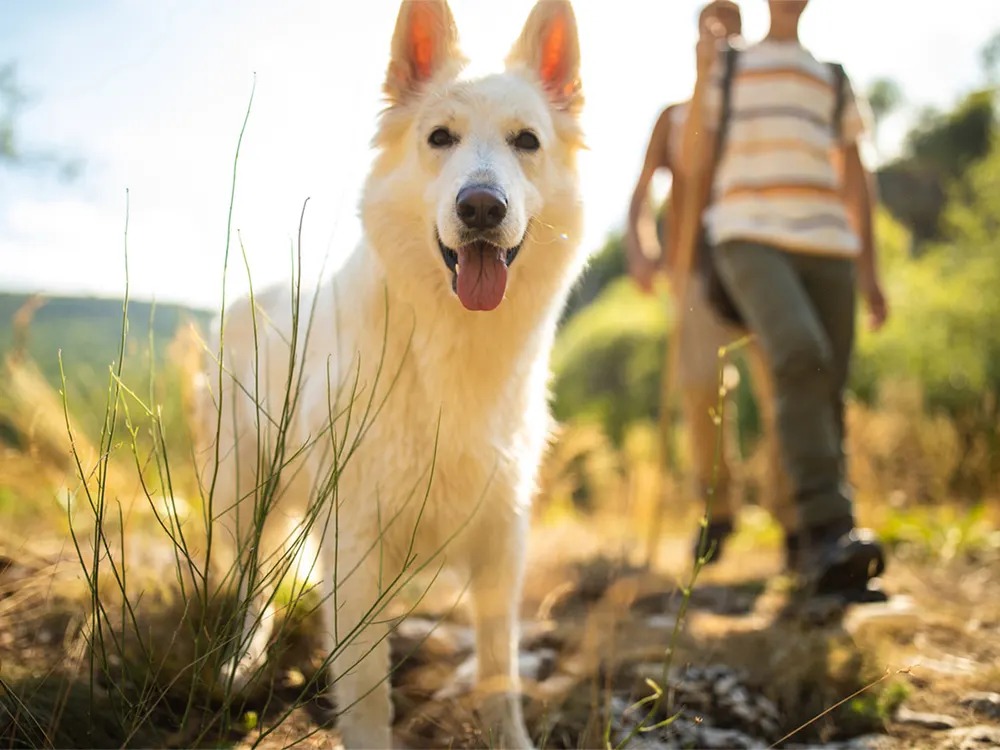
Most dog walks are the same walk. Same block, same hydrants, same loop, and a dog who’s done it a hundred times knows there’s nothing new waiting at the end. Geocaching fixes that for free. It takes the walk you were already going to take and hangs a genuine goal on it, a hidden container to track down at a set of GPS coordinates, which turns a stroll into a search. For a dog, that shift from aimless wandering to purposeful hunting is exactly the kind of mental work that a lot of pets are starving for.
What geocaching actually is
Geocaching is a real-world treasure hunt run through an app. Someone hides a small weatherproof container, a “cache,” somewhere in the world and posts its GPS coordinates online. Everyone else uses those coordinates to go find it. Inside a typical cache you’ll find a logbook to sign and a jumble of low-value trinkets, plastic toys, coins, keychains, meant for trading: take one, leave one. Thanks to GPS, the app can pinpoint your position on the planet to within about six to twenty feet, which gets you close enough to start searching but leaves the actual find to you.
The activity was born the moment it became possible. GPS started as military technology, but in 2000 the U.S. government opened the signal to the public, and geocaching appeared almost immediately as people realized they could hide things and share coordinates. It never went away.
Why it’s a genuinely good fit for dogs
The appeal for a dog isn’t the plastic trinket in the box. It’s everything the hunt demands along the way. Getting to a cache usually means covering new ground, and novelty alone lights up a dog’s brain in a way the familiar route never will. The searching itself leans on the sense a dog most wants to use, smell, and there’s a reason so many people who cache with dogs end up crediting their pup with the find. A dog nosing around the base of a rock or a tree stump is doing the thing it was built to do. Add the physical exercise of the hike to the mental workout of the search, and you get a tired, satisfied dog from an outing that also got you off the couch. It becomes a shared hobby rather than a chore you perform for the dog.
Reading a cache before you go
Caches hide in cities and out in the country alike, and they vary wildly in effort. Some sit a few steps off a paved path; others ask for a real hike, and a handful involve climbing, swimming, or even a boat. Every listing carries two ratings, one rating the difficulty of the actual find and the other the terrain you’ll cross, so you can match the challenge to your day and your dog. There’s no official dog-friendly label, but the community fills that gap: finders routinely leave notes in a cache’s online log about whether the spot suits a dog and what the local leash situation is. Those logs are your best pre-trip intel.
Doing it safely with a dog
A few habits keep geocaching fun instead of stressful. Start by being honest about your own dog. A dog that pulls hard or gets overstimulated in busy areas probably won’t enjoy an urban-park cache, and for backcountry finds you need a realistic read on your dog’s fitness, whether it will cross a stream on its own or needs carrying, and how it handles running into strangers, other animals, or a tempting cow patty. Sorting that out in advance lets you pick caches that play to your dog’s strengths.
Know the local rules, too. Leash laws vary, cleanup laws are common, and scooping is the decent thing to do regardless, so bring supplies. Prepare for the environment before you leave: keep vaccinations current, use tick and mosquito protection on both of you, consider a Lyme vaccine where the disease is common, carry a tick remover, check for ticks after any rural outing, and pack enough water for two. And if you ever hide a cache of your own, pay it forward by noting in the listing whether it’s dog-friendly and flagging the local leash rules.
A quick geocacher’s glossary
The hobby has its own slang, and a little of it goes a long way. CITO stands for Cache In, Trash Out, the ethic of always carrying out litter, whether or not it’s yours, and dog owners sometimes tack on the obvious corollary about scooping. A geomuggle, borrowed straight from Harry Potter, is a non-cacher, and a cache that a muggle stumbles onto and disturbs has been “muggled.” The log is the record of finds, both the paper notebook in the container and the running record online where people leave comments and photos. A spoiler is a log comment that gives away a hiding spot, frowned upon by finders who live for the hunt. TNLN/SL means “Took Nothing, Left Nothing, Signed Log,” for when you find a cache but don’t trade. And a Travel Bug is a tagged item that hitchhikes from cache to cache, its journey trackable by ID number, with some even designed to make their way specifically to dog-friendly hides.
What’s new since this was written
Geocaching is not a relic of the early-2000s GPS craze, and the current numbers dwarf what it looked like a decade ago. As the activity marked its 25th anniversary in 2025, having grown from just 75 hidden caches at its 2000 launch, the official count stood at more than 3.45 million active geocaches spread across roughly 190 countries and all seven continents, with a game piece even riding along on a Mars rover. In plain terms, that means wherever you and your dog happen to be, there is almost certainly a cache within walking distance right now. The free treasure hunt has quietly become one of the largest ongoing games on the planet, and it still works beautifully as an excuse to give your dog a better walk.
References
- Geocaching Newsroom. “Fast Facts.” https://newsroom.geocaching.com/fast-facts
- Geocaching Newsroom. “Geocaching celebrates 25 years of outdoor adventure in 2025.” https://newsroom.geocaching.com/25-years-outdoor-adventure
- Official Geocaching app. https://www.geocaching.com/play
Marcus Webb writes about the gear, gadgets, and everyday choices that make life with a pet easier. His coverage runs from product picks to training and the causes worth paying attention to, always with an eye on what actually earns a place in your home.
Meet our experts ↗Keep reading
 LivingItaly Just Ended the 'Big Dogs Ride in Cargo' Rule. The Rest of the World Is Watching.James Okafor · 4 min
 LivingNew Orleans Is a Great Dog Town. The Heat Is the Part Nobody Warns You About.Sasha Ford · 6 min
 LivingA Dallas Insider's Dog-Friendly Map: 7 Spots, and Who Each Is Really ForMarcus Webb · 5 min
 LivingA Nightlife Guy, a Stubby Bulldog Mix, and 7-Minute Trail MilesMarcus Webb · 6 min
 LivingDallas Just Lost Its Most Famous Dog Bar. The City Will Be Fine.Marcus Webb · 7 min
 Product PicksYour Hand Is the Worst Place for a Leash. 7 Hands-Free Picks for Active Dogs.Marcus Webb · 6 min