


They Went Out for Crappie. They Came Back With 38 Drowning Dogs.
Three guys on an ordinary Mississippi fishing trip found dozens of hounds treading water a mile from shore. None of them had ever rescued an animal. They just did it, then turned down the reward.

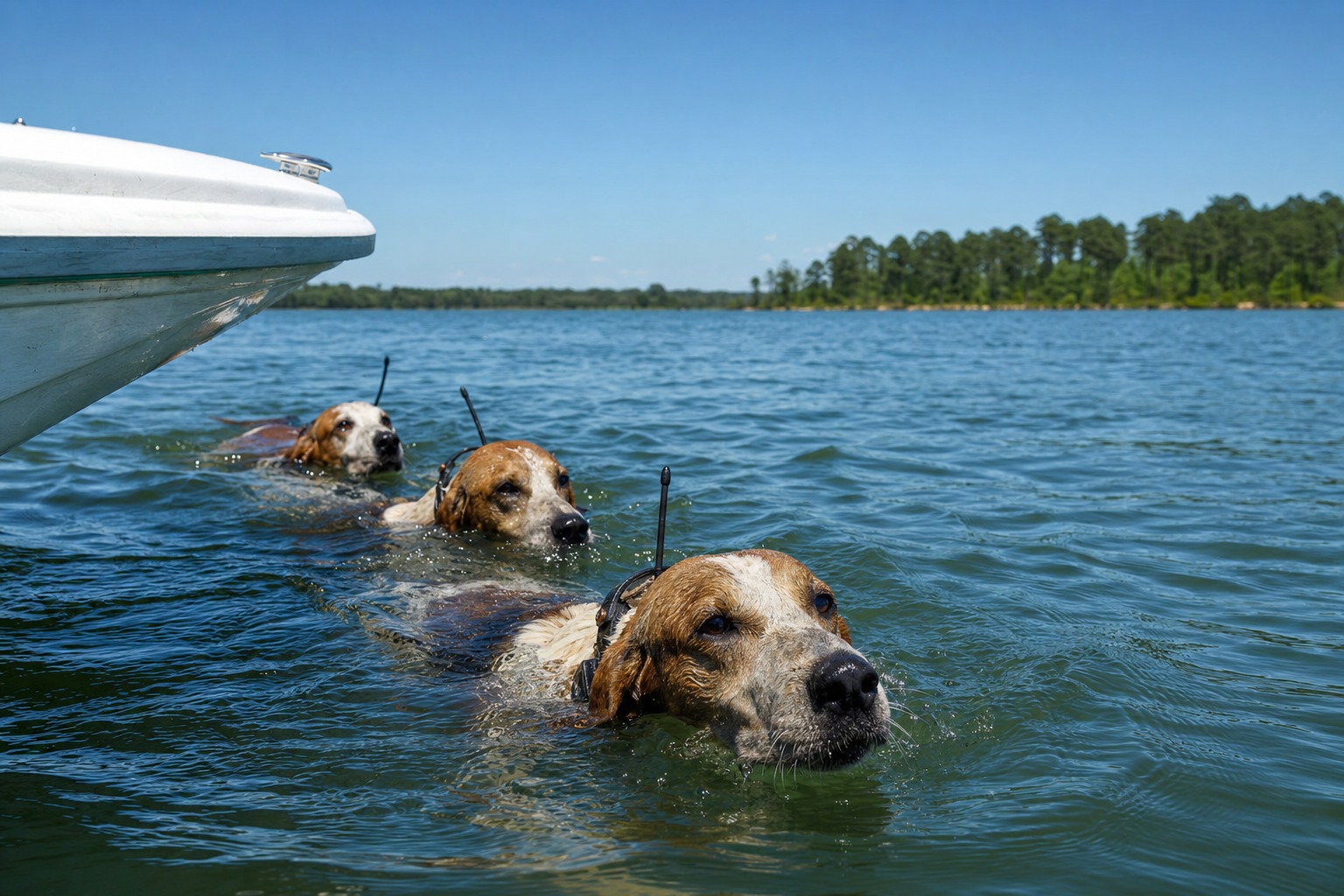
In June 2024, three men pushed off onto Mississippi’s Grenada Lake expecting a slow, sunny day of crappie fishing: Bob Gist, Brad Carlisle, and Jordan Chrestman. They didn’t catch a single fish worth keeping. They came home instead with 38 dogs who, without them, would almost certainly have drowned.
An ordinary trip, an extraordinary catch
Gist and Carlisle, two insurance agents, had planned the outing and brought along Chrestman, a guide with a local fishing service, according to a report from the radio station KEGI. Once they were fishing, Gist caught sight of something bobbing at the surface a good distance ahead. As the boat drew closer, the shape resolved into a dog, and the dog was not alone. Scattered across the open lake were dozens of hounds, each wearing the radio collar that hunters use to track their dogs on a run.
They were far from shore and clearly in trouble. Gist estimated the nearest dogs were at least a mile out, too far and too low in the water to even see land. From the way they held their heads, he could tell they were completely disoriented, paddling in place with no idea which way safety was.
The backstory came together later. The dogs had been on a fox hunt when something, most likely a deer, spooked them into the lake and they’d swum out chasing it, according to a report from WBAL. Chris Gurner, a natural-resource specialist with the U.S. Army Corps of Engineers, explained that it’s not unusual for hunting dogs to bolt after an animal that startles them, which is how a routine hunt turned into a mass rescue.
Getting them out
The three men didn’t overthink it. Chrestman worked the boat while Gist and Carlisle hauled dogs over the side, one exhausted hound at a time. They loaded 27 dogs on the first run, ferried them to shore where a few of the owners were waiting, then turned the boat around and went back for 11 more.
One moment stuck with Gist, and it says everything about how spent these animals were. On the first pass, a white dog was so panicked it snapped at Carlisle and then at Gist, and the men had to leave it behind rather than get bitten. By the time they returned roughly half an hour to 45 minutes later, the fight had drained out of it. The same dog that had been baring its teeth climbed calmly into the boat, done resisting, ready to be saved.
The part that makes it a story
The owners on the hunt had no boat of their own, which means that if these three particular fishermen hadn’t happened across the lake at that hour, there was no rescue coming. The dogs had reportedly been treading water for 45 minutes or more, and a dog can only do that for so long before fatigue wins.
“Exhaustion is the quiet danger with a dog in open water, more than the swimming itself,” says Dr. Lena Park. “Once the muscles fatigue and the body starts to chill, a strong swimmer can go under fast, and panic burns through their energy even faster. Getting them out and warm quickly, and watching for coughing or lethargy afterward, is what turns a scare into a full recovery.”
Here’s the detail that turned a good deed into a viral one: none of the three had ever rescued an animal in their lives, and when the dogs’ handlers tried to pay them for the trouble, they refused the money outright. Their answer was the kind of thing that sounds scripted until you realize it wasn’t. They told the handlers, in effect, that this is simply what you do: when you see us in trouble, you’ll come help us too.
They lost a day of fishing and gained a story they’ll tell for the rest of their lives. Thirty-eight dogs got to go home.
References
James Okafor covers rescue, adoption, and the causes shaping animal welfare. His work follows the people and organisations working to give more pets a home, and the issues owners and advocates care about most.
Meet our experts ↗Keep reading
 LivingThe CNN Hero of the Year Fosters Dogs for People in Addiction RecoveryClaire Sutton · 3 min
 LivingTom Brady Rescued a Shelter Pit Bull. Then He Made a Copy of Her.Jordan Ellis · 6 min
 LivingA Man Cried About His Dog on Live TV. A Shelter's Inbox Exploded.Sara Lim · 5 min
 LivingAmerica's Cutest Rescue Dog Can't Handle a LeashDr. Nina Kohl · 5 min
 LivingShe Paints the Rescue Dogs Nobody Wanted. They're Unforgettable.Leila Torres · 4 min
 LivingThe Maui Beach Day That Doubles as a Job Interview for a Shelter DogLeila Torres · 6 min