


Before You Squeeze: The At-Home Anal Gland Job Most Dogs Don't Need
Expressing your dog's anal glands at home is a real skill, but it's the last tool to reach for, not the first. Here's how the glands work, how to read the scoot, how to express safely if you truly need to, and why doing it too often can make the problem worse.

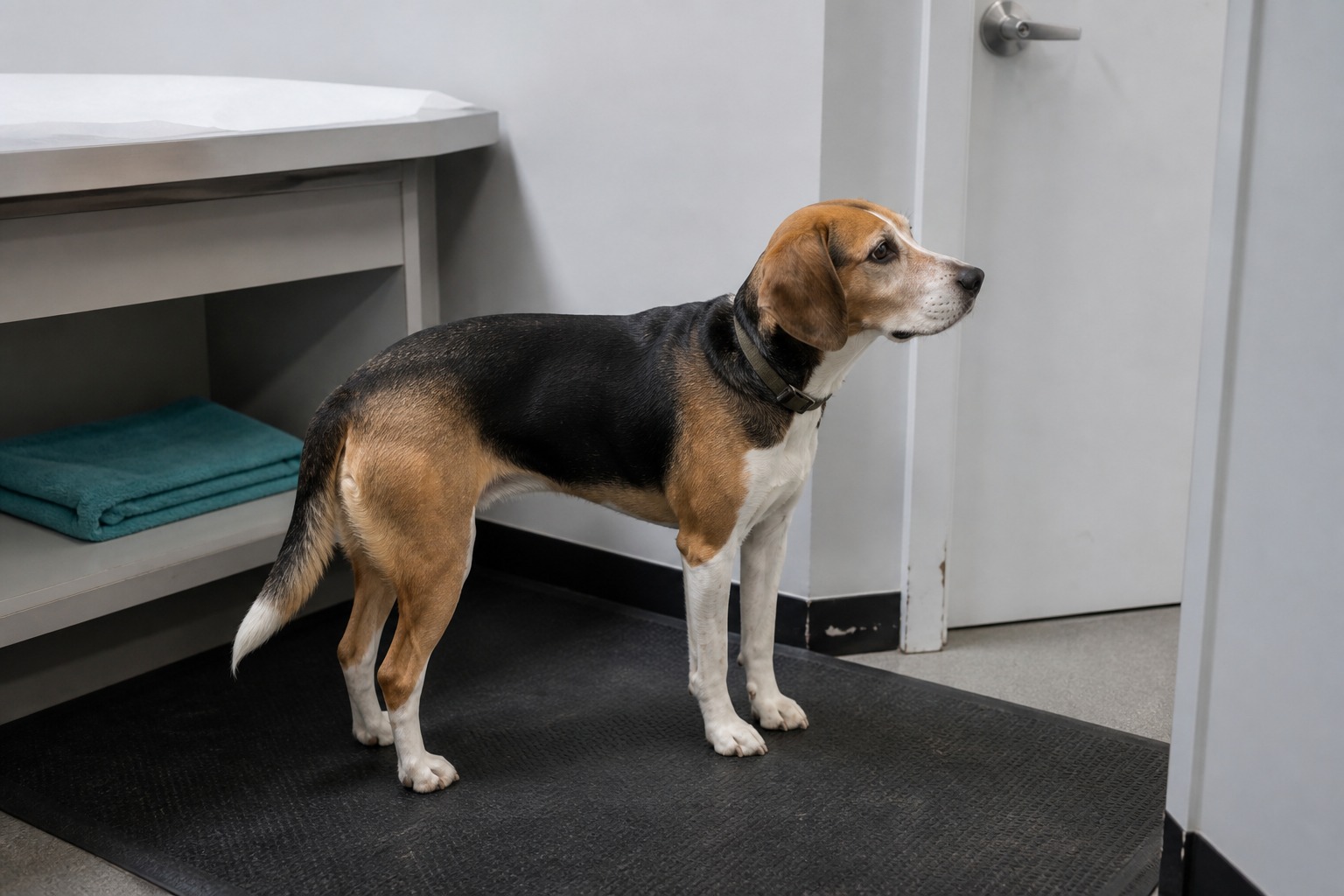
Every dog owner meets anal glands eventually, usually the hard way: a dog dragging its rear across the good rug, or a fishy smell that no amount of bathing seems to fix. From there, the internet hands you a tidy answer, learn to express them at home and save the vet trip. That advice skips the most important part.
The real skill isn’t the squeeze. It’s knowing whether your dog needs it at all. Most dogs go their whole lives without a human ever touching these glands, and a fair number of the dogs stuck in a cycle of “chronic gland problems” got there because someone was emptying sacs that were working fine. So this guide flips the usual order. First we cover what the glands do and how to read your dog, then how to express them safely if you genuinely have to, and finally the line where this stops being a home job.
What these glands actually are, and why most dogs never need help
Anal glands, or anal sacs, are two small reservoirs sitting just inside the anus at roughly the four and eight o’clock positions. They fill with an oily, pungent fluid that is as individual as a fingerprint. When your dog passes a firm stool, the pressure squeezes a little of that fluid out, which is why dogs are so interested in each other’s rear ends: it’s a scent-based ID card, left behind with every bowel movement.
That last detail is the whole point. In a healthy dog, the sacs empty themselves. Nothing about them requires a human hand. The dogs who run into trouble tend to have something else going on: soft stools that never build enough pressure, allergies and skin inflammation that swell the duct, obesity, or simply anatomy that sits the sacs a little deep. Small breeds are overrepresented. Data from large veterinary records in the UK put anal sac disease at a few percent of the dog population in any given year, with Cavalier King Charles Spaniels, Cockapoos, King Charles Spaniels, and Shih Tzus near the top of the risk list. If your dog isn’t scooting and doesn’t smell, the glands are almost certainly none of your business.
The single most common thing I fix in these cases isn’t the gland, it’s the stool. Firm up what’s coming out the back end, usually with a bit more fiber, and a lot of dogs stop having gland trouble entirely, no squeezing required.
Reading the scoot: the signs that actually mean something
Before you decide to intervene, learn what a full or irritated sac looks like from the outside. There are behavioral tells and physical ones, and it’s worth knowing both.
On the behavior side, scooting is the headline act. A dog dragging its bottom along the floor is trying to relieve pressure or an itch it can’t reach, and a full gland is the number-one reason. Persistent licking or nibbling at the base of the tail says the same thing. So does a dog that keeps shifting position, won’t settle into a sit, or turns suddenly touchy about being handled around the hindquarters.
The physical signs are more concrete. A genuinely foul, fishy odor that follows your dog around is a strong hint. So is a brown or yellowish smear left on bedding, your lap, or the dog’s own coat near the tail. Redness or swelling to one side of the anus is a red flag of a different order, and we’ll come back to it, because that one is not a squeeze-it-at-home situation.
If you truly need to express them, do it carefully
Say the signs are real, your vet has confirmed this is a recurring mechanical problem rather than an infection, and you’d rather not make a clinic trip every few weeks. Expressing externally at home is reasonable in that specific case. The first time, though, ask your vet or a technician to walk you through it in person. A two-minute demonstration prevents a lot of clumsy, uncomfortable fumbling later.
The mechanics are in the step-by-step box above: a mess-proof setup, gloves, finding the pea-sized sacs by feel, and gentle external pressure with gauze held over the area to catch what comes out. A few principles matter more than the choreography. Use light pressure only; if fluid doesn’t release easily, the sacs may not be full or the problem may not be simple fullness, and forcing it can bruise the tissue. Stick to external expression, since the internal technique carries a real risk of injury and belongs to professionals. And pay attention to what comes out. Normal fluid is thin-to-pasty and brown, yellow, or gray. Anything bloody, pus-like, or unusually thick changes the plan.
One caution that rarely makes the how-to lists: expressing glands that don’t need it is not harmless. Repeatedly manipulating healthy sacs can irritate the ducts and set up inflammation, which is exactly the road to the chronic, always-full gland that then seems to “need” constant expressing. Groomers who empty every dog’s glands as a matter of routine may be manufacturing customers. Express when there’s a reason. Otherwise, leave them be.
When to close the kit and call the vet
Some situations are simply not do-it-yourself, and recognizing them fast is the most useful thing in this whole article. Book a same-day visit if you see blood, pus, or thick discolored discharge; if there’s a red, hot, swollen area beside the anus, which can be an impaction turning into an abscess; if your dog is clearly in pain, feverish, or won’t let you near the area; or if the glands feel rock-hard. Also call if your dog keeps having problems no matter how carefully you manage things, because that pattern usually has an underlying cause, allergies, diet, or weight, that’s worth actually solving.
A vet can express difficult glands internally, drain and treat an abscess, prescribe antibiotics for infection, and in the small number of dogs with relentless disease, discuss surgical removal of the sacs as a last resort. Just as often, the fix is upstream: more dietary fiber to bulk the stool, weight loss, or getting a skin allergy under control so the whole area stops being inflamed.
What newer thinking adds
The clearest shift in recent veterinary guidance is away from routine, preventive expression and toward treating the reason the glands aren’t emptying. Large-scale records research has sharpened the picture of who’s actually at risk, small breeds, certain spaniels and doodles, and dogs with skin allergies, which lets owners of those dogs watch closely while everyone else can relax. Fiber has held up as the boring, effective first move: bulkier stool restores the natural pressure that empties the sacs on its own. If your dog is caught in a scoot-express-repeat loop, the current advice is to stop asking “how often should I express these?” and start asking “why won’t they empty themselves?” The answer to the second question is usually where the real fix lives.
This piece covers a health topic. Anal sac trouble can look minor and occasionally isn’t, so when something seems off, a quick vet check is always the safer call than guessing at home.
References
- Collins, Brian. “Anal Sac Diseases.” Cornell University College of Veterinary Medicine, Riney Canine Health Center. https://www.vet.cornell.edu/departments-centers-and-institutes/riney-canine-health-center/canine-health-information/anal-sac-diseases
- “Anal Sac Disease.” Washington State University College of Veterinary Medicine. https://hospital.vetmed.wsu.edu/2021/12/03/anal-sac-disease/
- O’Neill, D.G., et al. “Anal sac disorders in dogs under primary veterinary care in the UK.” Royal Veterinary College VetCompass Programme. https://www.rvc.ac.uk/vetcompass
Common questions
Should I express my dog's anal glands at home routinely?
No. Most dogs empty their glands on their own with every firm stool. Expressing glands that don't need it can inflame the sacs and create the very cycle of recurring trouble you're trying to avoid. Only express when there are real signs, and ideally after your vet has shown you once.
What if fluid won't come out or I see blood?
Stop. Blood, pus, thick or discolored discharge, a hot swollen spot, or a dog in pain means an infection or abscess, not a home job. Book a vet visit that day.
Not a substitute for your vet. Our guidance is educational. For urgent symptoms, contact a vet or emergency clinic right away. Editorial standards
Dr. Mehta is a board-certified veterinary nutritionist who evaluates pet food formulations, ingredient quality, and the science behind dietary trends. He writes and reviews all nutrition content at The Pet Times, including our food rankings and feeding guides.
Meet our experts ↗Keep reading
 Health & WellnessThose Clicking Nails Aren't Cosmetic. They're Changing How Your Dog Walks.Dr. Amara Solis · 9 min
 Health & WellnessMud Won't Hurt Your Dog. What's Living In It Might.Dr. Priya Nair · 6 min
 Health & WellnessBathing Your Dog More Won't Fix the Smell. Finding It Will.Dr. Priya Nair · 8 min
 Health & WellnessPut Down the Q-Tip: How to Actually Clean Your Dog's EarsDr. Ravi Mehta · 6 min
 Health & WellnessNothing in Your Pantry Will Cure Your Dog's Itch. 11 Things Will Make Tonight Bearable.Dr. Nina Kohl · 8 min
 Health & WellnessIf You Can Hear Your Dog's Nails on the Floor, You're Already LateDr. Priya Nair · 9 min