


We Romanticized the Dog Yawn. The Science Is Messier, and More Useful
Catching your dog's yawn feels like proof of a deep bond. The research is far shakier on that, and meanwhile a yawn is telling you something about stress that's easier to miss and more worth knowing.
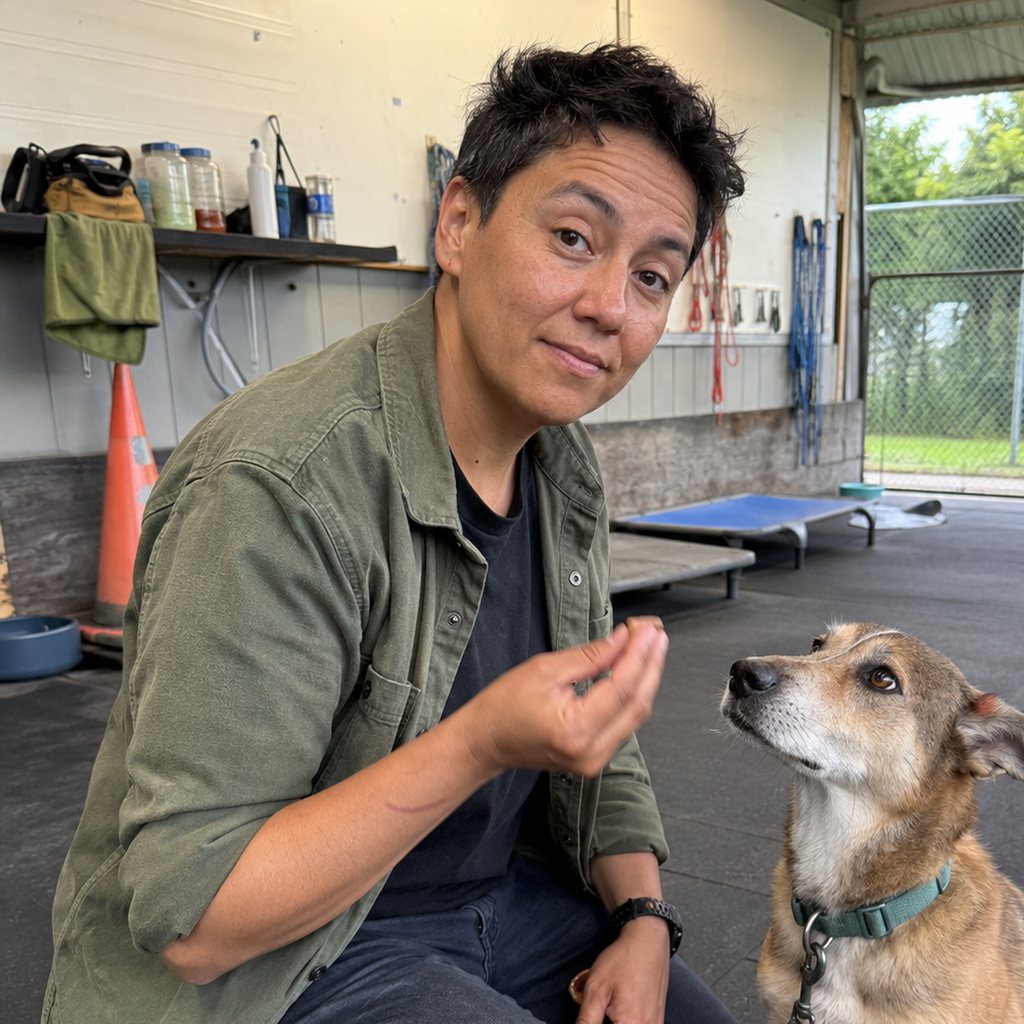
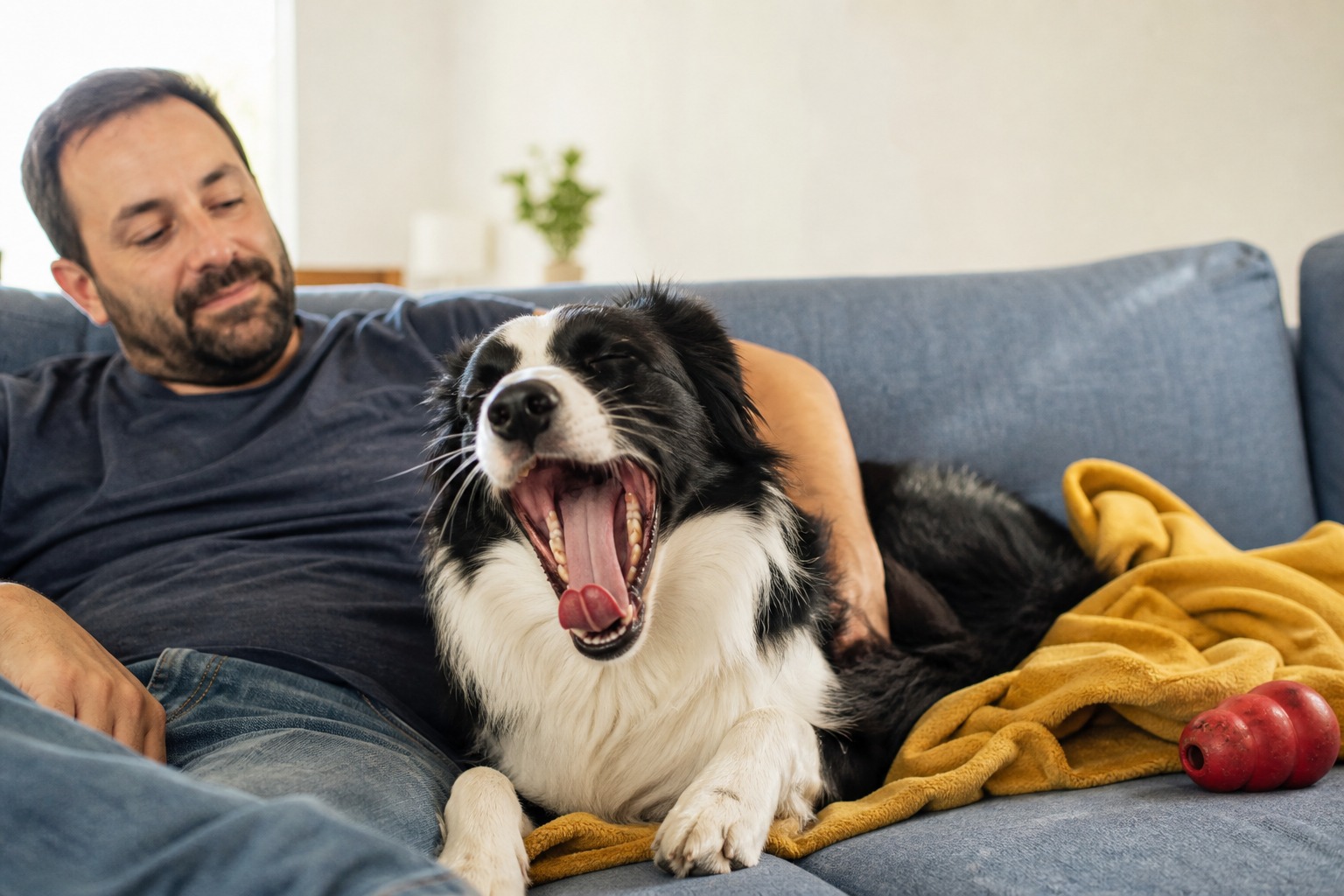
Catching your dog’s yawn feels like a tiny miracle of connection, proof that the bond runs so deep it loops right back through your own nervous system. It is a lovely story. It is also, scientifically, a lot shakier than the internet lets on, and clinging to the romantic version means missing the more practical thing a yawn is usually trying to tell you.
Here is the reframe worth making: stop treating a yawn as a love signal and start treating it as a data point. Whether or not your dog “caught” your yawn out of empathy is genuinely unresolved by the research. What is far better established, and far more useful day to day, is that a yawn is often a stress signal. The skill is not collecting evidence of your bond. It is learning to tell a sleepy yawn from a worried one.
What we actually know about contagious yawning
Contagious yawning in humans is well documented, and we do catch yawns more readily from people we are close to than from strangers, which is where the “empathy” interpretation comes from. The interesting question is whether that extends across the species line to dogs.
It might. Multiple studies have shown dogs can yawn in response to a human yawn. But “can” is doing heavy lifting, because the results are strikingly inconsistent. In one widely cited line of research, only a small minority of dogs yawned contagiously at all. In others, more than half did. That spread alone should make anyone cautious about sweeping claims.
“People want yawning to be a clean little proof of love, and I understand the appeal, but the data just doesn’t cooperate,” says Dr. Amara Solis, a veterinary behaviorist who consults for The Pet Times. “Some dogs catch yawns, many don’t, and the conditions that flip it on and off aren’t well pinned down. When a behavior is that variable across studies, the honest stance is curiosity, not certainty.”
The bonding story took a real hit
The most-shared version of this topic leans on an early-2010s study that found dogs yawned more in response to a familiar person than a stranger. That familiarity bias was the linchpin of the empathy argument: if closeness strengthens the effect, the reasoning went, then catching a yawn is an empathic act.
Then came the harder test. A larger, more carefully controlled study published in the Proceedings of the Royal Society B in 2019 confirmed that contagious yawning does occur in dogs, but found no familiarity bias and no other pattern the empathy hypothesis predicts. In other words, dogs caught yawns roughly the same whether the yawner was their beloved owner or a complete stranger. If empathy were driving it, that is not what you would expect.
“That replication matters more than people realize,” Dr. Solis says. “The whole ‘it proves your bond’ narrative rested on the familiarity effect, and a strong study failed to find it. It doesn’t mean dogs don’t bond with us, obviously they do. It means yawning is a weak and unreliable way to measure that bond, and we should stop selling it as one.”
So the cautious, accurate summary is this: dogs sometimes catch our yawns, the reason is unclear, and the warm “empathy” framing is far from confirmed. That is less Instagram-friendly and much closer to the truth.
The part that’s genuinely useful: yawning is a calming signal
Drop the question of whether yawns travel between you and your dog, and a more practical fact comes into focus. Yawning ranks among a dog’s calming signals, a subtle, easy-to-overlook behavior they rely on to regulate their own arousal and to ease tension with others.
“A yawn is one of the most overlooked words in a dog’s vocabulary,” says Leila Torres, a certified dog trainer who works with The Pet Times. “Context is everything. A yawn from a dog melting into the couch with nothing happening is almost certainly just sleepiness. The same yawn at the vet, while meeting a new dog, or right after you’ve asked for a tricky cue is usually a dog saying, ‘this is a lot, I’m trying to keep it together.’”
That repeated, out-of-place yawning rarely travels alone. It tends to come bundled with other low-key stress signals: lip-licking, turning the head or body away, a half-moon of white showing in the eye, sniffing the ground out of nowhere, or freezing. Read as a cluster, these tell you a dog is feeling pressure before that pressure boils over into a growl, a snap, or a shutdown.
“When you learn to catch the yawn-plus-lip-lick combo, you get a head start,” Torres says. “You can add space, lower the difficulty, or end the interaction before your dog feels they have no option left but to escalate. That’s worth far more than knowing whether they mirrored your yawn this morning.”
So which kind of yawn is this?
A quick way to sort it in the moment:
- Probably sleepy: relaxed body, calm setting, nothing demanding happening, often paired with a stretch.
- Probably stress: a tense or busy environment, repeated yawning, and other calming signals alongside it, like lip-licking, looking away, or a stiff posture.
When the second pattern appears, the kind move is to give your dog an out, not to push through.
Can you catch a yawn from your dog?
Interestingly, the traffic seems to run mostly one way. Humans readily catch yawns from each other, and dogs can catch them from us, but people rarely yawn back at a yawning dog. So as much as it feels like you start to droop watching your dog snooze the afternoon away, your own yawn is probably arriving on its own schedule, not theirs.
The bottom line
The feel-good claim that catching your dog’s yawn proves a special bond is built on evidence that did not survive a rigorous retest, so hold it loosely. The far more durable and actionable truth is that a dog’s yawn is frequently a calming signal, a quiet flag for stress that, read in context and alongside lip-licking or looking away, lets you step in before your dog gets overwhelmed. Spend less energy wondering whether the yawn was about love, and more learning what it is telling you. That is the version that actually helps your dog.
References
- Romero, Teresa, Akitsugu Konno, and Toshikazu Hasegawa. “Familiarity Bias and Physiological Responses in Contagious Yawning by Dogs Support Link to Empathy.” PLOS ONE, vol. 8, no. 8, 2013, e71365. https://journals.plos.org/plosone/article?id=10.1371/journal.pone.0071365.
- Neilands, Patrick, et al. “Contagious Yawning Is Not a Signal of Empathy: No Evidence of Familiarity, Gender or Prosociality Biases in Dogs.” Proceedings of the Royal Society B, vol. 287, 2020. https://royalsocietypublishing.org/doi/10.1098/rspb.2019.2236.
- Joly-Mascheroni, Ramiro M., Atsushi Senju, and Alex J. Shepherd. “Dogs Catch Human Yawns.” Biology Letters, vol. 4, no. 5, 2008, pp. 446-448. https://pmc.ncbi.nlm.nih.gov/articles/PMC2610100/.
- Rugaas, Turid. On Talking Terms with Dogs: Calming Signals. Dogwise Publishing.
Common questions
Is yawning contagious between dogs and humans?
Sometimes. Several studies show dogs can 'catch' yawns from people, but the effect is inconsistent across experiments, and the popular idea that it proves an empathic bond has not held up well to replication. Treat caught yawns as a real but unreliable phenomenon, not a love test.
Does my dog catch my yawns because they love me?
That is the appealing interpretation, but the evidence is weak. An early study found dogs yawned more for familiar people, suggesting empathy, yet a larger, more rigorous 2019 study found dogs caught yawns with no familiarity bias at all. The bonding explanation is far from settled.
Why does my dog yawn when they aren't tired?
Yawning is one of a dog's calming signals. Dogs often yawn when they feel stressed, conflicted, or overwhelmed, such as at the vet, around unfamiliar dogs, or when pushed to do something hard. A yawn out of context is usually about emotion, not sleepiness.
Can humans catch yawns from dogs?
It seems to be rare. People readily catch yawns from other people and dogs can catch them from us, but humans rarely yawn back at a yawning dog. So your dog's adorable yawn is unlikely to set off your own.
Jordan Ellis is a certified professional dog trainer with a decade of experience working with rescue organisations and private clients. They specialise in anxiety, reactivity, and positive reinforcement methods, and review all training and behaviour content at The Pet Times.
Meet our experts ↗Keep reading
 TrainingYour Husky Isn't Arguing With You. It's Doing the Job It Was Bred For.Dr. Ravi Mehta · 6 min
 Training8 Things 'Everyone Knows' About Dogs That Are Flat WrongDr. Amara Solis · 8 min
 TrainingYour Dog Isn't Misbehaving. They're Scared.Dr. Lena Park · 8 min
 LivingYour Dog Isn't Predicting Your Pregnancy. They're Reacting to It, and That's UsefulDr. Lena Park · 7 min
 Health & WellnessYour Old Dog Staring at the Wall Is Veterinary Medicine's Most Missed DiagnosisDr. Nina Kohl · 8 min
 TrainingSome Dogs Learn Words by Eavesdropping. Scientists Just Proved It.Marcus Webb · 5 min