


Walking Your Dog Sent 423,000 People to the ER
Over two decades, dog-walking injuries put nearly half a million American adults in emergency rooms, and the numbers are climbing. The leash turns your dog's momentum into force on your body. Here's how to keep it from hurting you.

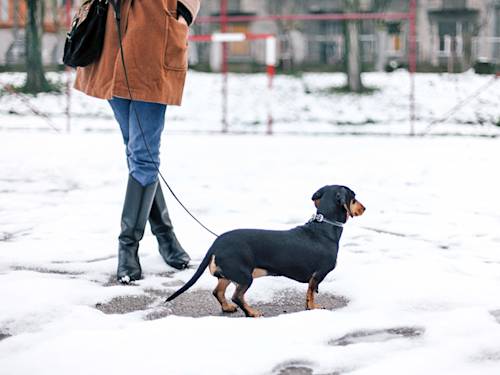
Walking the dog reads as the gentlest thing you do all day. The data says otherwise. Researchers at Johns Hopkins University counted nearly 423,000 American adults who landed in emergency rooms with dog-walking-related injuries between 2001 and 2020, and the trend line points the wrong way: there were almost four times as many such injuries in 2020 as in 2001. This isn’t a story about clumsy people. It’s a story about physics, and once you see the mechanism, the fix gets obvious.
The leash is a force multiplier
Picture what a leash actually is: a rigid link between a moving animal and your arm. When your dog surges, that momentum doesn’t dissipate; it travels up the line and yanks your hand away from your body, straining fingers, hands, wrists, elbows, and shoulders. The Johns Hopkins team catalogued the damage, and it runs from the common to the frightening: sprains and strains made up 28.3 percent of injuries, finger fractures 6.9 percent, and traumatic brain injuries 5.6 percent.
The bigger danger, though, isn’t the arm. It’s the fall. When a sudden pull or a leash wrapped around your legs puts you on the ground, the stakes jump. More than half of the injured walkers in the study had fallen, and falls are no small thing, they’re already a leading cause of injury-related ER visits across nearly every adult age group. For adults over 65, a fall while walking the dog most often produced a traumatic brain injury or a broken hip, the kinds of injuries that reshape a life.
Who’s getting hurt, and why the numbers are climbing
The injured skew a specific way. Three out of four were women. Forty-three percent were between 40 and 64, with an average age of 53. That’s not who most people picture when they imagine a dangerous dog encounter, and it’s part of why the risk goes unnoticed.
Why the fourfold rise? There are simply more dogs now, roughly 61.6 million in 2001 versus 83.3 million in 2020, but that alone doesn’t explain a quadrupling. Two other things changed. Our aging population is more physically active than before, putting more people on more walks. And the way we move through the world shifted: the smartphone arrived in 2007, and we’ve been walking with our eyes down ever since. Distracted walking causes missteps with or without a dog attached; add a dog and the margin for error shrinks.
People think of a leash as a tether, but on a hard pull it behaves more like a lever, and your wrist or shoulder is the fulcrum. The single highest-value change I recommend is boring: shorten the leash and stop wrapping it around your hand. You want to be able to release tension in a fraction of a second, and you can’t do that if the line is cinched around your fingers.
Build a safer setup
The good news is that most of these injuries are preventable with equipment and habits, not heroics.
Start with the dog’s gear. A front-clip harness with a snug fit discourages pulling at the source, the most common problem is a harness fitted too loosely, which twists to the side and stops doing its job. Pair it with a shorter, non-retractable leash, about four feet, which cuts the slack that turns a pull into a violent snap and gives a tangle less rope to work with. A rope leash, rather than flat webbed nylon, twists less and is easier to keep out from under your feet.
Then fix your grip. Hold the leash across your palm instead of winding it around your fingers or wrist, so you can adjust instantly and won’t break a finger if your dog takes off. Tie a knot roughly 18 inches below the handle and you get a firm grip point, with the loop still available over your wrist as a backup.
Training matters as much as gear. A dog who reliably responds to cues like “heel,” “leave it,” “look at me,” and “stay” is a dog who lunges less, and less lunging is the whole ballgame. Keep treats handy to redirect attention before a situation escalates.
Small habits, big difference
A few situational tweaks close the remaining gaps. At a blind corner, swing out toward the outer edge of the walkway, so nothing rounds the bend and startles your dog into a reaction while you’re too close to manage it. Hang back from the curb’s edge before crossing, so your dog can’t lunge into a bike lane or into traffic, and never let them relieve themselves in one, where a passing cyclist can spook them and injure all three of you.
Give unfamiliar dogs a wide berth, especially clusters of them like a group being walked by a professional, and off-leash dogs, since neither their reaction nor your own dog’s is anything you can count on. Walk during daylight when you can see uneven ground, wear sturdy shoes with real traction, and warm up before you head out. And if your dog remains genuinely hard to handle after all this, that’s a cue to bring in a trainer, for your body’s sake as much as your dog’s.
What’s new since the study
The Johns Hopkins analysis stopped at 2020, but the pattern it flagged, more dogs, older and more active walkers, more distraction, hasn’t reversed, and clinicians who treat these injuries continue to see the same profile: reactive pulls, tangled falls, and low-light missteps. The practical guidance has hardened around a few reliable moves, shorter non-retractable leashes, front-clip harnesses fitted correctly, and daylight walks, and away from retractable leashes, which pair long slack with a thin cord that can cut or burn on a fast pull. The headline number is alarming, but the fix stayed simple: shorten the line, mind your grip, and keep your eyes up.
References
- Forrester, J. D., et al. “Epidemiology of Dog Walking-Related Injuries among Adults Presenting to US Emergency Departments, 2001-2020.” Medicine & Science in Sports & Exercise, 2023. journals.lww.com
- Centers for Disease Control and Prevention. “Falls and fall injuries among adults.” cdc.gov
Common questions
What's the most dangerous part of walking a dog?
The leash and the fall it can cause. A dog's sudden lunge yanks the arm away from the body, injuring fingers, hands, wrists, elbows, and shoulders, and more than half of all injured walkers in the study had fallen. Falls are already a leading cause of injury-related ER visits across adult age groups.
Does the type of leash matter?
Yes. A shorter, non-retractable leash, around four feet, gives you more control and less slack, so a pull is less violent and you're less likely to get tangled. A rope leash resists twisting and is easier to handle than flat nylon.
Not a substitute for your vet. Our guidance is educational. For urgent symptoms, contact a vet or emergency clinic right away. Editorial standards
Dr. Mehta is a board-certified veterinary nutritionist who evaluates pet food formulations, ingredient quality, and the science behind dietary trends. He writes and reviews all nutrition content at The Pet Times, including our food rankings and feeding guides.
Meet our experts ↗Keep reading
 Health & Wellness'Teacup' Is a Sales Word. Vets Have a Different One for It.Dr. Mara Chen · 6 min
 Health & WellnessYour Tick Meds Won't Catch Them AllDr. Lena Park · 6 min
 Health & WellnessThere's an Actual Number for 'My Dog Drinks Too Much Water'Dr. Lena Park · 7 min
 Health & WellnessYour Dog's Panting Isn't the Problem. Panting With No Job to Do Is.Dr. Ravi Mehta · 8 min
 Health & WellnessThe Tick Isn't the Emergency. The Delay Is.Dr. Ravi Mehta · 8 min
 Health & WellnessThe 'Mystery Dog Illness' Wasn't a Mystery. Here Are 8 Ways to Keep Your Dog Out of It.Dr. Mara Chen · 7 min