


Your Dog Isn't Having a Seizure. Say Their Name.
Trancing looks neurological, and the single test that proves it isn't takes two seconds. It is also the test that tells you when something really is wrong.

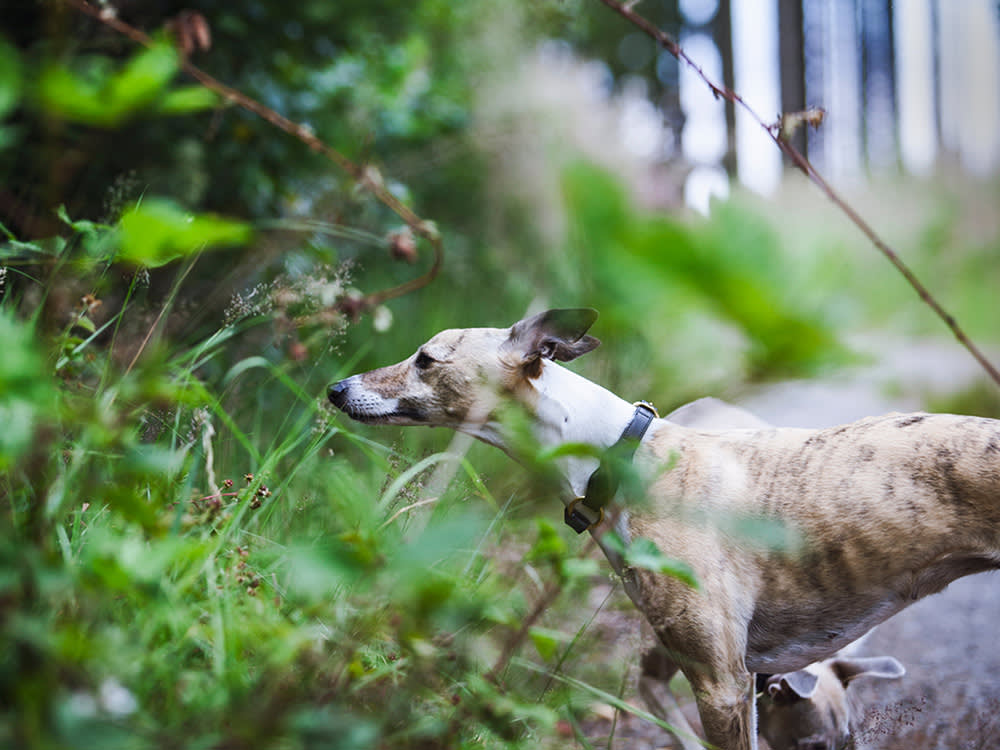
Your dog is walking under the clothesline in slow motion. Ears flat, nose tipped up, eyes squinted almost shut, paws coming down like they are afraid of waking the floor. They stop. They stand there. Then they resume the world’s slowest walk.
It is genuinely eerie the first time. It looks like the start of a seizure, or like some kind of obsessive loop you should be worried about.
There is a two-second test that settles it, and it is the whole reason this behavior gets a name of its own. Say your dog’s name.
If they snap out of it, look mildly irritated at you, and go back to being a normal dog, you have just watched trance-like syndrome, or TLS, and there is nothing to fix. If they cannot be reached, if there is no way to interrupt them, or if they surface confused and stumbling, you are not looking at trancing and you should be calling your vet. The interruptibility is not a fun fact about trancing. It is the diagnostic line.
Everything else in this article hangs off that one test.
Why interruptibility matters so much
A seizure is an electrical event. Once it starts, it runs to completion. You cannot talk a dog out of it, and afterward there is a postictal phase: minutes to hours of confusion, anxiety, nausea, pacing, sometimes temporary blindness. The dog comes back wrong before they come back right.
Trancing has none of that. Based on current evidence, these episodes are not seizure activity. There is no postictal phase. The dog is not gone; they are absorbed. Call them and they answer. And anti-seizure medication, which is the other obvious tell, does not prevent it. If the drugs that stop seizures do not touch a behavior, that behavior is not a seizure.
Owners come in braced to hear the word epilepsy, and the first thing I ask is whether they can get the dog’s attention mid-episode. When the answer is yes, most of the visit is me talking them down. When the answer is no, the visit changes completely.
What trancing actually looks like
Vets describe the movement as a hypokinetic gait: extremely slow pacing with soft, deliberate footfalls. It is set off by passing under something that hangs at head or back height and just barely touches the dog. Low plants. A clothesline. A tablecloth edge. The fringe of a hanging coat.
Some dogs add a whole face to it: the ears pinned down, the muzzle tipped upward, the eyes narrowed to slits. Once you have seen that expression you will not mistake it for anything else. They may freeze entirely for several seconds before resuming the crawl.
Left alone, an episode can run anywhere from a few seconds to half an hour. Interrupt it and it ends on the spot. Some dogs look briefly annoyed about the interruption, the way you would if someone turned off a song you liked, and then get on with their day.
Which dogs do it
The classic tranceers are Bull Terriers and sighthounds: Greyhounds, Whippets, Salukis. But it has been seen across many breeds and mixes, and it is reported more often in dogs who show other signs of canine compulsive disorder, like tail-chasing. That clustering hints at a possible genetic component, though nobody has demonstrated one for trancing specifically.
It has picked up nicknames along the way: “ghost-walking,” “weed-walking,” and just plain “trancing.”
So why do they do it?
The honest answer is that nobody knows, and the profession is comfortable saying so.
The prevailing guess is sensory. The light brush of foliage or fabric along the back and flanks appears to feel very good, and the dog slows down to keep the feeling going. It is not a thousand miles from why a person will stand under a shower longer than hygiene requires.
The competing view, held by some behaviorists, is that trancing belongs in the compulsive-disorder family, on the grounds that trancing dogs are over-represented among dogs with other repetitive behaviors. Both can be a little bit true. What has never been demonstrated is a link to any underlying neurological disease, and that is the part that matters for your dog on a Tuesday afternoon.
When it is not trancing: the actual red-flag list
This is where the interruption test earns its keep. Trancing plus nothing is a quirk. Trancing plus anything on this list is a vet visit, because it means you may be misreading a neurologic event as a personality trait.
Call your vet if the zoning-out comes with any of:
- Inability to interrupt the episode, or a dazed, confused recovery afterward
- Aggression during or around episodes
- Head pressing, which is always an emergency sign
- Trouble walking, stumbling, or knuckling over
- Muscle tremors
- Signs of pain
- Vomiting
- Unresponsiveness to outside stimuli
- Any sudden loss of consciousness
- Episodes that are escalating in frequency, duration, or intensity
Dogs presenting this way may have a seizure disorder, a metabolic abnormality, or organ dysfunction underneath, and your vet may recommend diagnostics or a referral to a veterinary neurologist.
There is one more, mundane check that gets forgotten: look at what your dog is trancing under. A “massage” from a poisonous or irritating shrub can leave a real rash on a dog who has spent twenty minutes pressed into it.
What to actually do about it
Nothing, mostly. Trancing needs no treatment and no discouragement. If you want to be thorough, take thirty seconds of video on your phone and show it to your vet at the next wellness visit, so somebody who knows your dog has actually seen the behavior rather than your description of it. Video is worth more than an adjective.
Then let them have their weird little walk.
What newer research adds
Two threads have developed since this behavior first got written up for pet owners, and they point in slightly different directions, which is worth being straight about.
The first is a 2015 case series in the Veterinary Record documenting trance-like syndrome in Bull Terriers. Its central contribution was to describe TLS as its own recognizable, benign phenomenon rather than an epilepsy variant. That is the evidence behind the reassurance most vets give.
The second complicates it. Work on compulsive tail-chasing in Bull Terriers has found trance-like behavior clustering together with tail-chasing, episodic aggression, and phobias, and in a small subset of tail-chasing dogs who were tested, EEG abnormalities turned up where controls had none. That does not mean your trancing dog has a brain lesion. The dogs in that work were selected for a severe compulsive behavior, which is a different animal from the Whippet dawdling under your azalea. But it does mean the line between “harmless quirk” and “part of a compulsive pattern” is real, and it is drawn by the rest of the dog’s behavior, not by the trancing itself.
Which brings you back to the same place. One weird slow walk under the laundry is a quirk. A weird slow walk in a dog who is also spinning, tail-chasing, and snapping is a conversation with your vet.
References
- Lowrie, M., & Garosi, L. (2015). Trance-like syndrome in bull terriers. Veterinary Record.
- Moon-Fanelli, A. A., Dodman, N. H., & Cottam, N. (2011). Characteristics of compulsive tail chasing and associated risk factors in Bull Terriers. Journal of the American Veterinary Medical Association.
- Overall, K. L., & Dunham, A. E. (2002). Clinical features and outcome in dogs and cats with obsessive-compulsive disorder. Journal of the American Veterinary Medical Association.
Common questions
Should I stop my dog from trancing?
There is no medical reason to. It is a harmless self-directed behavior. The only thing worth checking is what your dog is trancing under, since a poisonous or irritating shrub can leave a rash.
Which breeds trance most?
Bull Terriers and sighthounds like Greyhounds, Whippets, and Salukis are the classic tranceers, but it has been documented across many breeds and mixes.
How often do trancing dogs trance?
It varies widely, from weekly to once every few months. Episodes usually run from a few seconds to, at the outer edge, half an hour.
Dr. Mehta is a board-certified veterinary nutritionist who evaluates pet food formulations, ingredient quality, and the science behind dietary trends. He writes and reviews all nutrition content at The Pet Times, including our food rankings and feeding guides.
Meet our experts ↗Keep reading
 Health & WellnessWhen One Dog Dies, the Other One Changes. Science Finally Has Numbers on It.Dr. Mara Chen · 7 min
 TrainingOne Dog Licking Another's Ears Is Usually Fine. Two Things Make It Not.Dr. Ravi Mehta · 7 min
 TrainingYour Female Dog Humps. It's Normal, and It's Usually Not About SexDr. Lena Park · 7 min
 TrainingYour Dog's Sad Face Is a Muscle Wolves Don't Have. It Evolved to Work on You.Dr. Ravi Mehta · 8 min
 Health & WellnessA Quiet Dog Is Fine. A Newly Quiet Dog Is a Symptom.Dr. Ravi Mehta · 7 min
 Health & WellnessYour Dog Has a Mirror Behind Each Eye. It's Why They See at Night, and Why They See Worse Than You.Dr. Nina Kohl · 7 min