


A Grumpy Dog Isn't Misbehaving. They're Telling You Something
Yes, dogs wake up on the wrong side of the bed. But a bad mood is a message to decode and respect, not a problem to correct, and protecting sleep is the lever that actually prevents it.

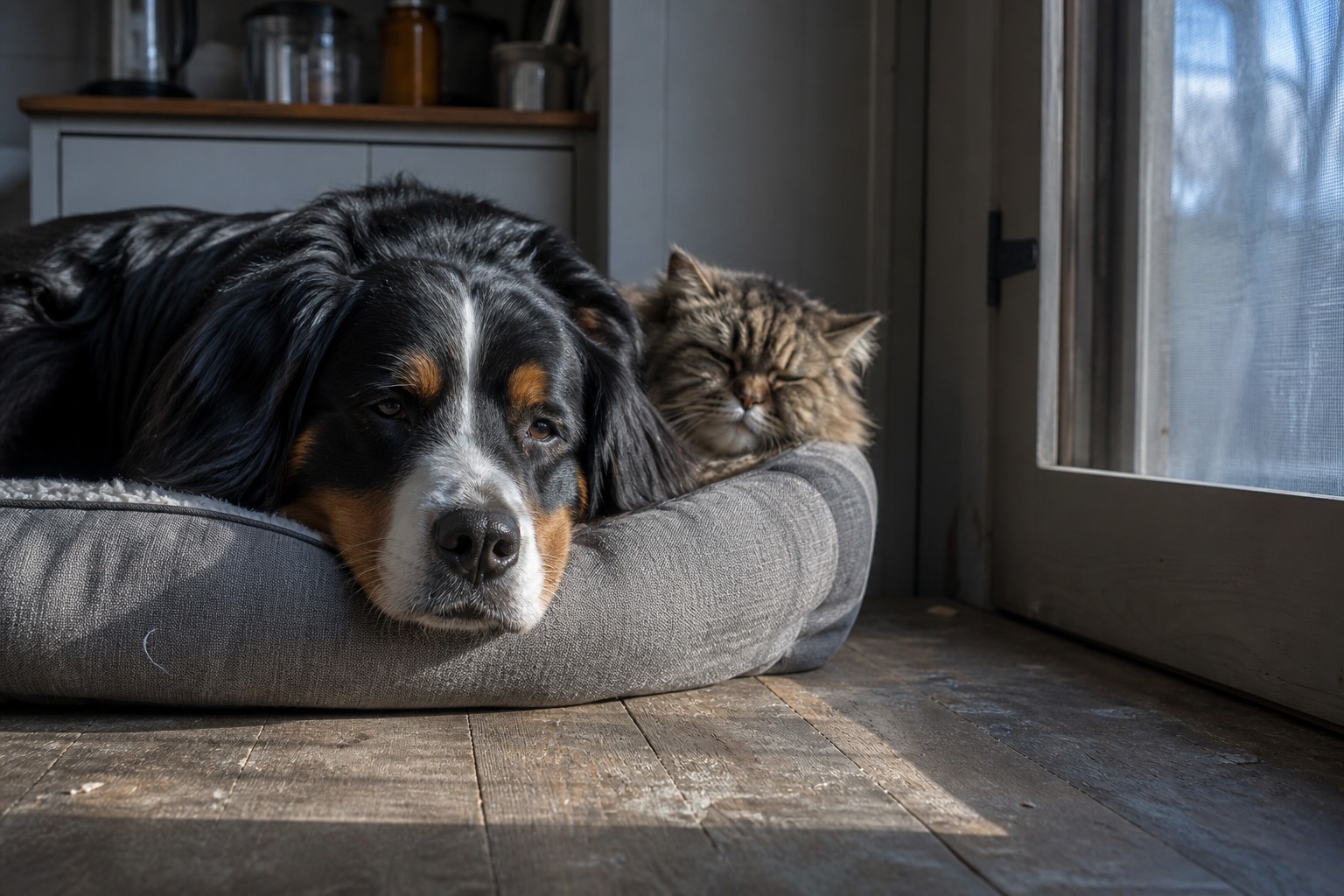
When a dog snaps during a belly rub they usually love, or slinks off and hides on a morning that looks like any other, the instinct is to treat it as a behavior problem, something to correct. That instinct gets it backward. A dog in a bad mood is not malfunctioning. They are communicating, in the only vocabulary they have, and the right response is not to fix them but to read the message and honor it. Once you see grumpiness as a signal rather than a glitch, two things follow: you stop punishing a dog for telling you the truth, and you start protecting the one thing that most often prevents the bad mood in the first place, their sleep.
First, yes, the bad mood is real
It helps to know the grumpiness is not your projection. “Bad mood” is a human phrase, and the more accurate framing is a change in a dog’s emotional state, but the underlying biology is shared. A dog’s brain processes emotion in ways that closely parallel ours, and the hormones steering a dog’s moods are the same ones steering yours. So the chemical shifts that leave you short-tempered after a rough night can leave your dog short-tempered too. When your dog surfaces from sleep cranky, that is brain chemistry, not imagination.
Owners apologize to me for their dog being ‘in a mood,’ as if it’s bad manners. I tell them it’s information. The same physiological shifts that make us irritable after a bad night make dogs irritable, and because they can’t say it, a growl or a turned back is them putting it into words. Our job is to listen, not to correct the messenger.
Step one: decode the signal
Because a dog cannot announce their feelings, you have to learn your own dog’s particular tells, which means knowing their normal baseline first. A dog who has woken up stressed, sore, or simply off might show it through pacing or restlessness, whining or barking, yawning (often a stress signal, not sleepiness), pinned-back ears, panting, digging, a tucked tail, or hiding.
One signal deserves special weight: anything that hints at pain. When a dog acts genuinely out of character, take note. A dog who normally adores being petted and suddenly avoids it, or snaps to prevent it, may be hurting somewhere. That is not a mood to wait out; that is a flag to investigate. Reading the difference between “leave me alone this morning” and “something hurts” is the most important decoding you will do.
Step two: respect it instead of overriding it
Here is where the reframe earns its keep. When your dog’s signal says give me space, the correct move is to give it, not to push through with the affection you had planned. If your dog growls when touched, stop touching and let them decompress. That is not rewarding bad behavior; it is respecting a clear “no,” which is exactly what builds a dog’s trust that communicating will be heard rather than punished.
There is a counterintuitive version of this worth flagging, because it trips up a lot of owners: good days can produce grumpy dogs. Picture a dog coming off an unusually big, exciting week, extra outings, a stimulating new class, more activity than usual. All positive, all also exhausting. That dog might later growl when their person tries something they normally love, like a paw massage. That is not aggression, it is a tired dog saying I’m wiped, please let me be. Backing off is the right call, and it teaches you your dog’s limits for next time.
Decompression looks different for different dogs. For one it is a long, sniffy walk full of new scents. For another it is gnawing a long-lasting chew. For another it is a round of tug. The point is to offer the exit they are asking for, not the interaction you wanted.
Step three: protect the lever you actually control, sleep
You cannot control your dog’s dreams or the weather, but you can control the biggest preventable driver of grumpy mornings: rest. And recent science makes this the most actionable part of the whole picture.
Canine sleep studies using non-invasive brain monitoring have found that poor or disrupted sleep is tied to more anxiety-like behavior, weaker performance on thinking tasks, and even depressive-type states in dogs. One especially telling result: the quality of a dog’s sleep, including how often they wake in the night, appears to affect how well they read human emotion the next day, our expressions and tone. Other work has shown that a stressful event before bed, like a separation, actually reshapes the structure of a dog’s sleep. In short, a bad night measurably degrades the next day.
That reframes a grumpy morning as feedback, not a flaw. The practical response is to defend your dog’s rest: a steady daily routine, enough physical and mental exercise, and a genuinely calm, secure place to sleep. A tent bed or a cozy crate the dog can enter and leave freely gives them somewhere to fully switch off, and the freedom to retreat matters as much as the comfort itself. Other common triggers, a disrupted routine, a stressful previous day like a vet visit, a drop in barometric pressure before a storm, are worth knowing too, but sleep is the one you can most directly improve.
When to bring in your vet
An occasional off morning is normal. But if the mood becomes a pattern, or your dog starts acting out in ways that could be dangerous, like digging under the fence to escape, loop in your veterinarian. The first priority is ruling out a medical cause, since pain and illness so often masquerade as behavior. A useful habit: log the out-of-character behavior in your phone or film a short clip, so your vet sees exactly what you see. Once a medical cause is ruled out, a certified trainer, behavior consultant, or veterinary behaviorist can help you get to the root, so both of you can wake up ready for the day, whether that means taking on the world together or happily doing nothing on the couch.
References
- Reicher, V., et al. “REM Versus Non-REM Sleep Disturbance Specifically Affects Inter-Specific Emotion Processing in Family Dogs (Canis familiaris).” Scientific Reports, 2020. https://www.nature.com/articles/s41598-020-79139-8
- Bunford, N., et al. “Sleep and Cognition in Aging Dogs: A Polysomnographic Study.” Frontiers in Veterinary Science, 2023. https://www.frontiersin.org/articles/10.3389/fvets.2023.1151266/full
Dr. Solis is a board-certified veterinary dermatologist with over twelve years of clinical experience. She advises on skin conditions, allergies, and grooming practices that affect coat and skin health. All dermatology and allergy content at The Pet Times is reviewed by her team before publication.
Meet our experts ↗Keep reading
 TrainingStop Telling Yourself Your Dog Was AbusedDr. Nina Kohl · 8 min
 TrainingYour Dog Isn't Shy at Your Party. Six Signs They Want Out.Dr. Lena Park · 8 min
 TrainingYelling at Your Dog Lands in Their Body, Not Just Their EarsDr. Mara Chen · 5 min
 TrainingYour Dog Is Running on Your Nervous SystemDr. Nina Kohl · 6 min
 TrainingYour Dog's DNA Isn't the Whole Story. The Part You Can Actually Change Is.Dr. Mara Chen · 5 min
 Training5 Reasons Your Dog Follows You Into the Bathroom (One Is Worth Watching)Dr. Nina Kohl · 6 min