


How a Touring DJ Raised a Puppy-Mill Rescue, Then Prepped Her for a Baby
Amrit Tietz spent 15 years on the road with Soy, a fearful Min Pin-Chihuahua rescue, in tow. What that life taught her about settling an anxious dog, and what she learned when a newborn entered the picture.

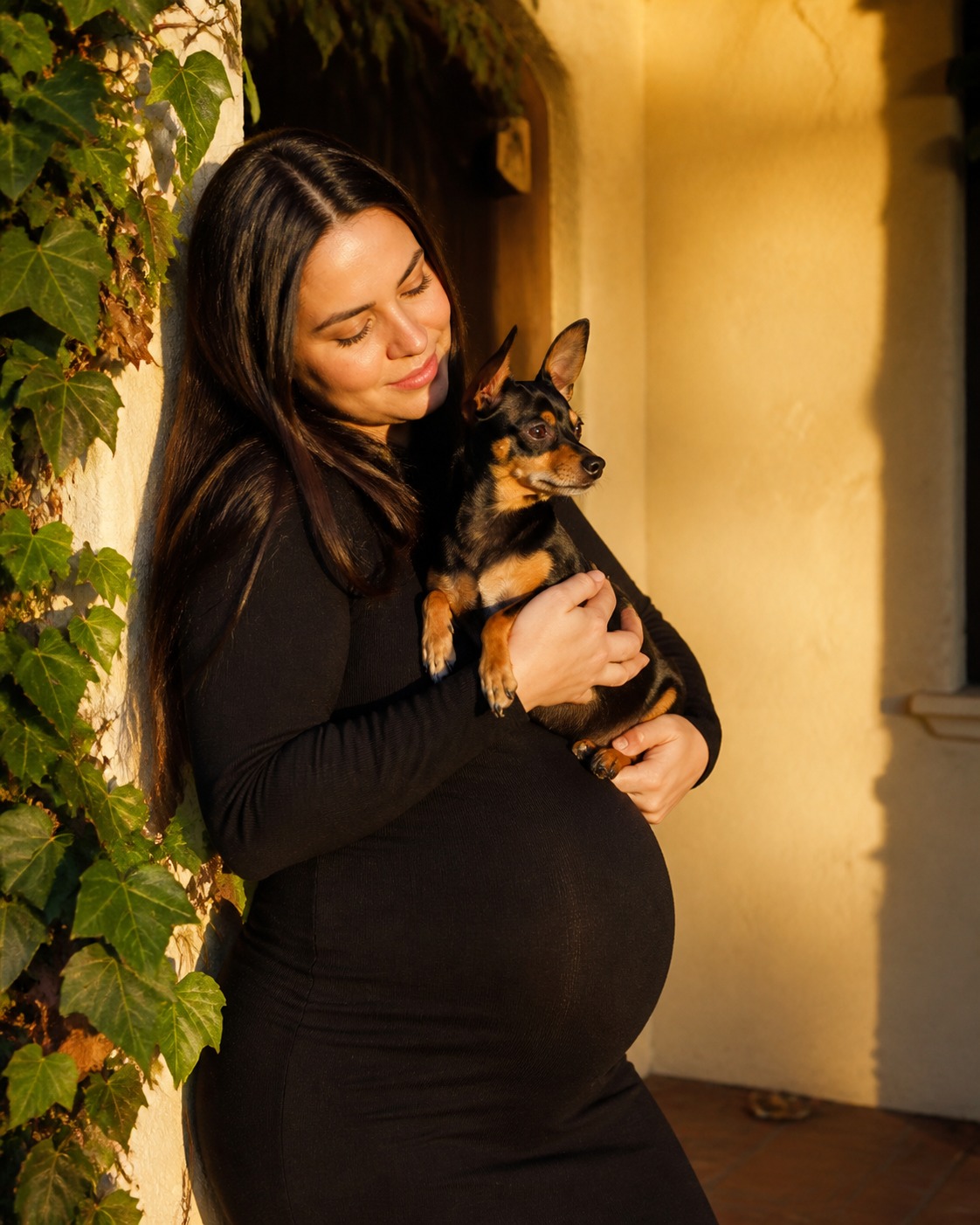
Most celebrity pet stories are about the pet as accessory. Amrit Tietz’s is the opposite: hers is about a dog who shaped how a chaotic, hard-traveling life actually got lived, and who then had to make room for a human baby. The throughline of her story is not “DJ has cute dog.” It is something more useful to anyone with an anxious rescue: how constant exposure, early and gentle, can turn a frightened animal into a confident one, and what that same instinct gets right, and misses, when a newborn arrives.
For 15 years, Tietz has been an in-demand DJ. The Los Angeles-based artist, Indian by descent and raised in Australia, has worked events for everyone from Dua Lipa and Lauryn Hill to Nike and Dior. She is also a founding member and director of partnerships for nonprofits including Feed the Streets, and the host of the lifestyle podcast Unhinged With Amrit. This past year she added the title she cares about most: mom, to a newborn daughter, Frankie Ava, and to Soy, the Miniature Pinscher and Chihuahua mix she calls her “first child.”
A rescue who started life afraid of almost everything
Soy did not arrive easy. Tietz adopted her at seven or eight weeks old from Social Tees, a New York rescue that ran pop-ups near her local dog park. The puppy had come out of a Tennessee puppy mill and showed it: night terrors, and a stretch on medication to manage them. “Obviously, she’s the light and love of my life, but I didn’t really realize what I was signing up for,” Tietz says. The name, fittingly, came from chaos too. With her Australian accent, friends kept hearing her call the dog “soy cute” instead of “so cute,” and it stuck.
The recovery story is the part worth borrowing. A dog who begins life that frightened can stay frightened for years if the world stays scary. Soy did the opposite, and it was not an accident. Tietz took her everywhere, early and often, until the overwhelming became ordinary.
The road as accidental confidence training
This is where a touring schedule turned out to be, by sheer repetition, exactly the kind of exposure a fearful dog needs. Soy flew constantly from the time she was small, and she became, in Tietz’s telling, an unflappable traveler. “She doesn’t make a peep out of her bag,” Tietz says. The dog has been to nearly every major U.S. city, riding along on tour, and once spent a couple of months in Malibu while Tietz programmed music for a project, “living her best life, frolicking on the beach.”
There is a real principle under the glamour. Repeated, low-drama exposure to novel sights, sounds, and motion, paired with the security of her person, is precisely what builds tolerance in an anxious dog. Soy got an extreme, accidental version of it, and the payoff was a rescue who treats a packed terminal like a nap spot. The lesson scales down: a nervous dog who rides in the car on ordinary errands, sits on the patio of a busy cafe, and meets the world in small, calm doses gets some of the same benefit.
It also produced a dog with opinions. After moving from New York to LA in 2020, Soy grew, in Tietz’s words, “bougie.” On trips back east she flatly refused to relieve herself on a city sidewalk. “She was like, ‘No, I’m experiencing the good life now, and I’m not going to go on this dirty sidewalk.’” The wardrobe shifted coasts too, from East Coast cable-knit sweaters and puffy jackets to LA’s fun collars and leashes. Soy even modeled for a friend’s psychedelic dog-collar line, Daisy.
When the baby came: what she did, and what experts would add
The genuinely instructive chapter is the pregnancy. Soy ignored it at first, which made Tietz nervous about how the dog would handle a newcomer. “I was getting a little nervous, because I was like, ‘Is she gonna be territorial?’” Then, as the baby began to move, Soy shifted. She started nestling against Tietz’s belly, lying close, looking toward where the baby was. “Sometimes, I’d wake up and it was all of us tangled in my pregnancy pillow.” For prep, Tietz went on a Reddit deep dive about rescue dogs and babies, and focused mostly on the long-running, unwinnable project of getting Soy to sleep in her own bed rather than the family’s.
Her instincts were warm, and a behaviorist would add structure to them. The evidence-based approach to introducing a resident dog to a newborn does not wait for the baby to arrive. It starts roughly four months out, gradually exposing the dog to the sights, sounds, and smells a baby brings, and pairing each one with something good.
“The single most overlooked step is sound,” says Dr. Lena Park, a veterinarian who works with behavior cases. “Play recordings of a baby crying and cooing at a very low volume while your dog eats or gets treats, then raise it slowly over weeks. You’re teaching the dog that the noise predicts good things, so the real cry on day one reads as curiosity instead of alarm. Pair that with letting the dog investigate baby gear and a blanket with the baby’s scent before the introduction, and you’ve done most of the work.”
That structure is what turns a hopeful “she seems fine with the bump” into a reliable, calm first meeting. Tietz’s natural read of Soy, attentive, unforced, never territorial, was a strong starting point; the desensitization layer is the part that makes it dependable.
Why “first child” is not a joke to her
Tietz is unbothered by people who bristle at the phrase. “Soy is my first child forever,” she says, even if the dog now openly favors Tietz’s husband, who entered the picture years after the adoption. “Don’t forget you’re my child first. I rescued you from the depths of Tennessee.” The people who take offense, she notes, tend to be the ones without pets. As for juggling a newborn, a dog, and a touring career, she is sanguine: years as a self-employed creative taught her to “thrive in the chaos,” and she and her husband both work largely from home, a flexibility she is quick to acknowledge most new parents in the U.S. don’t get.
The takeaway is less about a DJ than about her dog. A puppy who started life medicated for night terrors became a confident traveler and a gentle presence around a newborn, because the scary world was introduced to her steadily, with her person beside her, until it stopped being scary. That is a playbook any owner of an anxious rescue can run, no tour bus required.
References
- “Dogs and Babies.” ASPCA, aspca.org.
- “Desensitization and Counterconditioning.” ASPCA, aspca.org.
- Tietz, Amrit. Unhinged With Amrit (podcast), Apple Podcasts.
Claire Sutton writes about life with pets, from the first days home to the small daily routines that make a household work. Her reporting spans people-and-pet relationships, training basics, and the practical side of bringing a new animal into the family.
Meet our experts ↗Keep reading
 LivingThe Dog Picked Me. My Partner Did the Work. I Have No Regrets.Nina Vasquez · 4 min
 LivingStare Into Your Dog's Eyes and Your Brains Literally Sync. There's a Catch.Dr. Priya Nair · 5 min
 TrainingYour Dog Isn't Trolling You. They're Playing, or Trying to Tell You Something.Dr. Nina Kohl · 7 min
 LivingFor Alex Proba, Designing for Her Dog Is the Same Risk That Built Her StudioNina Vasquez · 5 min
 LivingPetting a Dog Lights Up Your Social Brain, and the Glow Doesn't Fade When They LeaveDr. Lena Park · 5 min
 Living'The Truffle Hunters' Is Really About the Dogs. That's the Whole PointMarcus Webb · 4 min