


The Best Cat Toy Is the One You Don't Hide in a Basket
A dog brand quietly started making felted wool cat toys, and the design argument behind them is better than the cuteness suggests: a toy that lives out in the open gets played with. One in a bin doesn't.

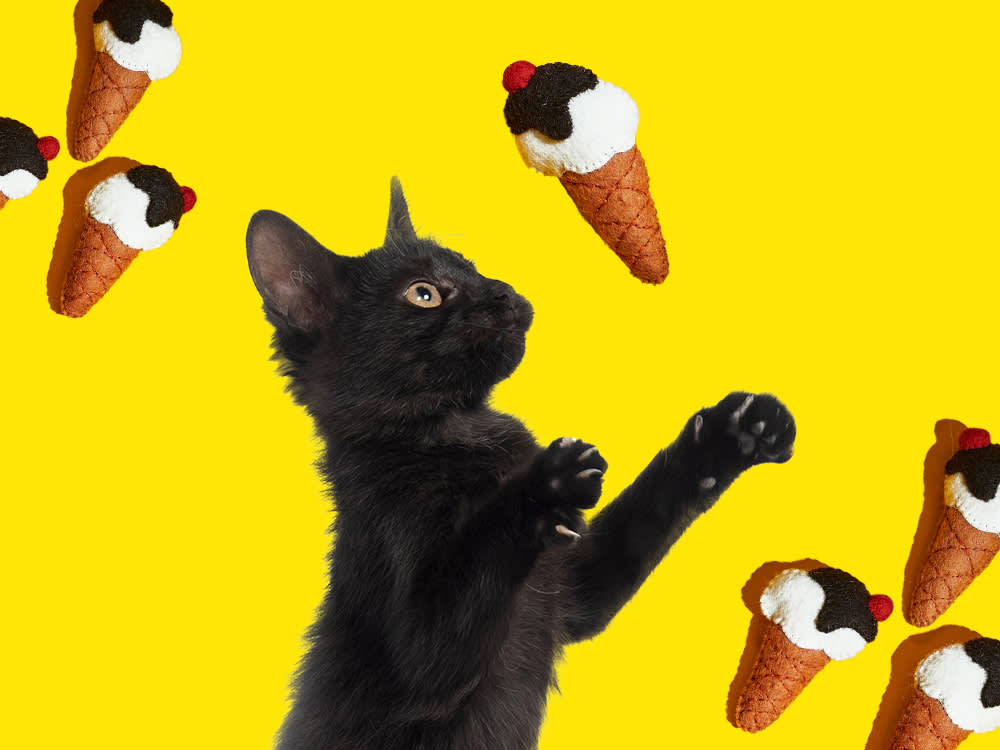
Look under your sofa. Go on.
Whatever is under there, plus whatever is in the basket by the door, plus whatever is in the drawer you shoved things into before people came over, is your cat’s actual toy collection. And your cat is not playing with any of it, because your cat cannot see any of it.
This is the quiet failure mode of cat toys, and almost nobody names it. We buy toys that are ugly, so we put them away, and a toy that is put away is not a toy. It is inventory. Cats are opportunistic. They play with what is in front of them, at the moment the mood lands, which is usually 4am and never when you have thoughtfully staged a play session.
Which is the real reason Ware of the Dog, an indie brand that until now made things for dogs, is worth paying attention to for having made a run of cat toys. Not because they are cute, although they are aggressively cute. Because founder Jackie Rosenthal designed them around a specific and slightly subversive premise: the best pet toys are the ones you don’t mind seeing around your house.
That sounds like a decorating argument. It is actually a play argument. A toy you leave on the rug gets batted at. A toy you hide does not exist.
What they actually are
The line is hand-felted from 100% natural wool, stuffed with catnip, and the pieces are made by craftswomen in Nepal and Turkey on fair-trade terms, with natural dyes. That is a genuinely unusual supply chain for a cat toy, and it is the reason they look handmade rather than injection-molded.
There are ten pieces in the collection, which is eight distinct designs once you accept that the three sports balls are one idea.
And rather than march through them in catalog order, I have sorted them by how your cat will actually use them, because that is the only sorting that helps you buy. Cats broadly divide into wrestlers and chasers, and buying a chaser a wrestling toy is how a toy ends up in the basket.
For the wrestler: the ones a cat can get hold of
A wrestling cat wants something they can seize with the front paws, haul into the belly, and bunny-kick with the back feet. That is the full predatory sequence, and it needs bulk and something to grip.
The green wool dinosaur
The most substantial silhouette in the range, with limbs and a tail jutting out at awkward angles, and that is precisely its functional advantage: a protrusion is something to bite and hold. A toy a cat can lock onto gets wrestled. A smooth one gets tapped once and forgotten. If your cat is a wrestler, this is the single best-designed object here, dinosaur jokes notwithstanding.
The wool mouse
Brightly colored, and roughly six inches long. That length is doing more work than you would guess: it is big enough for the grab-and-kick, where a tiny felt mouse is only big enough for a swipe. If your cat has ever looked witheringly at a little felt mouse and walked off, size was very likely the reason.
This is the one to buy if you are buying exactly one.
The wool shrimp
Honestly the best shape in the collection. The curve gives the paws something asymmetric to grip, and it tumbles off in an unpredictable direction when it is struck, which is the thing a symmetrical ball can never do. Underrated.
For the chaser: the ones that skitter
A chasing cat is not interested in a grapple. They want something that leaves.
The felted sports balls — baseball, football, soccer
A trio of small felted balls for the athletically-minded cat. Light enough to shoot across a hardwood floor when swatted, which is the entire point of them, and also the reason they will be the first things to vanish beneath the sofa I told you to check at the top of this article.
Buy them knowing that. They are consumable joy.
For the shelf: the ones that earn their place by being seen
Remember the thesis. A toy that is out is a toy that gets played with. These are the ones that make being left out easy.
The wool Pop-Tart — the $8 internet artifact
It is made in strawberry and in blueberry, and it costs $8.
The connection, if you were not online in 2011, is Nyan Cat: a looping 8-bit cat with a Pop-Tart where its torso should be, trailing a rainbow across outer space. It was among the very first GIFs to go properly viral. Years later an NFT of it went under the hammer for $580,000 in Bitcoin.
So a piece of that moment now costs you eight dollars, and unlike the NFT, an actual cat can get actual use out of it.
The ice cream cone
An ice cream cone, chocolate dipped. The gag is that your cat would love the real thing and absolutely must not have it, since dairy does them no favors at all.
It is also the piece that looks best sitting out on a surface, which, by the logic of this entire article, makes it the one your cat is most likely to trip over and therefore most likely to play with.
The Swiss cheese wedge
A wedge of wool Swiss cheese. To lure the wool mouse, obviously.
There is no play argument to make for it. It is a good size, and it is funny on a bookshelf. That is the whole brand in one object, so it stays.
The chocolate kiss — the one I would skip
Let’s be honest: it looks like a cross between the poop emoji and a hacky sack. Chef’s kiss to a cat, I am sure. But if you are buying two or three rather than the set, this is the one I would leave behind.
The thing nobody tells you about catnip
Every one of these is stuffed with catnip, and that is where a real caveat lives, because there is a decent chance your cat does not care.
About one in three cats does not respond to catnip at all. The response is genetically determined and inherited, and no amount of enthusiasm from you will install it. If you have ever bought a catnip toy, presented it triumphantly, and watched your cat blink at you and walk away, this is why. It was never a defect in the toy.
Here is the useful part. In a 2017 study published in BMC Veterinary Research, researchers tested cats against four plants and found that 79% responded to silver vine, compared with 68% for catnip. More importantly, of the cats that did not respond to catnip, almost 75% did respond to silver vine.
Silver vine works because it carries at least two olfactory attractants, actinidine and dihydroactinidiolide, where catnip has just the one, nepetalactone. Two doors instead of one. (For completeness, the same study found significantly fewer cats respond to Tatarian honeysuckle, 53%, or valerian root, 47%.)
The practical translation: if your cat is a catnip non-responder, do not conclude they are not a toy cat. They are a cat who needs a different molecule. Buy the toy for the shape and the fact that it will live on your rug, and add silver vine separately, in a sprinkle or a spray.
Where to buy them, and the small print
These are sold directly by Ware of the Dog, not through Amazon. They are a house-brand line from a small independent designer, hand-felted in small runs, and there is no equivalent listing to point you at.
Which is worth stating plainly because it comes with a real tradeoff. You are paying indie-brand prices for a hand-felted wool toy that your cat may, if things go well, destroy. That is fine. But be honest with yourself about which of your cats you are buying for. If you have a shredder, buy one and see what happens before you buy the set.
The actual takeaway
Buy the mouse. Buy the dinosaur if your cat wrestles, or the balls if your cat chases. Skip the chocolate kiss.
And then, this is the part that matters more than any of the individual picks: leave them out.
Not in the basket. Not in the bin by the door. On the rug, on the arm of the chair, next to the plant. The entire design premise of this collection is that these are objects you can tolerate looking at, and that premise is worthless if you undermine it by tidying them away the second someone rings the doorbell.
A cat toy in a drawer has a play rate of exactly zero. That is the whole reason a brand made cat toys that look like this in the first place.
References
- Bol, S., et al. “Responsiveness of cats (Felidae) to silver vine (Actinidia polygama), Tatarian honeysuckle (Lonicera tatarica), valerian (Valeriana officinalis) and catnip (Nepeta cataria).” BMC Veterinary Research, vol. 13, 2017. https://doi.org/10.1186/s12917-017-0987-6
- Uenoyama, R., et al. “The characteristic response of domestic cats to plant iridoids allows them to gain chemical defense against mosquitoes.” Science Advances, vol. 7, no. 4, 2021. https://doi.org/10.1126/sciadv.abd9135
- EveryCat Health Foundation. “Olfactory enrichment for cats.” https://everycat.org/cat-health/olfactory-enrichment-for-cats/
- Ware of the Dog. “Cat Toys.” https://wareofthedog.com/collections/cat-toys
Sasha Ford is a certified cat behaviour consultant who has worked with shelters, catteries, and private clients across the country. They review all feline behaviour content at The Pet Times, with expertise in multi-cat households, indoor enrichment, and stress-related disorders.
Meet our experts ↗Keep reading
 Product PicksZara's Pet Collection Is Beautiful. Half of It Shouldn't Go Near a Dog.Sasha Ford · 8 min
 Product PicksA Wellness Influencer's Cat-Parent Gift Guide That Skips the JunkSara Lim · 4 min
 Product PicksA Third of Cats Get Absolutely Nothing From Catnip. Check Before You Buy the Cute One.Sasha Ford · 7 min
 Product PicksThe Case for Making Your Food-Obsessed Cat Work for DinnerSara Lim · 4 min
 Product PicksYour Cat Can't Have the Snack. These 11 Food-Shaped Toys Are the Next Best Thing.Sara Lim · 6 min
 Product PicksThe Ripple Rug Isn't a Cat Toy. It's Reconfigurable Terrain.Nina Vasquez · 4 min