


Voting With Your Dog: Who's Actually Allowed Inside, and What Everyone Else Does
There's a bright legal line at the polling place: service dogs go in, everyone else waits outside. Here's the rule, the outside-plan that keeps your dog safe, and why 2024 made pets a ballot-box talking point.

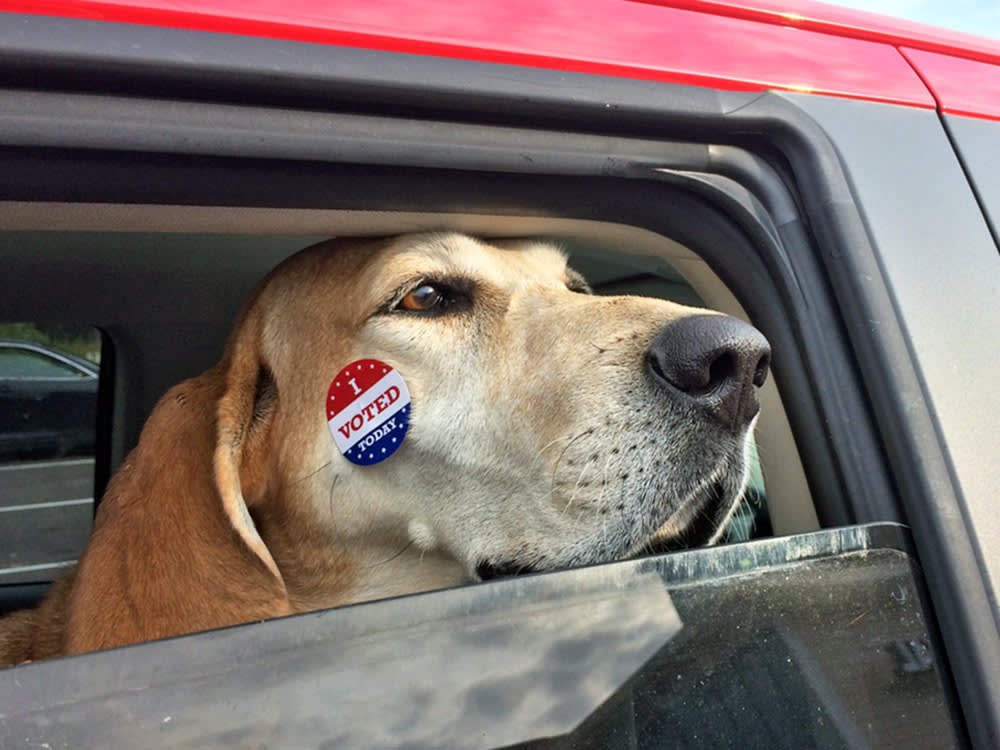
There is a single, bright legal line running through the whole question of voting with your dog, and once you see it, everything else falls into place. On one side of that line are service dogs, who are allowed inside the polling place by federal law. On the other side is every other dog in America, who is not. So the real question is not “can I bring my dog to vote,” which invites a fuzzy maybe. It is “which side of the line is my dog on,” and for most of us the answer is the outside. This guide sorts you onto the right side, then spends most of its time on the part the permission-slip framing skips entirely: what to actually do with the dog who has to wait.
The line: only service dogs cross it
Under Title II of the Americans with Disabilities Act, a service dog is permitted to accompany its handler with a disability into any state or local government facility, and polling places are explicitly covered. That protection holds even at a site that normally posts a strict no-pets policy. If your dog is a trained service animal, you walk in together, and no poll worker can lawfully turn you away for having the dog with you.
Two boundaries on that rule are worth stating plainly, because they trip people up. First, the protection attaches to service animals specifically, the ones individually trained to perform tasks for a person with a disability. It does not extend to emotional support animals, however much they help you, and it does not extend to household pets. Second, being allowed in does not mean the dog gets a pass on behavior. If a service dog is out of control and the handler cannot regain control, or the dog is not housebroken, staff can ask that the dog be removed. The access right protects a working dog doing its job, not a disruption.
If your dog is a pet, the answer is the sidewalk, not the booth
Voter guidance across the country lands in the same place for household pets: leave them home, or leave them outside with a person. This is not a technicality invented to be annoying. Most polling places are borrowed rooms in schools, libraries, churches, and community centers, buildings that were never set up to have dogs threading through them. Add an Election Day crowd, a slow-moving line, and a flood of unfamiliar smells and sounds, and you have an environment almost engineered to stress a dog out. Bringing a pet inside is discouraged whether they are on a leash or zipped into a carrier bag.
None of this means your dog cannot come along for the trip. It means the dog’s place is outside the door, with a plan.
The outside plan, done right
Here is the part that actually matters, and the part a simple yes-or-no answer leaves you unprepared for. If your dog is coming to the polls, you need three things sorted before you leave the house.
A human, not a hitch. Bring a friend or family member whose entire job is to stay with the dog while you go in. Do not tie your dog to a post or railing and walk away, even for the ten minutes you think the line will take. Polling places are crowded and chaotic, an unattended dog is an easy dog to walk off with, and a leash tied to a fixed object is exactly where a spooked dog hurts themselves trying to bolt. And to say the obvious because it needs saying: do not ask a poll worker to hold your dog. They are slammed, it is not remotely their job, and it puts them in an impossible spot.
Supplies for a wait that runs long. Assume the line inside moves slowly, because sometimes it does. Your dog-sitter should have a portable bowl, water, and a few treats, and should post up well clear of the entrance so the dog is not underfoot for voters and election workers coming and going. Keep the dog leashed the entire time. Make sure they are wearing a collar tag with current contact information; do this even if your dog is microchipped, because a stranger who finds a loose dog will look for a tag long before anyone thinks to scan for a chip.
A watcher who reads body language. Even a dog who is usually a social butterfly can come undone in a dense, loud, unpredictable crowd, and it is on the handler to catch that early. Tell whoever is watching the dog to look for a stiff or lowered posture, heavy lip-licking or panting that is not about heat, wide “whale eye” with the whites showing, trembling, jumpiness, growling, or snapping. Any of those is the signal to take the dog home before a merely stressful outing becomes a bad memory that makes the next crowd harder. You lose nothing by ending early. You can carry an “I Voted” sticker back to the dog and call it a win.
Should the dog come at all? A gut check first
Before any of the logistics, ask the honest question: is this trip good for the dog, or just fun for you? Plenty of dogs genuinely enjoy an errand and a change of scene. Plenty of others would rather be asleep on the couch than parked on a strange sidewalk while their person disappears into a building full of strangers. If your dog is anxious around crowds, reactive on leash, or simply happier at home, the kindest and simplest choice is to vote solo and come back to a relaxed dog. The best plan is sometimes no plan at all.
Why pets ended up on the 2024 ballot conversation
The 2024 general election turned pets into an unlikely political storyline, at least as a talking point. According to AP VoteCast, a survey of more than 120,000 voters, dog owners and cat owners split noticeably at the ballot box: dog owners favored Donald Trump, with roughly 55 percent backing him, while cat owners leaned the other way, with about 54 percent supporting Kamala Harris. Because dog owners made up a much larger share of the electorate than cat-only households, they carried more weight as a bloc, which is a big part of why the split drew so much post-election coverage. In a few cities, organizers leaned into the theme directly, staging events that brought adoptable shelter dogs near voting areas to ease Election Day nerves and nudge adoptions.
The talking points changed. The rules did not. Service dogs remain protected inside the polling place under the ADA, and every other dog is still best left at home or waiting outside with a person. If you want your dog there in spirit for the next election, that sticker on the fridge is still the safest way to include them.
References
Nina Vasquez writes about life at home with pets and the relationships at the heart of it. Her work covers day-to-day living, people-and-pet stories, and the products that fit into a real household, with a warm, grounded take on everyday pet ownership.
Meet our experts ↗Keep reading
 LivingThe Bigger Dog Always Loses in CourtDr. Mara Chen · 9 min
 LivingSome States Once Banned Black Families From Owning Dogs. A Yale Scholar on Why That Still Echoes.Leila Torres · 6 min
 LivingHe Kicked a Working Beagle Off the Ground. The Beagle Went Back to Work.Marcus Webb · 4 min
 LivingBreed Bans Don't Reduce Bites. They Just Break Up FamiliesLeila Torres · 6 min
 LivingShe Couldn't Eat for Two Years. Now She Bakes for Dogs Across the CountryLeila Torres · 5 min
 LivingA Service Dog Doesn't 'Cure' PTSD. What It Actually Does Is Now Backed by Real Data.Dr. Amara Solis · 6 min