


He Flies Infrared Drones Into Disaster Zones to Find the Animals Left Behind
Ryan Okrant packed 85 pounds of thermal-drone equipment and headed for a wildfire. Two years later he was pulling kittens out of a war zone. Inside ASSERT, the drone-powered animal rescue he built from scratch.

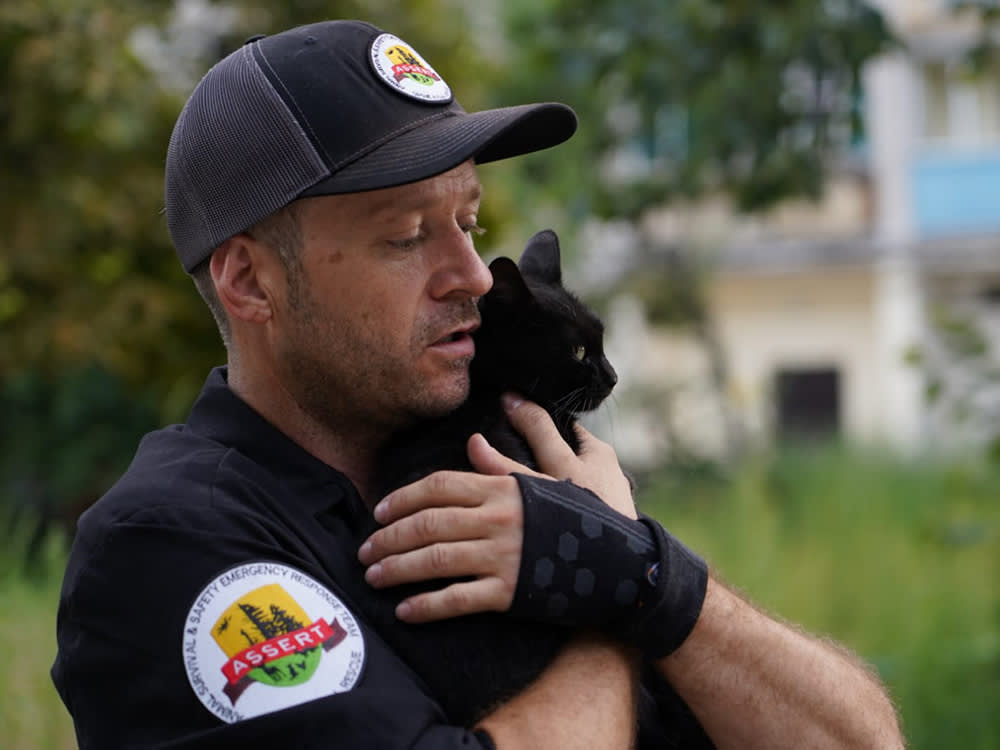
Most people, watching a wildfire close in on their hometown from two thousand miles away, feel helpless. Ryan Okrant packed 85 pounds of gear and got on a plane.
Okrant is the co-founder and executive director of the Animal Survival and Safety Emergency Response Team, or ASSERT, a rescue organization with an unusual specialty: it uses infrared drones to locate animals stranded by disasters, from wildfires to tornadoes to war. He was raised in a cabin outside Boulder Creek, a small mountain town in California, and by his own telling he came out of childhood with a bottomless love for animals. Today he is dad to three cats, one of whom he pulled out of a disaster himself.
The fire that started it
In August 2020, the CZU wildfires tore through the hills near his hometown. Okrant was living in Florida at the time, working for a company in the cannabis-tools business, and he could not sit still for it. He flew back to Northern California, secured a media pass to get past the closures, and quickly found the thing he could actually do: search for and care for animals stranded by the sudden evacuations.
For the next seventeen days he was out in the Santa Cruz Mountains every day, trapping cats, hunting for lost dogs, and helping with livestock. Between the animals he pulled to safety and the way neighbors rallied around him with donations and help, he understood he had stumbled into his calling. In under two years, that seventeen-day scramble became a 501(c)(3) nonprofit.
Turning instinct into an organization
The nonprofit grew out of logistics, not sentiment. While he was helping during the CZU fires, donations of animal food and cash kept arriving so he could buy more supplies, and he saw an obvious gap: the disaster-animal-rescue world badly needed some business sense. With a background in business management and economics, he figured he was as good a candidate as any to supply it. He filed the paperwork and built ASSERT into a real entity, one that came to include around 20 active volunteers scattered across the world, working different pieces of the operation.
His ambition, stated plainly, is enormous: he wants ASSERT to become something like a Red Cross for animals. The evidence that it might get there is in the range of what it has already handled. After tornadoes flattened parts of Kentucky, an ASSERT team rescued 41 animals in a three-week stretch and reunited more than a dozen with their owners. One of the cats Okrant did not reunite, because no owner could be found, he kept and named Kentucky Storm.
Ask him what keeps him doing it and the answer is the reunions. When a family has lost everything and their terrified animal has been out on the streets for days, the moment they reconnect is, in his words, worth the whole effort.
Where the drones come in
The technology that defines ASSERT arrived through a partnership. Okrant’s co-founder, Douglas Thron, is a cinematographer who had been flying a drone for a film shoot and who knew a man using handheld infrared scopes to find cats in Northern California after fires. Thron had the idea to mount the infrared scope onto the drone itself. He and Okrant networked online for roughly two years before ever meeting face to face, which they finally did in Kentucky, and their combined approach is what powered those 41 rescues in three weeks. An infrared drone can spot a frightened animal’s heat signature in rubble or brush that a human on foot would walk right past.
Okrant has also trained widely to handle what the drone finds. He has worked under a native-animal-rescue permit to handle wildlife, from raccoons and skunks to jackrabbits and pygmy owls, learning from experienced handlers who deal with genuinely difficult animals like rattlesnakes and bobcats. Cats, he admits, remain the hardest domestic animals to rescue, though a lifetime of living with them has taught him to read when a cat is calm enough to be handled and when it is too frightened.
The war zone
The most dangerous mission, by a wide margin, was Ukraine. Simply getting two drones into the country was a logistical ordeal. Before arriving, Okrant networked through Facebook groups until he reached a source who connected ASSERT with Ukrainian armed-forces security guards, who vetted the organization and got approval from their commander to escort the team through checkpoints and curfews. That protection, he says, was the only reason the work was possible.
The reality on the ground was war. Within an hour of arriving the team heard its first missile-warning siren, sending everyone into the subways, and they would hear those sirens multiple times a day. Outside Kyiv, past the relative safety of the city, they saw what tanks and airstrikes had done, damage he describes as a hurricane and a fire combined. They worked in ballistic helmets and vests.
One rescue captures the whole enterprise. The drone picked out a grown cat stranded on a building’s eighth floor. Okrant set a live trap and had her within twenty minutes; Thron then spotted and grabbed one of her kittens. Suspecting more, and forbidden from rescuing during curfew, they lashed infrared trail cameras to a chair and left them running overnight, and by morning the footage had revealed three additional kittens. Okrant baited a drop trap and sat in near-total darkness fifteen meters away until, after fifteen silent minutes, the kittens crept out one by one.
The story behind that cat is the kind of thing that stays with a person. The team confirmed her identity through the sister of the family who had owned her. All three family members had died in the bombing; the father had been a well-respected man, and there was a photo he had posted of the cat months earlier, calling her his love. ASSERT made sure she reached a safe home.
The scale of it
By the time Okrant spoke about the work, ASSERT had established a temporary shelter in a three-bedroom Kyiv apartment holding around 57 cats, tended by six volunteers, with most already seen by a vet. The plan was to prepare a van in Munich, drive it to Kyiv, and transport roughly 30 documented cats out of Ukraine and eventually to a partner rescue near Boston. Through local partners, the team had also learned of a rescue sheltering some 5,000 dogs and intended to assess how it could help move them, too.
Ukraine had banned civilian drone flights during the war, so the infrared drone, ASSERT’s signature tool, sat idle there. But Okrant was already eyeing a separate drone project with the Dominican Republic’s government to find dogs stranded in its dumping grounds, and he expected ASSERT to keep working in and around Ukraine for years, cycling animals to veterinary care and out to adoption, while building a sanctuary base in Central Europe to support future European disasters. Back home, the group had bought a 40-foot disaster-response vehicle to reach major U.S. disasters and stay on site for extended stretches.
Why it matters
Strip away the drones and the war-zone drama and ASSERT is built on a simple, stubborn premise: when catastrophe scatters people, it scatters their animals too, and someone has to go looking for the ones left behind. Okrant tells the story of a small gray cat in Ukraine who walked right up to him wanting to be rescued, whom the team photographed and posted until they located her owner, a woman four or five hours away who had fled a strike and could not bring her cat. A volunteer took the cat by train to the reunion. Weeks later, the good news got better: the cat, pregnant when she was found, had just given birth to four kittens.
That is the whole job, told in one cat. Find the animal nobody else can reach. Get it home. Repeat.
References
James Okafor covers rescue, adoption, and the causes shaping animal welfare. His work follows the people and organisations working to give more pets a home, and the issues owners and advocates care about most.
Meet our experts ↗Keep reading
 LivingOne Fake Email Nearly Shut Down This Animal ShelterMarcus Webb · 5 min
 LivingPeople Don't Surrender Pets Because They Stopped Loving ThemLeila Torres · 8 min
 LivingThe Unlikely Shelter Marketing That Works: Kids With PaintbrushesLeila Torres · 5 min
 Living18 Pet Charities That Turn Your Giving Tuesday Dollar Into a Real RescueJordan Ellis · 8 min
 LivingStarting an Animal Rescue Is Mostly Paperwork, Not Puppies. Read This Before You LeapLeila Torres · 8 min
 Living10 Free Ways to Help Animal Shelters, Ranked by What They Need MostNina Vasquez · 5 min