


The Most Feared Dog in America Is This Woman's Lifeline
People cross the street when they see Pirate the Pit Bull. What they cannot see is that he is a trained psychiatric service dog, and the reason Asha Leo can function at all.

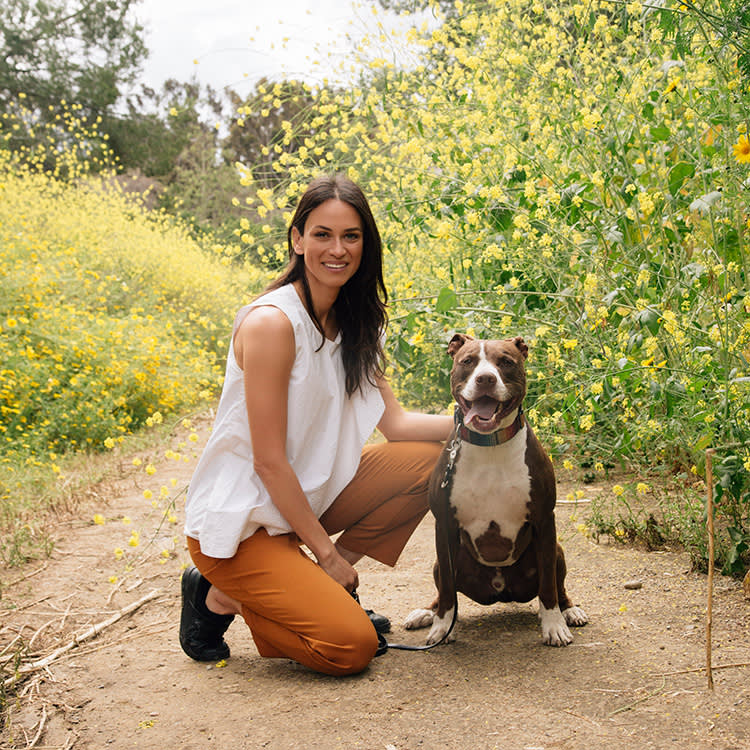
There is a particular kind of work Pirate does that nobody at the dog park can see. When Asha Leo’s nervous system tips into a flashback, when the trauma she has carried since childhood floods back through therapy and her body decides it is in danger, Pirate climbs onto her and lays his full weight across her chest. She tunes into the rhythm of his breathing and the press of his body until the room comes back. It is a clinical technique called deep-pressure therapy, and Pirate has been trained to deliver it on cue.
To almost everyone who passes them on the street, though, Pirate is something else entirely: a Pit Bull, and therefore, in the cultural shorthand, a threat. That gap, between the dog who is quietly keeping a woman functional and the dog strangers assume is dangerous, is the whole story of Asha Leo and Pirate. He is, by one common measure, the most feared dog in America. He is also her lifeline. Both things are true, and the distance between them is exactly what she has spent years trying to close.
How a “happy accident” became a service dog
Leo, who was born and raised in London and moved to the U.S. about 14 years ago, never set out to get a dog. She had never had one in her life. Newly arrived in an unfamiliar neighborhood and eager to meet people, she followed a trail of hand-lettered signs toward what looked like a street festival. The “festival” turned out to be an adoption drive.
“I saw Pirate, then seven months old and called Sam, in his crate, and I was like, ‘I need to go see that dog,’” she recalls. By the time she crossed the lot, a rescue worker had already clipped a leash on him and handed it over, asking her to walk him around the fair. Twelve minutes later, she says, she was in love. The responsible part of her took the rescue’s information and walked back to her car, planning to think it over for the weekend. Then she sat there and imagined calling on Monday only to learn he was gone. She got out of the car and went straight back for him.
Nearly five years on, they are inseparable, and Pirate has become her task-trained psychiatric service dog. That term matters, and it is worth slowing down on, because it is the part most people, even dog lovers, get wrong.
What a psychiatric service dog actually does
A psychiatric service dog is not an emotional support animal, and the difference is legal as well as practical. Under the Americans with Disabilities Act, a service dog is individually trained to perform specific tasks that mitigate a person’s disability, and that training is what grants the dog public-access rights. An emotional support animal provides comfort by its presence but is not trained to perform tasks and does not have the same access. Pirate is the former: he has a job, and he has been taught to do it.
Leo lives with post-traumatic stress disorder as a survivor of childhood sexual abuse. She is enrolled in EMDR (eye movement desensitization and reprocessing) therapy, which works by deliberately reopening trauma that the mind has locked away in order to function. The catch, she explains, is that the body does not keep good time. “Your amygdala, your nervous system, can’t really tell timelines; it just senses danger,” she says. Even though the trauma happened more than 30 years ago, accessing it in therapy can throw her body into fight-or-flight, panic attacks, nausea, nightmares.
Pirate’s trained tasks are aimed precisely at those moments. They include:
- Deep-pressure therapy: lying his full body weight across her to interrupt a panic response and ground her, the technique he performed after a recent EMDR session when, she says, “the only way to calm myself is to get Pirate to lay his entire body weight on top of me.”
- Medication retrieval: bringing her what she needs when she cannot get it herself.
- Grounding interruptions: breaking a dissociative or panic spiral by demanding her attention and redirecting her into the present.
“He doesn’t know why he’s doing it,” she says, “but he does it because there’s love between us.” The result is not a comfort blanket. It is functional support that lets her move through the world. “I can’t function without him,” she says, “particularly at moments when I’m really going through some of this trauma work.”
The agility champion who shames the purebreds
The same dog who does that delicate work is also, improbably, a decorated athlete. Pirate is a highly accomplished agility competitor, and Leo has watched the same scene play out at trial after trial. “We turn up, and it’s like being in high school again,” she says. “People whisper behind our backs, and take a wide berth of us.” Then Pirate runs the course, flawlessly, beating, in her words, “third-generation champion lineage, $4,000 pedigree dogs.” By day two, the whispering flips. “People will line the course and cheer his name,” she says. “When we come out, people want to pet him, want to congratulate him.”
That arc, suspicion to admiration over the span of a single competition, is the advocacy in miniature. To get there, Leo trained with Los Angeles Responsible Pit Bull Owners (LARPBO), where she learned a lesson that reframed everything: “It’s not about training the dog; it’s about training me. My dog is a reaction to me and my energy.” Through that work she discovered the world of American Kennel Club certifications, including the Canine Good Citizen credential, considered the gold standard for canine behavior. She and Pirate also compete in Fast CAT, Barn Hunt, scent work, and trailing, partly for the bond, partly as a public demonstration of the athleticism, intelligence, and trainability of Pit Bull-type dogs.
Why the “dangerous breed” reputation is built on bad data
Here is where Pirate’s two lives collide, and where the case for him goes from heartwarming to factual. The fear that follows him is not supported by reliable statistics, and Leo is precise about why.
Start with what “Pit Bull” even means. It is not a breed; it is an umbrella term that gets stretched over the American Pit Bull Terrier, the Staffordshire Bull Terrier, the American Staffordshire Terrier, the American Bully, and a great many mixed-breed dogs that simply look the part. Pirate is mostly American Pit Bull Terrier, so the label fits him, but the category is so loose that it pulls in dogs of wildly different ancestry.
That looseness poisons the bite statistics people cite. Bite reports rest on a witness’s guess about breed, and visual breed identification is notoriously unreliable, even among shelter staff and veterinarians, studies have found, who frequently misidentify a dog’s actual genetic makeup. A bite by a blocky-headed mixed-breed dog gets logged as a “Pit Bull bite,” while a bite by a clearly identifiable breed often gets logged by that breed’s name. As Leo puts it, “because of this miseducation of what a Pit Bull is, that bite report statistic is inflated, biased, and unreliable.” This is not special pleading; it is the consistent finding of researchers who have looked at how breed-attributed bite data is collected.
The consequences are not abstract. States, countries, landlords, and insurers ban these dogs. “To think that this dog has so much of a capacity to heal and help and love and yet people want to deny him of his life,” Leo says. “If he’d been found in a different state he would’ve been euthanized on the spot.”
The cost and the point of going public
Hundreds of thousands of people follow Pirate across Instagram and TikTok, where some videos reach millions. Leo is candid that the platform is “a love-hate relationship.” The community is real and sustaining, dog lovers, Pit Bull advocates, fellow trauma survivors. “Sometimes I’ll have 1,000 nice comments on a post,” she says, “and I’ll think about what it would be like to walk through a room and have 1,000 people say, ‘Well done. We love you.’”
And then a post escapes that community. One lighthearted video about being 41 and single drew more than 11 million views, and with them a flood of strangers telling her she would die alone, that she was empty, soulless, unlovable. “There are some days when I open my phone, and my entire feed of comments is just people telling me I’m worthless,” she says. She keeps posting anyway, because the upside is not vanity, it is reach. Someone told her they watched Pirate videos to laugh during their mother’s cancer treatment. Fellow survivors message to say her openness motivates them.
That same impulse drives her shelter volunteering, which she describes in terms that fold back into her own healing. Working with abused, abandoned dogs, she says, she is essentially telling them what she wishes someone had told her younger self: “You are safe, you are loved. It was not your fault.” She calls it being the person she needed when she was younger. “You feel like you’re healing a small part of yourself every time you go help a shelter dog.”
From a “me” to a “we”
Ask Leo to sum up what Pirate has done for her and she does not lead with the service tasks, impressive as they are. She leads with companionship. “What Pirate has added to my life is he’s taken me from being a ‘me’ to a ‘we,’” she says. Alone in the U.S. for holidays and birthdays, she now has a partner for all of it. She describes him tripping over his own back legs on a walk out of sheer joy, rolling and bouncing back up, and how that goofiness lands as pure happiness for her too.
The service work sits on top of that bond, not apart from it. “He’s definitely my person,” she says. “I think having an animal in your life is a gift; we’re really lucky to have them in our lives.” The dog the world meets with a wide berth is, to the one person who knows him, simply her hero, her family, and the reason she can do the hard work of getting better. The hope is modest and enormous at once: that more people might learn to see what she sees.
References
- Americans with Disabilities Act, U.S. Department of Justice, “Service Animals” guidance (definition and public-access rights of task-trained service dogs)
- EMDR Institute, “What Is EMDR?” (overview of eye movement desensitization and reprocessing therapy)
- Olson KR et al., “Inconsistent identification of pit bull-type dogs by shelter staff,” The Veterinary Journal, 2015 (reliability of visual breed identification)
- American Veterinary Medical Association, “Dog Bite Risk and Prevention: The Role of Breed” (limitations of breed-attributed bite data)
- American Kennel Club, “Canine Good Citizen (CGC) Program”
Leila Torres leads our Living coverage, from home life and travel to the products and rescue stories that come with sharing a life with animals. She edits and writes across the section, with a soft spot for pieces about the bond between people and their pets.
Meet our experts ↗Keep reading
 Training5 Reasons Your Dog Follows You Into the Bathroom (One Is Worth Watching)Dr. Nina Kohl · 6 min
 TrainingYour Perfectly Trained Dog Becomes a Stranger at Grandma's. Here's Why.Sasha Ford · 6 min
 LivingShe's Fostering 23 Dogs. Nobody Posts the Rest of It.Leila Torres · 6 min
 LivingA 'Soul Dog' Isn't Magic. It's Fluency, and You Can Build It.Jordan Ellis · 8 min
 LivingIs Your Dog Really Jealous, or Just Afraid of Missing Out? The Science Is Messier Than the Headlines.Dr. Nina Kohl · 5 min
 Training'Gentle Parenting' Your Dog Isn't Permissive. That's the Part People Get Wrong.Dr. Nina Kohl · 9 min