


Your Dog Lives in a Different World Than You. Here's the Science
Dogs smell first and see second, perceive time itself differently, and may carry a life story in their heads. A field guide to the sensory reality your dog actually inhabits.

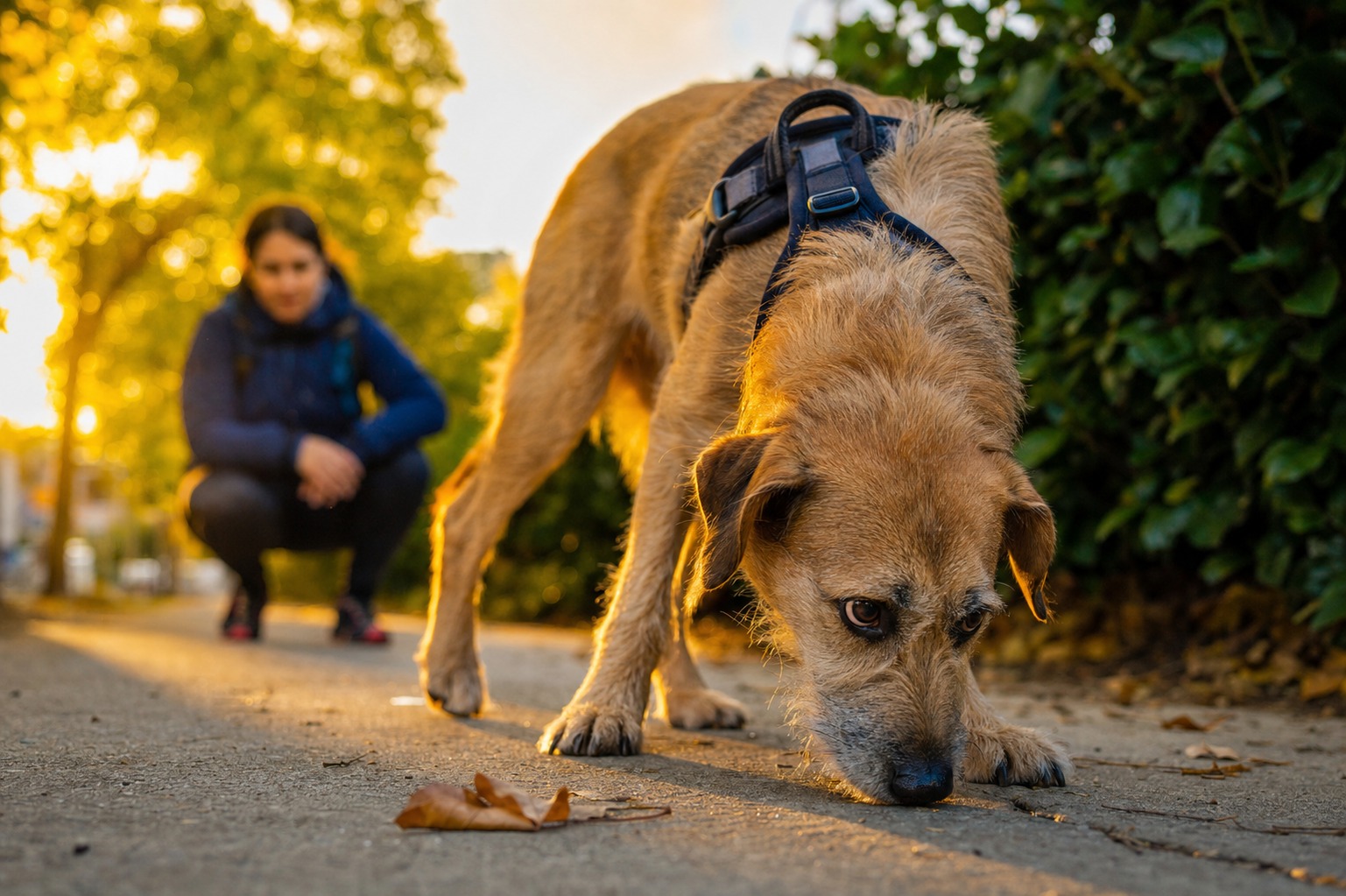
Here is a thought that should change how you walk your dog: you and your dog can stand on the exact same sidewalk and be in two completely different places. You are in a visual world, reading the scene with your eyes and using smell only as an afterthought. Your dog is in an olfactory world, reading the air the way you read a room, and using vision to fill in the gaps. Neither of you is getting the “real” version. You are each getting the version your equipment delivers.
That insight is the foundation of modern canine cognition research, much of it pioneered at Barnard College’s Dog Cognition Lab and popularized in books like Inside of a Dog and Being a Dog. Pull the science together and a picture emerges of an animal whose senses, sense of time, and even sense of self differ from ours in ways that explain a surprising amount of everyday dog behavior. Here is the field guide.
A dog smells the world before they see it
Start with the nose, because for a dog, the nose comes first. A human has roughly six million olfactory receptors. A dog has up to 300 million, and the portion of the brain devoted to analyzing smell is, proportionally, about 40 times larger than ours. This is not “a better version of human smell.” It is a different primary sense doing the job vision does for us.
That difference reorganizes the whole world. A visual scene is stable: a tree across the field just looks “more distant,” and it does not change when the wind shifts. A scent landscape is the opposite. Odors fade over distance, pool in still corners, and get carried “hither and thither,” in Horowitz’s phrase, by every current of air. So the world is genuinely mapped differently for an animal who reads it by nose. When your dog freezes mid-walk, nose working, ignoring you entirely, they are not being stubborn. They are reading something as vivid and informative to them as a billboard is to you.
The practical takeaway is the one most owners get backwards. A walk, to your dog, is not primarily exercise. It is information. Letting them stop and sniff, taking deliberate “smell walks” rather than route marches, is one of the most enriching things you can give a dog, and it tires them out more thoroughly than distance does.
What makes a great nose: drive, not just breed
It is tempting to assume some breeds simply smell better, full stop. The research complicates that. The strongest predictor of whether a dog excels at detection work turns out to be drive: the will to chase an odor, to keep working through frustration, to push toward the reward (often a game with a tug toy) at the end.
Breed is not irrelevant. Bloodhounds and Beagles do carry more olfactory cells and more odor-gathering hardware, the long ears and drooly jowls that waft scent upward, and may detect smells at lower concentrations. Some breeds are simply built to pursue an odor relentlessly. But the popular belief that certain breeds are automatically the best detection dogs has not held up under study. As researchers put it, it is tradition more than science. A driven mutt can outwork a “scent breed” that would rather nap.
(One folk belief that does find some support: female dogs are often said to be better smellers, an observation from working-dog trainers that has not been formally tested in dogs, but mirrors research showing women, on average, outperform men at smell identification.)
Why a working nose doesn’t “fill up”
Walk into a coffee shop and within minutes you stop smelling the coffee. That is olfactory adaptation, the receptors simply stop firing after steady exposure, and a dog’s nose works the same way. So how does a detection dog track a scent for an hour without going nose-blind?
By never sitting still on one smell. A working dog constantly samples different patches of the scent “scene,” so no single receptor population stays saturated, and tracking dogs will periodically lift the nose off the ground to sniff fresh air, essentially clearing the palate. What does fatigue a working dog is total exertion and overstimulation, not the nose itself, which is why good handlers read their dog and call breaks before the dog burns out.
Dogs see time differently than you do (which is why they hated old TVs)
Now the eyes, and a genuinely strange fact. Vision depends on light-sensitive cells that briefly go offline while their pigment resets, which sets a ceiling on how many distinct images per second an animal can perceive. That ceiling is the flicker-fusion rate. Humans sit around 60 images per second, which is why old film and television, a fast sequence of stills, looked like smooth motion to us.
Dogs run faster, with a critical flicker-fusion frequency measured at about 70 to 80 cycles per second. On an old-style screen, they could literally see the individual frames flickering and the dark gaps between them, which is a large part of why dogs historically ignored television. (Modern digital displays work differently, so a dog can perceive today’s TV as continuous, though it remains, as Horowitz dryly notes, “not very olfactorily interesting.”) The deeper point: your dog’s nervous system samples the visual world at a different rate than yours. They are, in a small but real way, living in slightly faster time.
Play is a language, and it has grammar
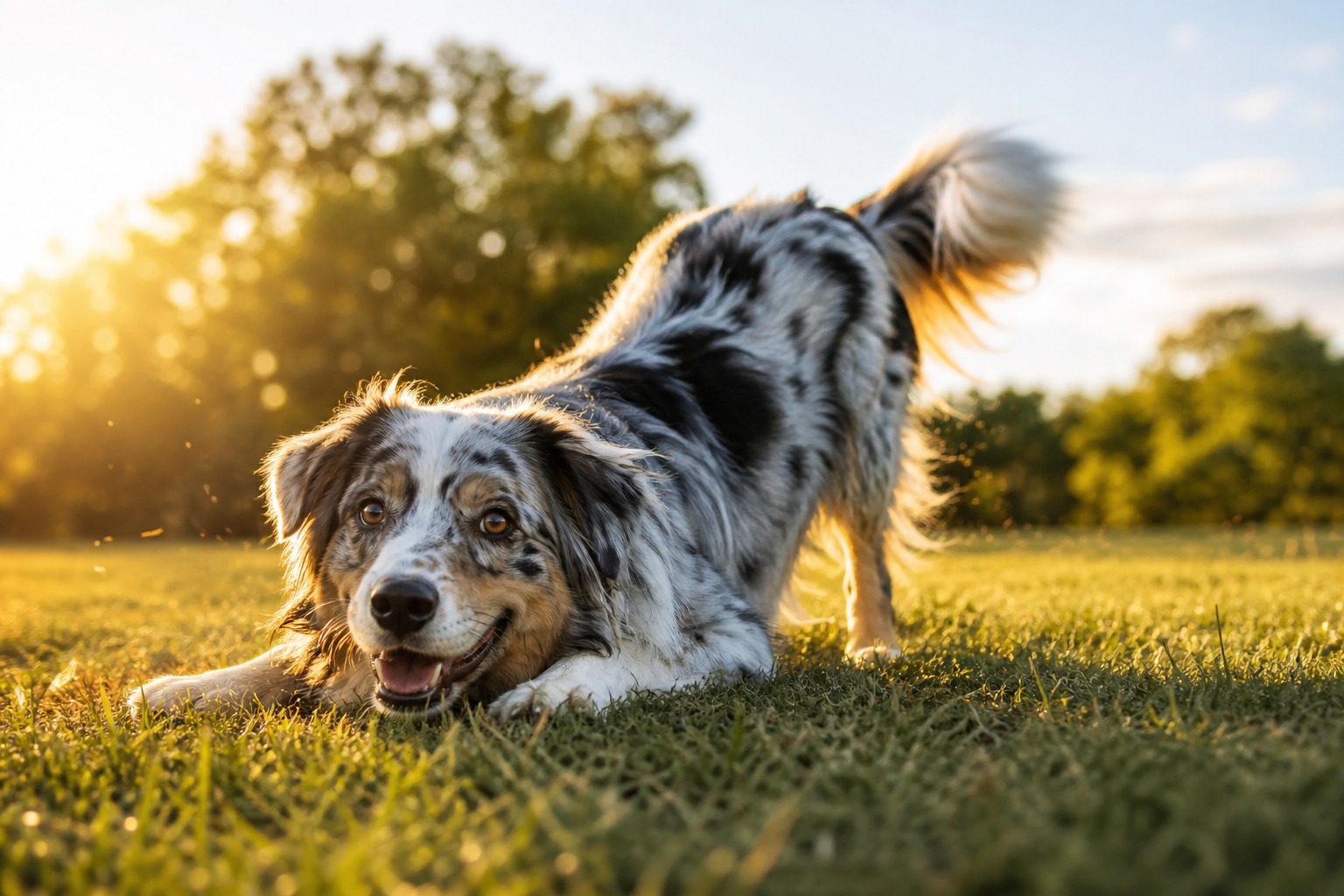
Watch two dogs play and you are watching sophisticated, fast, coordinated communication, not chaos. Most bouts open with a play signal, the classic “play bow” (front legs down, rump and tail up) or an “exaggerated approach,” a loose, bouncy lope toward a hoped-for partner. These are not decoration. They are explicit announcements that the biting, mounting, and body-slamming about to follow is play and not a fight.
Slow-motion analysis revealed something even more impressive: dogs get a playmate’s attention before signaling, and they calibrate how forcefully based on the situation, a strong attention-getter for a distracted dog, a gentle one for a dog already paying attention. That is social intelligence: reading another’s state and adjusting your approach, the canine version of knowing whether to tap a shoulder or shout across a room. Close playmates even develop shorthand, a quick “play slap” (just the front-leg dip, sometimes with an audible slap) standing in for the full bow, or a brief open-mouth “grin” doing the work of a longer display. Learn the full signals and you start to see the abbreviations everywhere.
The “guilty look” is not guilt
This one rewrites a daily misunderstanding. Owners are certain their dog “looks guilty” after misbehaving, ears pinned, tail tucked, slinking away, avoiding eye contact. A controlled study of that exact look found the opposite of what people assume: dogs showed the guilty look most not when they had actually done something wrong, but when they were scolded or confronted by a suspicious owner, even when they had done nothing.
In other words, the “guilty look” is a response to your body language, an appeasement display meant to head off punishment, not a confession. Dogs do learn that certain actions reliably provoke anger, so they treat those actions as “off-limits,” but that is learned consequence, not moral guilt. The takeaway for training: punishing a dog after the fact does not teach remorse, it just teaches them to brace when you come home looking annoyed.
Boredom, and how to fix it
Bored dogs look a lot like bored humans: low energy, poor focus, too much sleep, sometimes pacing (the same restless loop you see in an under-stimulated zoo animal) or repetitive self-directed behavior like obsessive licking or chewing. And the classic clue, the disemboweled couch cushion and shredded socks waiting when you get home, is very often a bored dog who found a job for themselves.
The fix is occupation, not punishment. Active play, social time with other dogs, and food puzzles or hidden treats to hunt while you are out all give a dog something to do with a mind that is built to work. A dog with a job rarely needs to invent one out of your throw pillows.
Does your dog have a life story?
The biggest question is whether dogs think about themselves, whether they carry a sense of their own autobiography. It is genuinely hard to test. But a great deal of ordinary dog behavior, remembering where a bone was buried last summer, recognizing the dog who was hostile at the last meeting, knowing a shortcut home, suggests dogs are, in some functional way, drawing on a personal history. They behave as if their memories are episodes in the story of their life, not just trained reflexes.
You do not need a lab to honor any of this. The single best thing you can do, the researchers’ own recommendation, is to let your dog smell. Let them smell you (to a dog, you essentially are your scent), let them smell other dogs (that is how they learn who is who), and let them smell the world on a walk taken for sniffing, not just for exercise or a quick bathroom stop. Watching a dog work a trail, nose down then up, steered by nothing but invisible filaments of odor drifting past, is a window into a world you will never directly experience. Giving them the time to live in it is one of the kindest things an owner can do.
“Once you accept that your dog is having a fundamentally different sensory experience than you are, a lot of so-called misbehavior stops looking like defiance,” says Dr. Nina Kohl. “The dog frozen at a hydrant isn’t ignoring you. They’re reading. Our job is to make room for that, not to drag them past it.”
References
- Alexandra Horowitz, Inside of a Dog: What Dogs See, Smell, and Know (Scribner, 2009)
- Horowitz A. “Disambiguating the ‘guilty look’: Salient prompts to a familiar dog behaviour.” Behavioural Processes, 2009
- Coile DC, Pollitz CH, Smith JC. “Behavioral determination of critical flicker fusion in dogs.” Physiology & Behavior, 1989
- Dogs’ Dazzling Sense of Smell, NOVA / PBS
- Barnard College Dog Cognition Lab
Marcus Webb writes about the gear, gadgets, and everyday choices that make life with a pet easier. His coverage runs from product picks to training and the causes worth paying attention to, always with an eye on what actually earns a place in your home.
Meet our experts ↗Keep reading
 TrainingThe Play Bow Is Your Dog Saying 'I'm Only Joking'Dr. Priya Nair · 6 min
 TrainingStop Telling Yourself Your Dog Was AbusedDr. Nina Kohl · 8 min
 LivingWe Docked Their Tails for Looks. Other Dogs Literally Can't Read Them Anymore.Dr. Nina Kohl · 8 min
 TrainingThat Study Said Dogs Ignore Your Bad Advice. Newer Research Says the Opposite.Dr. Ravi Mehta · 6 min
 TrainingYour Dog Doesn't Hate Intact Dogs. He Hates Being Surprised.Dr. Lena Park · 6 min
 TrainingHow to Say Sorry to Your Dog (Put the Tearful Hug Away)Dr. Amara Solis · 6 min