


Does Acupuncture Actually Work for Dogs? What the Evidence Says
Skip the debate about Qi. Here is what controlled studies show acupuncture can and cannot do for dogs, which conditions respond best, and how to find a vet who is properly trained to do it.

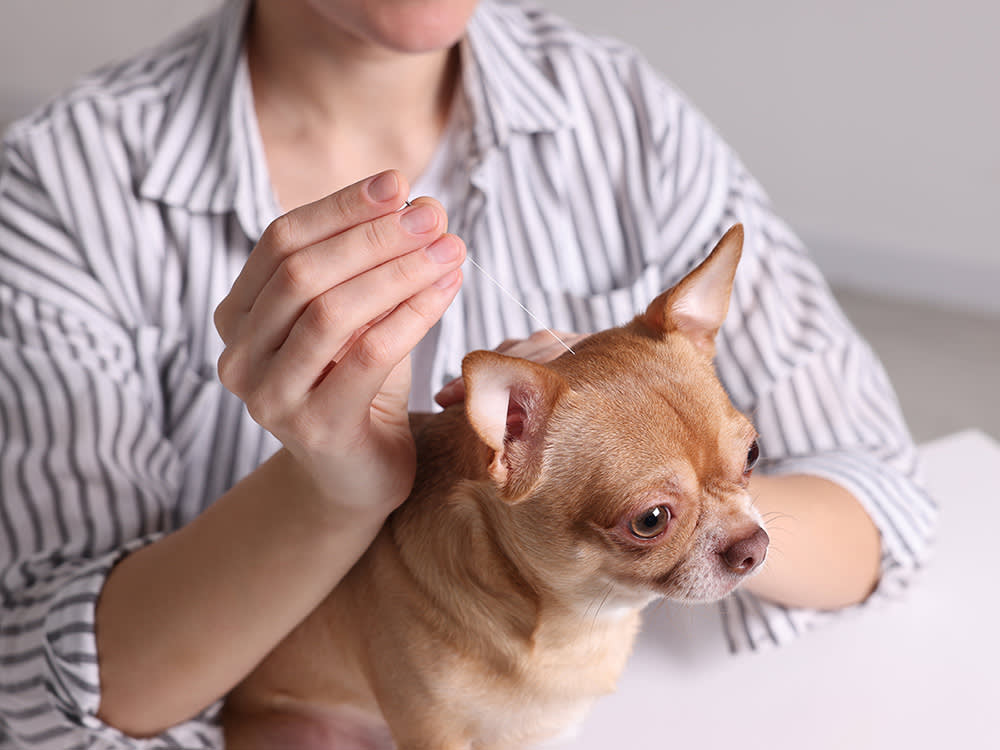
There is a version of the acupuncture conversation that gets stuck on whether Qi is real, whether meridians exist, and whether the whole thing is ancient wisdom or elaborate placebo. That debate is interesting, but it is not the question a dog owner actually needs answered. The useful questions are narrower and more practical: does it measurably help, what does it help with, and is my dog a good candidate? Those have real answers.
So let us start there, with the evidence, and work outward to whether it makes sense for your dog.
What the research actually shows
Acupuncture for dogs is no longer fringe. It has moved into the toolkit of mainstream veterinary practice, particularly in pain management, surgery, oncology, and the care of aging patients, and that shift is grounded in more than tradition.
The strongest case is for chronic pain, especially osteoarthritis. In a placebo-controlled, blinded clinical trial, client-owned dogs with naturally occurring arthritis received either real acupuncture or a sham version weekly for several weeks, and the dogs getting genuine treatment showed measurable improvements in lameness and function on objective measures, not just owner impressions. More recent controlled work on laser acupuncture has pointed in the same direction, with reductions in pain scores alongside changes in inflammatory and oxidative-stress markers. That is the kind of evidence that earns a therapy a place in current pain-management thinking as an adjunct to conventional drugs.
The mechanism is less mysterious than the folklore suggests. Stimulating an acupoint prompts the local release of natural chemicals, including beta-endorphins, serotonin, and other neurotransmitters, which modulate pain signaling and can produce a broad sense of calm. You do not have to accept any particular philosophy to accept that needling specific points triggers a measurable neurochemical response.
Where the evidence is thinner, it is fair to say so. Claims that acupuncture treats cancer, organ disease, or chronic systemic conditions outright are not well supported, and you should be skeptical of anyone who promises that. The honest framing is this: acupuncture is a credible, low-risk complement to conventional medicine for specific problems, mostly pain related, and a poor substitute for it everywhere else.
Is your dog a good candidate?
Rather than asking whether acupuncture “works” in the abstract, it is more useful to ask whether your dog’s specific situation is one it tends to help. The conditions with the best track record share a theme: pain, inflammation, and nerve involvement.
- Musculoskeletal pain. Arthritis, degenerative joint disease, muscle soreness, and back pain are the bread and butter of veterinary acupuncture, and the area with the most supporting evidence.
- Intervertebral disc disease and neurological problems. Acupuncture is often used alongside conventional treatment for herniated discs, limb weakness, and certain seizure cases, frequently as part of a broader rehabilitation plan.
- Post-surgical pain and inflammation. Surgery is an acute trauma, and acupuncture can help manage the pain and inflammation that follow, sometimes reducing how much medication a dog needs.
- Gastrointestinal upset. Some dogs with chronic diarrhea, vomiting, or constipation see benefit, though the evidence here is more modest.
- Chemotherapy support and comfort care. In oncology and end-of-life settings, it is used to ease nausea, appetite loss, and discomfort rather than to treat disease, and many owners find it a meaningful part of keeping an aging or ill dog comfortable.
A good candidate is a dog with a chronic, pain-driven, or comfort-focused issue whose owner sees acupuncture as one part of a plan that still includes their regular vet. A poor candidate is a dog whose owner hopes it will replace a needed surgery, medication, or diagnosis.
What a session is actually like
Do not let the look of it rattle you. Acupuncture needles are sterile, single-use, and very fine, nothing like the vaccination needles your puppy endured. For most dogs, placement is essentially painless. A dog may feel a mild sensation of pressure or tingling at the moment of insertion, particularly at sensitive points, but once the needles are in there is no pain. Many dogs settle, and a fair number fall asleep mid-session, which practitioners take as a good sign.
A typical treatment lasts 20 to 60 minutes, with the practitioner placing roughly 10 to 20 needles depending on what is being addressed. The dog usually rests on a mat or in their owner’s lap, and the calmer the environment, the better most dogs do.
How many treatments, and what it costs
The honest answer to “how many sessions” is that it depends on the nature, severity, and duration of the problem. A sudden, acute issue might respond after one or two treatments. A chronic condition like arthritis usually needs three to six sessions before you can fairly judge whether it is helping, and degenerative conditions often settle into a maintenance rhythm of treatments every few weeks to a few months.
On cost, individual sessions generally run from around $60 on the low end to as much as $300, depending on your region, the clinic, the complexity of the case, and session length. Packages of multiple sessions are common and sometimes cheaper per visit. Many pet insurance plans now cover acupuncture when it is performed by a licensed veterinarian, so it is worth checking your policy before you start, since that can meaningfully change the math on a long course.
How to find someone genuinely qualified
This is the part the glossy explainers tend to skip, and it matters more than any other detail here. Acupuncture involves placing needles near nerves, joints, blood vessels, and organs, so it should only be done by someone with full veterinary medical training.
Look for a licensed veterinarian who holds additional certification in veterinary acupuncture, often shown as a CVA (Certified Veterinary Acupuncturist) credential from a recognized training program such as the Chi University or the International Veterinary Acupuncture Society. A human acupuncturist, however skilled, is not trained in canine anatomy or veterinary medicine, and an uncertified “animal acupuncturist” is a real risk. A properly trained vet will also do something important: take a full history, coordinate with your dog’s primary vet, and tell you honestly whether your dog is likely to benefit, rather than promising results.
A note on Chinese herbs
Herbal therapy often comes packaged with acupuncture in traditional Chinese veterinary medicine. Some herbal preparations may be used safely alongside conventional medications, but this is an area to approach with more caution than the needles. Herbal products are far less regulated than pharmaceuticals, quality and potency vary, and some can interact with prescription drugs or affect organ function. If your practitioner recommends herbs, make sure your dog’s regular vet knows exactly what they are taking, and treat any supplement as a real medication rather than a harmless add-on.
The takeaway
Acupuncture earns its place in modern veterinary care for the right dog and the right problem, with the clearest evidence in chronic pain and arthritis. Approached as a complement to conventional medicine, delivered by a certified veterinarian, and judged after a fair trial of several sessions, it is a low-risk option that can genuinely improve quality of life. Approached as a cure-all or a substitute for needed care, it disappoints. Knowing the difference is what makes it worth trying.
References
- Kapatkin, A.S., et al. “Evaluation of acupuncture for the treatment of pain associated with naturally-occurring osteoarthritis in dogs: a prospective, randomized, placebo-controlled, blinded clinical trial.” PeerJ, vol. 8, 2020, e10131.
- “Laser Acupuncture Effects on Chronic Pain, Inflammatory Response, and Biochemical and Oxidative Stress Markers in Osteoarthritic Dogs: A Randomized Controlled Trial.” Animals, vol. 15, no. 17, 2025, 2568.
- Gruen, Margaret E., et al. “2022 AAHA Pain Management Guidelines for Dogs and Cats.” Journal of the American Animal Hospital Association, vol. 58, no. 2, 2022, pp. 55-76.
- American Academy of Veterinary Acupuncture. “Find a Practitioner / Certification.” aava.org.
Common questions
Does acupuncture hurt dogs?
For most dogs, placing the needles is essentially painless. The needles are sterile, single-use, and far finer than a vaccination needle. Many dogs relax during a session and some fall asleep. A few may feel the initial insertion at sensitive points, but there is no ongoing pain once the needles are in.
How many acupuncture sessions will my dog need?
It depends on the condition. A sudden, acute problem might respond in one or two sessions, while chronic issues like arthritis typically need three to six sessions before you can judge whether it is helping, often followed by maintenance treatments every few weeks to months. Each session runs about 20 to 60 minutes.
Who is qualified to perform acupuncture on a dog?
Look for a licensed veterinarian with additional certification in veterinary acupuncture, such as a CVA credential from a recognized program. Acupuncture involves placing needles near nerves, joints, and organs, so it should be done by someone with full veterinary medical training, not a human acupuncturist or an uncertified practitioner.
Not a substitute for your vet. Our guidance is educational. For urgent symptoms, contact a vet or emergency clinic right away. Editorial standards
Dr. Mehta is a board-certified veterinary nutritionist who evaluates pet food formulations, ingredient quality, and the science behind dietary trends. He writes and reviews all nutrition content at The Pet Times, including our food rankings and feeding guides.
Meet our experts ↗Keep reading
 Health & WellnessCatnip Won't Mellow Your Dog. What It Actually Does Is StrangerDr. Lena Park · 8 min
 Health & WellnessSound Baths for Dogs Sound Like Woo. The Research Isn't.Dr. Lena Park · 6 min
 Health & WellnessThe CBD-for-Seizures Pitch Is Way Ahead of the ScienceDr. Ravi Mehta · 7 min
 Health & WellnessCBD Oil and Canine Cancer: What the Research Actually ShowsDr. Ravi Mehta · 7 min
 Health & WellnessYour Senior Dog Isn't 'Just Slowing Down.' They're in Pain.Dr. Ravi Mehta · 7 min
 LivingYour Dog Would Rather Sniff Than Almost Anything. Give Them Something Worth Smelling.Dr. Priya Nair · 6 min