


17 Surprising Dog Facts That All Come Back to One Thing: The Nose
Dogs can smell the passage of time, sniff 200 times a minute, and carry a nose print as unique as your fingerprint. The strangest dog facts almost all trace back to that nose.

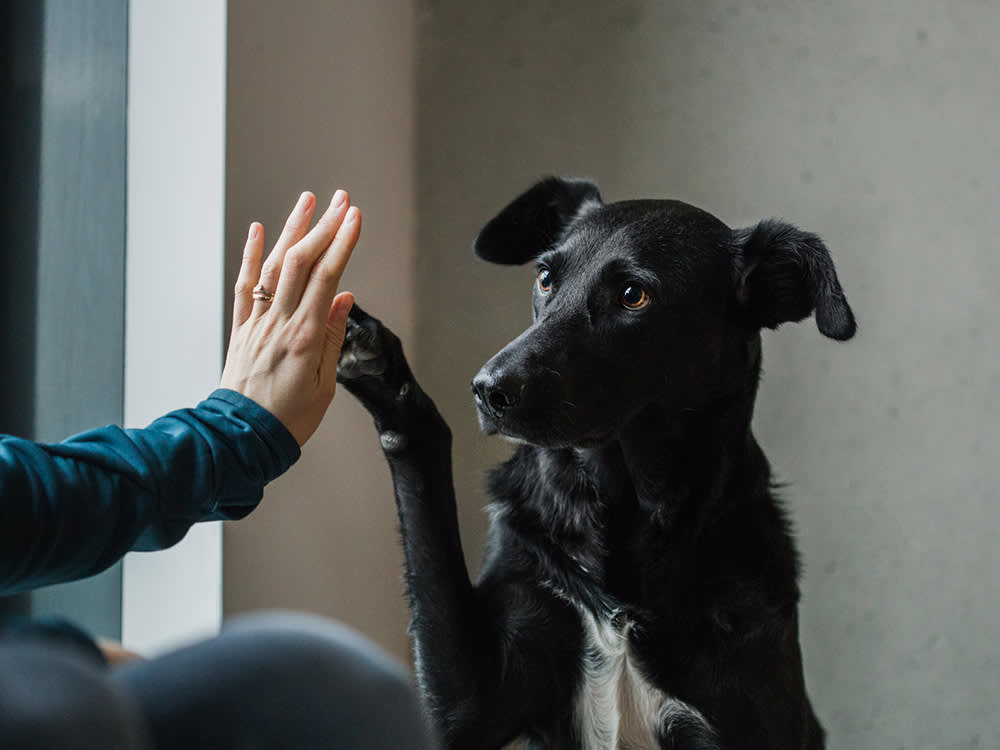
Pull on almost any surprising fact about dogs and you’ll find the same thread at the other end: the nose. A dog’s nose isn’t just a better version of ours. It’s the organ that shapes how they greet each other, choose a partner, navigate the world, and, no exaggeration, perceive time itself. So we’ve organized these the way a dog probably would, starting with the superpower that drives most of the others, then fanning out to the wonderfully weird rest. Seventeen facts in all, and a good half of them are really just the nose in disguise.
The nose, first, because everything else follows from it
1. Their sense of smell genuinely dwarfs ours. Dogs have somewhere between 125 and 300 million olfactory receptor cells, against our roughly 5 million, and dedicate about a third of their brain to interpreting odor. Frank Rosell, the scientist behind Secrets of the Snout, estimates a dog’s nose is between 100,000 and 100 million times more sensitive than a human’s. That’s not a sharper version of our sense of smell. It’s closer to a different sense entirely.
2. They sniff at an astonishing rate. A calmly resting dog breathes about 15 times a minute, roughly like us. On a walk that climbs to around 31. But when a dog is actively sniffing, the inhale-exhale rate rockets to between 140 and 200 times a minute, a separate, dedicated airflow system that routes air over the scent receptors without interrupting normal breathing.
3. They can smell the passage of time. This is the one that stops people. According to cognitive scientist Alexandra Horowitz, dogs read a room as a layered timeline of odor: fresh, strong smells sit on top, older, fainter ones underneath. A dog can effectively smell that you left two hours ago and are due home soon, because your scent has been decaying on a schedule they can read. Time, to a dog, partly has a smell.
4. Every nose print is unique, like a fingerprint. The pattern of ridges and beads on a dog’s nose is individual to that dog and, per a 2021 study, well established by about two months of age and stable thereafter. The Canadian Kennel Club has actually accepted nose prints as proof of identity since 1938, and modern apps now scan them to reunite lost dogs with their owners, a biometric ID built right into the snout.
5. Females may be the keener sniffers. The experts behind K9 Scent Training observed that female dogs tend to out-sniff males, and Horowitz has noted that, in humans too, women are often the more sensitive smellers. The nose, it seems, isn’t distributed evenly.
How the nose shapes their social life
6. Greetings are a nose-led ritual, and they differ by sex. Female dogs tend to greet another dog by sniffing the snout and muzzle first; males head straight for the anogenital region. Watch closely and you can often guess a greeting dog’s sex from its opening move alone.
7. But most of their communication is silent. Dogs do “talk” when they bark or growl, yet their first language is body language, an upright or tucked tail, ears pricked or pinned, a loose or rigid posture. A wagging tail, famously, does not automatically mean a happy dog; the height and speed of the wag carry the real message.
8. A short petting session measurably calms a shelter dog. Researchers have confirmed that a quiet 15-minute session of being petted produces real, measurable shifts in a shelter dog’s behavior and physiology. Touch, like scent, is a channel we sometimes underuse.
9. Mounting is mostly a male thing, and usually isn’t about sex. Observations at dog parks found mounting was about 16 times more frequent in male-male pairs than female-female ones. It’s frequently a stress-and-overstimulation behavior rather than a sexual one, which is why it spikes in chaotic, exciting settings.
The body and the brain
10. Paw preference may hint at temperament. Dogs who show a clear paw preference, right-pawed ones especially, tend to be associated with lower arousal and calmer reactions to novelty and strangers. Your dog’s “handedness” is a small window into their nervous system.
11. Mutual gazing floods you both with oxytocin. When a dog gazes into your eyes and you hold the look, both of you show a marked rise in oxytocin, the bonding hormone, in a pattern strikingly like the one between a parent and infant. The bond is, quite literally, chemical.
12. They see the world in blue and yellow. Dogs are dichromats: two cone types instead of our three, which gives them color vision roughly like a person with red-green color blindness. They distinguish blues and yellows well but can’t really separate red from green. The upside is more rods, so they crush us at low-light vision and at catching movement, which is why a tossed yellow or blue toy reads far better to them than a red one lost in green grass.
13. Dogs are individuals before they’re a breed. Not every Retriever loves fetch, not every Pointer points. The landmark study Genetics and the Social Behavior of the Dog found temperament and talent often vary more between dogs of the same breed than between breeds, a finding modern genomics has only strengthened.
The genuinely strange ones
14. The size range is almost absurd. The tallest dog ever recorded was a Great Dane standing 44 inches at the shoulder; the shortest was a Chihuahua measuring 3.8 inches. Same species, a tenfold difference in height.
15. They can sense Earth’s magnetic field. When your dog seems to deliberate forever over the perfect spot to do their business, there may be physics involved: studies have found dogs prefer to align their bodies along the north-south magnetic axis when they go.
16. They’re fast, just not cat-fast. The Greyhound, the quickest of all dogs, tops out around 45 mph. Impressive, until you remember the cheetah hits 75 in short bursts. Dogs win the endurance race, though; cats are sprinters.
17. The “dog days of summer” come from a star. The phrase for the hot, sluggish stretch of late July and August comes from ancient Greek and Roman astronomers, who noticed it coincided with the dawn rising of Sirius, the Dog Star, the brightest star in the night sky.
References
- Horowitz, Alexandra. Being a Dog: Following the Dog Into a World of Smell. Scribner, 2016.
- Rosell, Frank. Secrets of the Snout: The Dog’s Incredible Nose. University of Chicago Press, 2018.
- Jia, Hong, et al. “Dog Nose-Print Recognition.” Study confirming individual uniqueness of canine nose prints, 2021.
- Scott, John Paul, and John L. Fuller. Genetics and the Social Behavior of the Dog. University of Chicago Press, 1965.
- Guinness World Records. “Tallest Dog Ever.”
James Okafor covers rescue, adoption, and the causes shaping animal welfare. His work follows the people and organisations working to give more pets a home, and the issues owners and advocates care about most.
Meet our experts ↗Keep reading
 LivingA Furniture Designer Got Fed Up With Ugly Dog Beds. So He Fixed ThemMarcus Webb · 6 min
 Health & WellnessThe Alzheimer's Drugs Did Nothing. Playtime Grew Their Brains.Dr. Ravi Mehta · 4 min
 LivingHow to Run an Easter Egg Hunt Your Dog Won't End Up at the Vet ForDr. Amara Solis · 5 min
 LivingYour Dog Won't Break the Bank With One Big Bill. It's the Slow Drip That Gets YouMarcus Webb · 8 min
 Health & WellnessBath Day Wrecks Your Back Because You're Doing It in the Wrong RoomLeila Torres · 6 min
 LivingAustin's Most Famous Dog Bar Just Closed. Here's What's Still Standing.Marcus Webb · 7 min