


Netflix Gave Queen Charlotte Her First Pomeranian. History Says She Brought Her Own.
The Bridgerton spin-off staged the Poms as a peace offering from a difficult husband. The real Charlotte arrived in England at 17 with two of them already in tow, and her descendants turned the breed into a British institution.
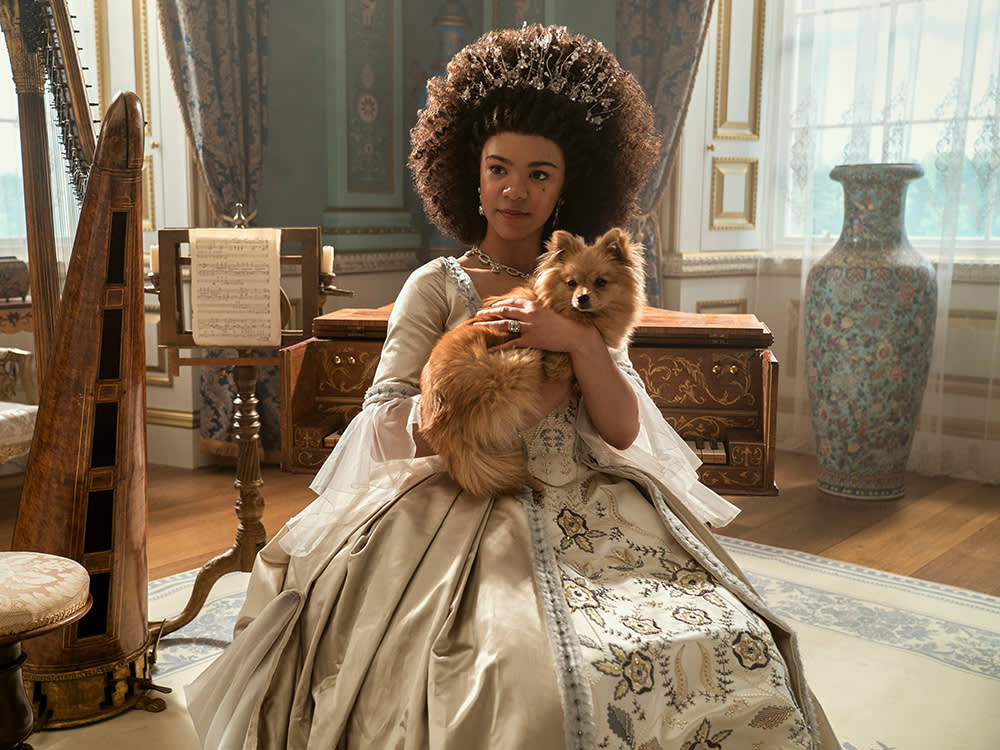
Queen Charlotte: A Bridgerton Story gives its heroine a lovely little scene. After a wedding night that goes spectacularly badly, King George sends his new wife a peace offering, delivered in a basket: a small caramel-coloured Pomeranian, and a note saying he does not want her to be lonely. Charlotte is not charmed. She had understood dogs to be majestic animals, she says, and this one looks to her like a bunny that came out wrong.
It is a great beat. It is also backwards.
The real Sophia Charlotte of Mecklenburg-Strelitz did not need anyone to introduce her to Pomeranians. She sailed to England at 17 to marry George with two of them, Phoebe and Mercury, already at her side. The dogs were not George’s apology. They were hers, and they came with her, and they went on to reshape which dog the British monarchy would be associated with for the next century and a half.
What Charlotte actually did for the breed
Very little is documented about Phoebe and Mercury themselves, which is frustrating, because everything downstream suggests they mattered enormously to her.
What survives is the evidence of a household organized around dogs. Most of her Poms were white, with the notable exception of Fino, who was black and white. In 1779 Benjamin West painted her with one of the white Poms tucked in near her hem, and that was a decision, not an accident. Dogs do not wander into royal portraits. Her home with George included a purpose-built “square deal tub” so she could bathe them herself. They lived inside the palace rather than out in a kennel block, and she developed a habit of handing Poms out as presents to the women who attended her and to the courtiers around her.
That last detail is the one that did the work. A queen who hands out her favorite breed to the women closest to her is not just being generous. She is seeding a fashion through the most influential social network in the country.
Worth noting, too: the Pomeranian of Charlotte’s era was not the three-pound handbag dog of today. These were considerably larger animals, closer in size to a small spitz, and the miniaturization came later, under a descendant with even stronger opinions about them.
The inheritance
George IV carried it on. Fino had been his personal favorite growing up, and when he took over as regent during his father’s illness, his enthusiasm for dogs came with him. He was a famous excess in nearly every direction, and he was painted with his Poms: George Stubbs produced both Fino and Tiny in 1791 and The Prince of Wales’s Phaeton in 1793.
But the person who turned Charlotte’s fondness into a national craze was her granddaughter.
Queen Victoria did not simply like Pomeranians, she industrialized her affection for them. She imported dogs from across Europe. Her kennel held more than 30. They traveled with her, in dedicated compartments on the royal train, with their own security detail, which is a sentence worth reading twice. She exhibited them at dog shows, and it is largely her preference for smaller specimens that drove breeders to shrink the Pomeranian toward the size we recognize now.
She also, quite openly, used them. After Prince Albert’s death, Victoria leaned on her dogs in a way her court noticed and recorded. The one most often at her side in her final years was Turi, whom she bought in 1893, and who appears in photographs with her. It is said that on her deathbed in 1901, she asked for him.
Three generations, one breed, and a straight line from a 17-year-old bringing two dogs on a ship.
The show’s dogs came from rescues
Here is the part that survives the fact-check and improves on the fiction.
The Pomeranians who make up Charlotte’s yapping entourage across the Bridgerton universe, eleven of them, were all rescue dogs. Jane, Mini, Polly, and Spy carry the main workload, and they are swapped out with the others when they have had enough of set life, because a dog who is done for the day is done for the day. Golda Rosheuvel, who plays the older Charlotte, has described her canine scene partners as very feisty, which anyone who has met a Pomeranian will find entirely plausible.
Their fees, meanwhile, are donated onward to the Kennel Club Charitable Trust.
So the show, which invented the Poms as a gift Charlotte did not want, staffed them with rescue dogs who now fund dog welfare work. The real Charlotte, who gave her dogs away to half her court and had a tub built for washing them, would have found the whole arrangement entirely sensible.
The thing the fiction gets right
Strip away the invented origin and the show’s instinct is sound. Charlotte’s Pomeranians really were part of who she was, not set dressing. She really did arrive in a strange country at 17, into a marriage arranged for her, to a husband whose mental illness would be treated with what any modern person would recognize as torture. And she brought her dogs.
Anyone who has moved somewhere frightening with an animal in a crate understands that choice completely. What the writers got wrong is the direction of the gift. Nobody gave Charlotte those dogs to comfort her.
She packed them herself.
References
- Royal Collection Trust. “Benjamin West: Queen Charlotte (1744-1818).” rct.uk
- Royal Collection Trust. “George Stubbs: Fino and Tiny (1791).” rct.uk
- The Kennel Club. “Pomeranian: Breed History.” thekennelclub.org.uk
- Royal Collection Trust. “Queen Victoria and her dogs.” rct.uk
Sasha Ford is a certified cat behaviour consultant who has worked with shelters, catteries, and private clients across the country. They review all feline behaviour content at The Pet Times, with expertise in multi-cat households, indoor enrichment, and stress-related disorders.
Meet our experts ↗Keep reading
 LivingYour Dog Won't Break the Bank With One Big Bill. It's the Slow Drip That Gets YouMarcus Webb · 8 min
 LivingThe Oscar Winner Whose Dog Was Also His Co-WriterSasha Ford · 5 min
 TrainingYour Dog Can't Catch You in a Lie. It Can Decide You're Not Worth Trusting.Dr. Priya Nair · 6 min
 LivingBring the Dog: 11 NYC Date Spots Where Your Pup Is the Best WingmanSasha Ford · 5 min
 LivingEveryone Treats Your Dogs Like a Dating Red Flag. They're Wrong.Jordan Ellis · 6 min
 LivingHow a Pug Named Ziggy Helped Cake Artist Alana Jones-Mann Find Her Joy AgainNina Vasquez · 6 min