


The Best Pet Portraits Are the Least Dignified Ones
A digital collage artist turns cats and dogs into 1980s mall-portrait royalty, floating heads and all. The joke is the point, and so are the animals nobody else asks to photograph.
There is a whole industry devoted to giving your pet a tasteful portrait. Muted palette, clean linen background, the dog gazing off-camera like a retired senator. It is fine. It is also a lie, because nothing about living with an animal is tasteful.
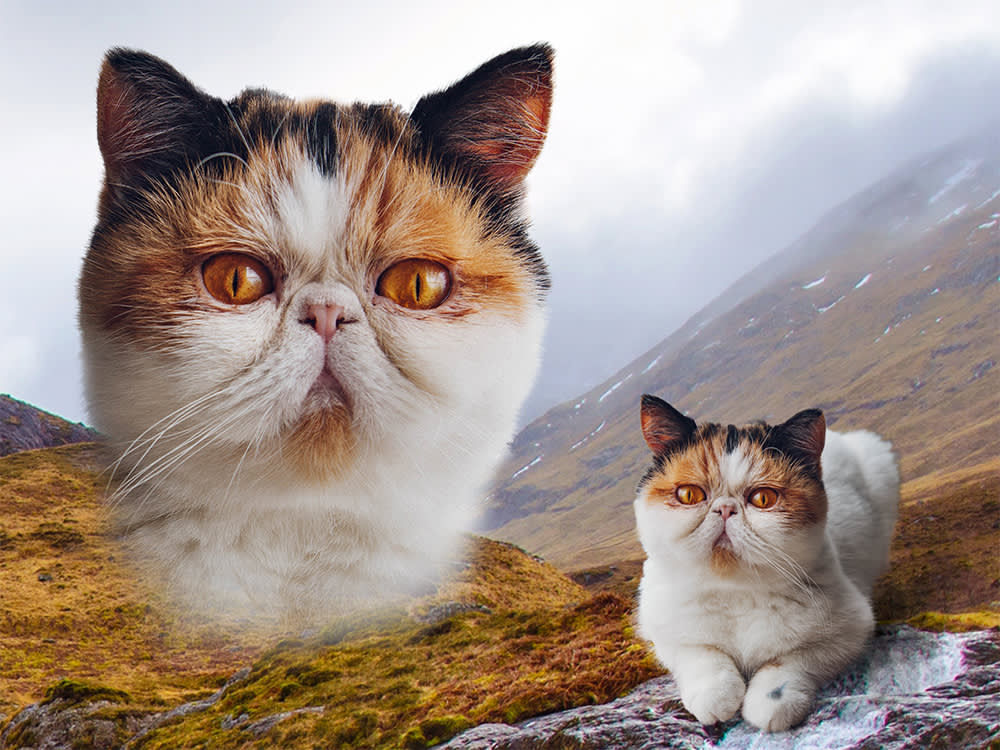
The funniest and, weirdly, the most accurate pet portraits going right now do the opposite. They pile on. A cat’s head floats, semi-transparent, over a fog-wrapped mountain range, while the cat itself sits below in the grass, staring you down with the calm of a creature who has never apologized. It is the 1980s mall portrait studio crossed with a Bob Ross landscape, played completely straight. And it captures the animal better than any minimalist print ever has.
The kitsch is the whole argument
Wild Masterpieces is the work of Evan Douglas, a digital collage artist who works from home in Arkansas. It started as a Christmas gift: a collage of his sister and sister-in-law’s dog, Bruce, planted in the Gryffindor common room and framed like something hanging over an oil baron’s fireplace. It went over well enough that he made another the next year, this time reaching for the Bob Ross palette and the semi-transparent floating head that anyone who grew up with a family portrait in the hallway will recognize instantly.
That combination, grandeur plus a wink, is the trick. Overshoot the dignity by a factor of ten and it circles back around to sincerity. Your cat does think she is the sole heir to a Scottish estate. The portrait simply agrees with her.
Douglas is not an academy-trained painter. He dabbled in high school, gravitated toward mixed media, and did most of his real visual education in architecture school, where he also picked up the software that ended up carrying this entire project.
The subjects he actually wants
Ask most portrait artists about their favorite commissions and you will hear about photogenic dogs. Douglas goes the other direction. The pets he lights up about are the special-needs ones, the animals whose faces are asymmetrical or unusual or scarred, because those are the faces with the most information in them. Distinctiveness is not a problem to be smoothed out. It is the reason the portrait is worth making.
The same instinct shows up in his own house. He grew up with pets, went years without one after moving to Arkansas, and now shares his home with his girlfriend’s two cats: one shelter rescue, one found in a drainage culvert. He is unsentimental but firm about adoption. Shelters are full of animals who have had a rough run and need a soft landing, and starting your search there is the right move, even if he declines to judge anyone who does not.
He is also, quietly, an evangelist for old animals. There is a settling that happens as pets age, a slowing down, a narrowing of the day to the parts that matter. The grey creeping into the muzzle, the changing texture of the skin, none of it reads to him as decline. It reads as character, and it photographs beautifully.
Requests that break the format
Turtles are hard, and not for artistic reasons. The shape simply does not want to be a portrait. Alpacas, on the other hand, are a gift: extraordinary hair, strong opinions, exactly the kind of face that rewards this treatment. Commissions occasionally arrive from people working at animal sanctuaries, wanting a portrait of a favorite orangutan or resident alpaca, which is how you end up with a Bob Ross sunset behind a great ape.
If you’re going to commission one
A few things worth knowing before you send anyone a photo of your pet.
Turnaround runs about five days, though the gift crunches around Christmas and Valentine’s Day stretch that considerably. Order early or accept your fate.
Bad photos are not disqualifying. A huge share of these commissions are memorials, built from a scan of an old print of a pet who died years ago. There are tricks for salvaging almost anything, and nobody is turned away for a grainy source image.
What actually makes the portrait land is personality, not resolution. The best reference photo is not the sharpest one. It is the one where your dog is doing the specific idiotic thing only your dog does. Send that one.
The real reason these work
A good pet portrait is not a flattering pet portrait. It is an honest one, dressed up in a ridiculous costume, which is exactly what our relationship with these animals looks like from the outside anyway. We talk to them in voices. We rearrange our lives around their naps. We think they are the most remarkable creature ever to draw breath.
A giant floating head over a windswept moor is not an exaggeration of that feeling. It is just the first medium to be honest about it.
Sasha Ford is a certified cat behaviour consultant who has worked with shelters, catteries, and private clients across the country. They review all feline behaviour content at The Pet Times, with expertise in multi-cat households, indoor enrichment, and stress-related disorders.
Meet our experts ↗Keep reading
 LivingThere's a Tree in Central Park Covered in Dead Pets. New Yorkers Made It Sacred.Leila Torres · 5 min
 LivingTaurus Season Is a Rest Prescription. Your Pet Already Filled It.Sasha Ford · 6 min
 LivingHow to Get a Landlord to Say Yes to Your PetJames Okafor · 6 min
 LivingShould You Co-Parent a Pet With Your Ex?Sasha Ford · 8 min
 LivingYour Partner Is Allergic to Your Pet. Treat It Like a Medical Problem, Not a BreakupDr. Amara Solis · 6 min
 LivingThis Romance Bookstore Used to Be a Pet Shop. The Neighborhood Dogs Never Got the Memo.Jordan Ellis · 6 min