


Your Dog's Lip Lick Means Nausea or 'Please Back Off.' Learn to Tell.
The same flick of the tongue can mean a queasy stomach or a dog asking you to stop. What separates them isn't the lick, it's what you were doing when it happened.

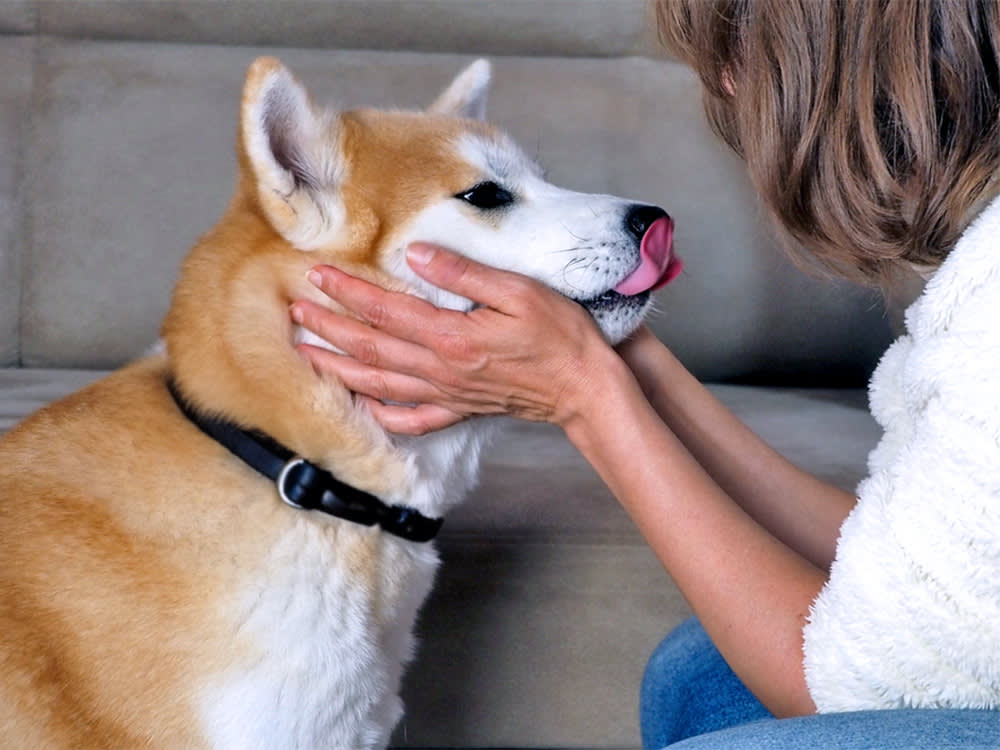
Your dog’s tongue flicks out and swipes across their nose. Then again. Then again.
Most people file this under “dogs lick, it’s what they do,” which is true and useless. Because lip-licking is one of the few behaviors that regularly means two completely unrelated things, and mixing them up has real consequences.
One is a body signal: my stomach is unhappy, my mouth hurts, something is wrong in here.
The other is a social signal: I’m uncomfortable with what’s happening right now and I would like it to stop.
The lick looks identical either way. What separates them is what was happening in the room when it occurred. That’s it. That’s the whole skill.
Start with the social version, because it’s the one people get bitten over
Lip-licking is one of a set of behaviors trainers call appeasement signals: gestures a dog uses to defuse tension and communicate that they’re not a threat. Yawning, turning the head away, blinking hard, a paw lift, a slow lick of the lips.
They mean: I’m not comfortable, I’m not being aggressive, please give me some room.
They come out when a stranger leans in for a hug. When a child grabs the collar. When a dog is being scolded. When another dog gets too close too fast. When someone is looming over them at the vet.
And they come before the growl. That’s the important part. A dog escalating toward a bite runs through this vocabulary first, and a lip-lick is often the very first word. When people say a bite “came out of nowhere,” what they usually mean is that they missed the paragraph the dog wrote beforehand.
So: your dog is licking their lips while being handled, greeted, hugged, cornered, or scolded? That’s a request. Grant it. Give them space. Let them leave. Stop the interaction.
That single reframe prevents more bites than any training tool sold.
The lip lick is the cheapest information your dog will ever give you. It costs them nothing to offer and it costs us nothing to listen. The dogs who end up biting are almost always the ones whose earlier signals nobody answered.
Now the medical version
Take the same lick and remove the social context. Your dog is lying alone on their bed, licking their lips over and over, swallowing repeatedly. Nobody is touching them. Nobody is looming.
That is a very different message, and it’s a body message.
Nausea. Salivation and repeated licking and swallowing are the canine version of the queasy feeling that precedes vomiting. It’s the single most common medical explanation.
Acid reflux. Classically worse overnight and in the early morning, before breakfast, when the stomach has been empty for a long stretch. If your dog licks, swallows, and gulps at 5 a.m., and sometimes brings up bile or foam, that pattern is worth reporting exactly as you’ve described it.
Dental pain or oral disease. A fractured tooth, an abscess, an ulcer, or a foreign object wedged in the mouth all drive licking. Look for licking that comes with dropping food, chewing on one side, or reluctance to have the face touched.
Toxin exposure or oral irritation. A dog who suddenly begins licking and drooling heavily may have eaten or mouthed something caustic. Check the house: a chewed plant, a bitten wire, a spilled cleaner. This one is urgent. Sudden onset heavy licking plus drooling plus distress is a call to your vet or a poison helpline, not a wait-and-see.
Neurological problems. Air-licking and snapping at things that aren’t there (“fly-biting”) can be neurological. They can also, notably, be gastrointestinal, which we’ll get to below.
Allergies and parasites. A dog licking their lips, paws, and body generally, with red irritated skin, recurrent ear infections, and itchiness, is usually an allergy story rather than a nausea story.
The question that sorts them
When your dog licks their lips, ask: what was happening one second ago?
| One second ago… | It’s probably… |
|---|---|
| Someone leaned over, hugged, grabbed, or scolded them | Appeasement. Give space. |
| Another dog approached, or a stranger reached for them | Appeasement. Create distance. |
| They were being asked to do something confusing | Frustration or uncertainty. Simplify the task. |
| Nothing. They’re alone on their bed. | Body signal. Look for a medical cause. |
| They just smelled food | Anticipation. Completely normal. |
| They just ate, or are settling for the night | Grooming. Completely normal. |
| They ate something you can’t identify | Possible toxin. Call now. |
Occasional licking is entirely normal, and this is worth saying clearly so nobody spends the evening staring at their dog. Dogs lick after eating, when they smell something good, and while settling into bed at night, which is essentially a wash-up before sleep. None of that is a problem.
The threshold is excessive: a clear increase from your dog’s baseline, or licking that has you repeatedly asking them to stop.
When to call the vet
Contact your vet, especially if any of this is sudden and has lasted more than a day or so:
- Excessive lip-licking with drooling, panting, or a wet chin and neck
- Lip-licking with burping or frequent swallowing
- Lip-licking with sneezing while eating, which can point to a problem in the mouth or nose
- Licking at the air or snapping at imaginary flies
- Excessive licking of the paws or body, especially with red paws or irritated skin
- Any lip-licking alongside vomiting, regurgitation, appetite loss, or weight change
Keep a lick log. This is the highest-value thing you can bring to the appointment, and almost nobody does it. Note the time, what your dog had eaten and when, what was happening around them, and how long it lasted. Patterns emerge on paper that are invisible in real time, and “it happens between 4 and 6 a.m., before breakfast, and sometimes he throws up bile” is a nearly complete diagnosis handed over at the door.
And check the environment. A dog who starts licking excessively out of nowhere may have found something. Look for chewed plant leaves, gnawed cords, spilled products, and anything in the trash that shouldn’t have been reachable. The more you can hand your vet, the faster this gets solved.
What newer research adds
Two findings genuinely change how to read this behavior.
The lip lick is aimed at us, specifically. A study published in Behavioural Processes by researchers in the UK and Brazil tested how dogs respond to human and canine facial expressions. Dogs mouth-licked significantly more when shown angry human faces than positive ones. Angry voices did not produce the same effect, and the response was much stronger toward human faces than toward other dogs’ faces.
That’s a meaningful result. It suggests mouth-licking isn’t just a generic stress reflex or a reaction to food. It looks like a communication signal directed at people, in response to seeing that a person is upset, and quite possibly something shaped during domestication.
Which is another way of saying: when you’re annoyed at your dog and they lick their lips at you, they know. They are responding to your face, and they are trying to defuse it.
And the “fly-biting” dog may have a stomach problem, not a brain problem. Air-licking and snapping at nothing has traditionally been treated as a neurological or compulsive disorder. Research over the past decade has found that a substantial proportion of dogs presenting with fly-biting behavior turn out to have underlying gastrointestinal disease, and that treating the GI disease resolves the behavior.
That is a big deal for anyone whose dog has been written off as quirky or obsessive. If your dog licks the air, snaps at things that aren’t there, or stares at the ceiling and swallows, ask specifically about a gastrointestinal workup before accepting a behavioral diagnosis.
Bottom line
Lip-licking is a sentence with two meanings, and your dog is not the ambiguous one. You are.
If a person is looming, handling, greeting, or correcting your dog and the tongue comes out, that’s a polite request for space, and it’s the last polite one you’re going to get. Answer it.
If nobody is touching them and the licking keeps coming, that’s a body sending a message. Log it, look for what changed, and take it to your vet.
FAQs
Why does my dog keep licking their lips? Occasional licking after food, before sleep, or at an interesting smell is normal. Excessive licking is either a stress and appeasement signal, given in response to something happening around them, or a medical sign, most often nausea, reflux, dental pain, or oral irritation.
Why does my dog lick their lips and swallow at night? That pattern points strongly at gastrointestinal upset, often acid reflux on an empty stomach. It’s especially suggestive if it comes with vomiting or regurgitation in the early morning. Track it and report it.
Why does my dog keep licking their paws? Usually allergies or stress. Allergic dogs get itchy feet, often with red irritated skin, recurrent ear or skin infections, and sometimes soft stool. Persistent paw licking deserves a vet visit.
Does lip-licking mean my dog is stressed? Often, yes. It’s a well-documented appeasement signal that dogs use to defuse tension, and research shows they direct it at angry human faces specifically. If it happens during handling, greeting, or scolding, give your dog space.
My dog snaps at imaginary flies. Is that neurological? Not necessarily. A meaningful share of fly-biting dogs turn out to have underlying gastrointestinal disease, and treating it resolves the behavior. Ask your vet about a GI workup before settling on a behavioral or neurological diagnosis.
References
- Albuquerque, Natalia, et al. “Mouth-Licking by Dogs as a Response to Emotional Stimuli.” Behavioural Processes, vol. 146, 2018, pp. 42–45. https://doi.org/10.1016/j.beproc.2017.11.006
- Firnkes, Alexandra, et al. “Appeasement Signals Used by Dogs during Dog–Human Communication.” Journal of Veterinary Behavior, vol. 19, 2017, pp. 35–44. https://doi.org/10.1016/j.jveb.2016.12.012
- Bécuwe-Bonnet, Vanessa, et al. “Gastrointestinal Disorders in Dogs with Excessive Licking of Surfaces.” Journal of Veterinary Behavior, vol. 7, no. 4, 2012, pp. 194–204. https://doi.org/10.1016/j.jveb.2011.07.003
- Frank, Diane, et al. “Prospective Medical Evaluation of 7 Dogs Presented with Fly Biting.” Canadian Veterinary Journal, vol. 53, no. 12, 2012, pp. 1279–1284. https://pmc.ncbi.nlm.nih.gov/articles/PMC3500122/
- “Gastroesophageal Reflux in Small Animals.” MSD Veterinary Manual. https://www.msdvetmanual.com/digestive-system/diseases-of-the-esophagus-in-small-animals/gastroesophageal-reflux-in-small-animals
- Pet Poison Helpline. https://www.petpoisonhelpline.com/
Not a substitute for your vet. Our guidance is educational. For urgent symptoms, contact a vet or emergency clinic right away. Editorial standards
Dr. Nair is a veterinarian focused on diet and feeding. She covers everyday nutrition, treats, and the many "can they eat this?" questions owners ask, grounding each answer in what is actually safe and sensible for dogs and cats.
Meet our experts ↗Keep reading
 Health & WellnessWhen One Dog Dies, the Other One Changes. Science Finally Has Numbers on It.Dr. Mara Chen · 7 min
 TrainingA Shelter Dog Predicted a Stranger's Seizure With No Training. How?Dr. Lena Park · 6 min
 Health & WellnessNo, Your Dog Isn't Schizophrenic. But What They Have Is Real.Dr. Lena Park · 7 min
 Health & WellnessYour Dog's Sleep-Twitching Is Almost Always a Dream. Here's When It Isn't.Dr. Ravi Mehta · 6 min
 TrainingOne Dog Licking Another's Ears Is Usually Fine. Two Things Make It Not.Dr. Ravi Mehta · 7 min
 Health & WellnessYour Old Dog Staring at the Wall Is Veterinary Medicine's Most Missed DiagnosisDr. Nina Kohl · 8 min