


Can Dogs Catch Your Flu? Canine vs. Human Influenza Explained
Dogs can carry some human flu strains but rarely get sick from them. Learn the real risks, what canine influenza looks like, and how to protect your pup.

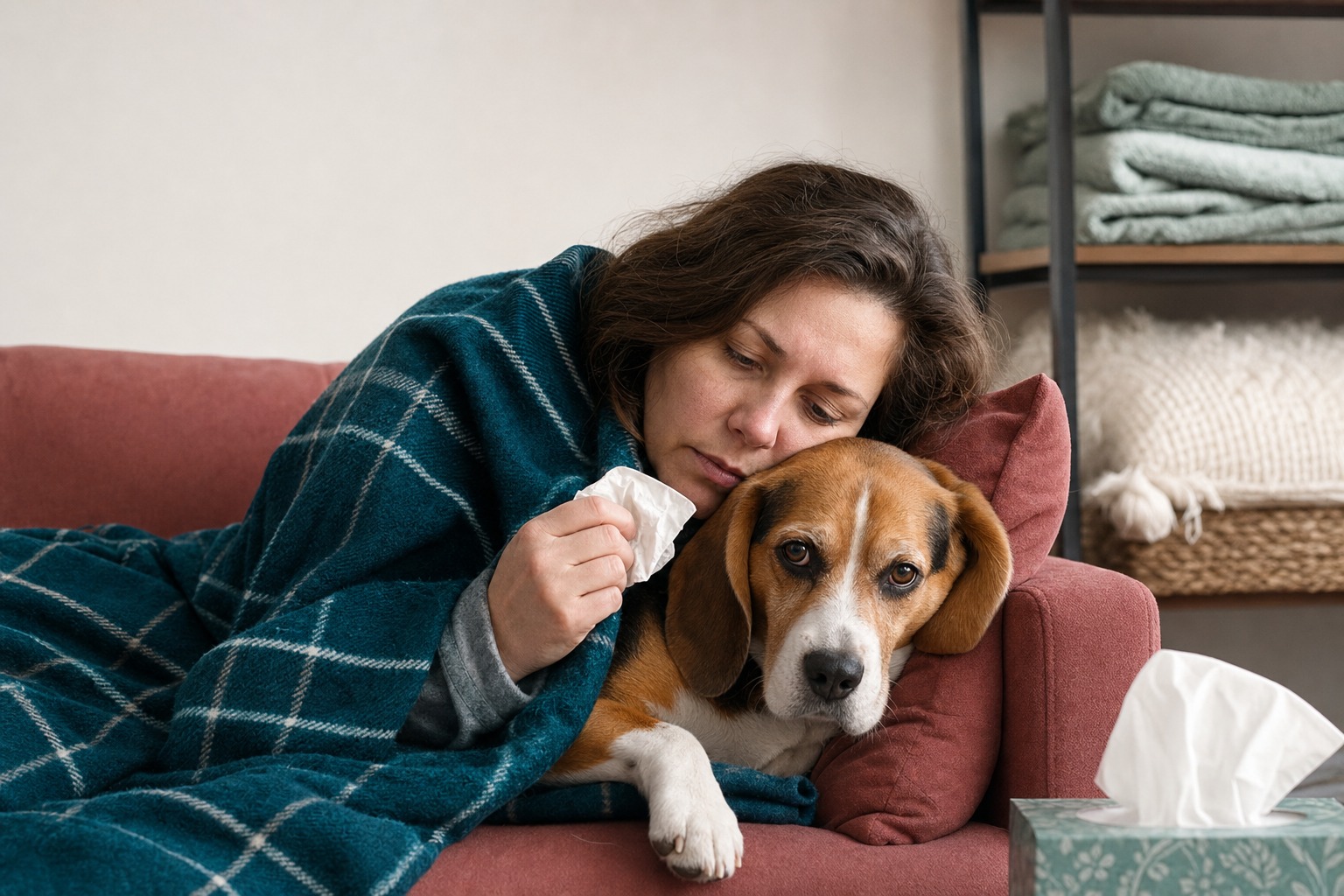
There aren’t many upsides to being sick, but curling up with your dog while you ride it out is one of them. So it’s fair to wonder whether you’ll pass your flu along. The short version: dogs can pick up certain human influenza strains, a phenomenon called reverse zoonosis, but those viruses rarely make dogs ill. The bigger concern for dogs is canine influenza, a different beast entirely. Let’s sort out what’s real and what isn’t.
Can dogs get the flu from humans?
It’s a little complicated. Dogs can become infected with some strains of human influenza, but they almost never develop any actual illness from it. Here’s the wrinkle: an infected dog could silently carry and spread the flu to other people in close contact for up to 10 days.
That said, dogs are not a major reservoir for human flu. Dog-to-human transmission is poorly documented and isn’t considered a meaningful source of human infections. To be cautious, it’s reasonable to keep your dog out of other people’s faces for a week or two after they’ve nursed you through the flu.
Do dogs get the flu?
Dogs do get a flu of their own, but it’s a different virus than the ones we catch. The good news is that these canine flu viruses aren’t readily transmitted to people, so your dog won’t give you the flu.
What is canine influenza?
There are two recognized canine influenza strains, both influenza A viruses, which are common in animals:
- H3N8 was first recognized in 2004, appearing as an outbreak of respiratory illness at a Greyhound track in Florida. It’s a mutation of an equine influenza virus.
- H3N2 first showed up in the US in 2015, though it likely originated in Asia about a decade earlier. It came from an avian influenza virus and may have entered the US through a single dog brought to Chicago from South Korea.
Intermittent outbreaks of both strains have been documented across the US, and the virus has turned up in nearly every state. Fortunately, routine spread is uncommon, and most cases trace back to events or facilities packed with dogs.
Do dogs get the stomach flu?
If a sick parent’s dog starts vomiting or having diarrhea, it’s natural to wonder if the stomach flu jumped over. It didn’t. Dogs don’t catch the stomach flu from people, and canine influenza causes respiratory problems, not GI symptoms. Don’t ignore an upset stomach, but don’t blame yourself for it either.
How do dogs get dog flu?
Canine influenza spreads mainly through aerosol transmission. Every time an infected dog coughs or sneezes, it releases countless viral particles that can infect other dogs. Since you can’t exactly teach a dog to wear a mask, isolating sick dogs is the key to limiting spread. The strains have relatively low transmissibility, so outbreaks usually require a lot of dogs in a tight space.
The virus can also spread through direct contact, like nose-to-nose or mouth-to-nose, or via contaminated bedding and clothing moved between dogs. Practice good hygiene after handling a sick dog, and clean surfaces and materials before other dogs are exposed.
Is there a dog flu vaccine?
Yes, several. Some cover a single strain, others cover both. Canine flu vaccines aren’t part of the core series, so they’re typically reserved for dogs in higher-risk situations. Most outbreaks are tied to settings that gather many dogs, including:
- Dog shows
- Boarding facilities
- Doggy day care
- Animal shelters
- Agility competitions
If canine influenza is circulating in your area and your dog will be in a risky setting, talk with your vet about vaccinating. Plan ahead, because the vaccine is a two-shot series given three to four weeks apart, and your dog isn’t protected until seven to 10 days after the second dose. That means thinking about vaccination at least a month before an event.
Flu vaccines don’t reliably prevent infection or viral shedding, but they do offer solid protection against severe disease. Vaccinated dogs can still get canine influenza, but their symptoms tend to be mild.
The question I hear most in flu season is whether someone will get their dog sick by snuggling them, and I can usually put that worry to rest. It’s canine influenza I keep an eye on, especially for dogs that board, compete, or do day care. If your dog runs in those crowds, that’s the conversation to have with me, and plan a month ahead because the vaccine needs time.
Signs of dog flu
Canine influenza is primarily respiratory. Dogs don’t get the GI misery that makes human flu so unpleasant, but even the limited range of symptoms can turn dangerous. Dogs with the flu need close monitoring, and treatment must start quickly if they progress beyond simple upper respiratory signs. Common symptoms include:
Coughing and sneezing
These are the most common and recognizable signs. The cough is often described as soft and moist, though it varies by stage and severity. Because so many diseases share these signs, testing is needed to confirm dog flu.
Nasal discharge
Like human flu, canine influenza can cause a runny nose. The discharge is usually clear early on but may turn thick and greenish if a secondary bacterial infection sets in. It can come with ocular discharge and red eyes.
Fever
Most dogs never progress past coughing, sneezing, and a runny nose. But a more severe infection can bring a high fever, over 104 degrees Fahrenheit. Monitoring your dog’s temperature helps you catch worsening illness. If your dog has the flu and spikes a fever, contact a vet immediately.
Decreased appetite
Dogs with mild flu usually keep eating. A loss of appetite can signal a more severe illness and may come alongside lethargy and difficulty breathing.
Shortness of breath
Severe infections can lead to pneumonia, which can be dangerous and progress quickly. Watch for rapid or labored breathing, pale or bluish gums, increased respiratory noise, weakness, or coughing up bloody phlegm. Overall mortality for dog flu is low, under two percent for previously healthy dogs, but fever and pneumonia can escalate within hours and turn fatal, so don’t wait.
Dog flu vs. other illnesses
Kennel cough vs. canine influenza
Kennel cough is the dog version of the common cold. This disease complex is caused by viruses, bacteria, or a mix, and usually resolves on its own in a week or two. Canine influenza viruses are among its possible viral causes. The specific cause often goes undiagnosed because mild cases all look similar: coughing, sneezing, runny nose. Only when more severe signs appear does a vet usually go hunting for the cause.
Allergies vs. dog flu
Dogs can be allergic to almost anything. Many allergies show up as skin problems, but some cause respiratory signs. Respiratory allergies are often seasonal, driven by pollen or airborne materials, and tend to bring sneezing and clear discharge with minimal coughing.
Bronchitis vs. dog flu
Chronic bronchitis can be triggered by allergies and other causes. Affected dogs often have a chronic cough that flares up intermittently. Their parents usually know the dog’s typical cough well and can spot a change in frequency or character that might signal an infection.
What newer research adds
The CDC continues to classify dog-to-human flu transmission as not well documented and not a significant driver of human infections, while still noting that dogs can be infected by human strains. This keeps the practical guidance steady: you’re unlikely to make your dog sick, and an exposed dog is unlikely to make others sick, but brief caution after your own flu is sensible.
Recent laboratory work, including studies on the adaptation potential of H3N8 canine influenza in human respiratory cells, is part of ongoing surveillance into how these viruses might evolve. Nothing in that research changes day-to-day advice for dog parents, but it underscores why vets keep tracking canine influenza and why vaccination remains worthwhile for dogs in high-contact settings.
The bottom line
Dogs can carry some human flu strains but rarely get sick from them, so you don’t need to feel guilty about snuggling your pup when you’re under the weather. The real concern is canine influenza, a separate set of viruses that cause respiratory illness in dogs and spread mainly in crowded settings. Keep an eye on the warning signs, isolate sick dogs, and talk to your vet about vaccination if your dog spends time around lots of other dogs.
References
- CDC. “About Dog Flu.” Influenza in Animals. https://www.cdc.gov/flu-in-animals/about/canine-flu.html.
- Dunn, Danielle, et al. “Outcomes of and Risk Factors for Presumed Canine H3N2 Influenza Virus Infection in a Metropolitan Outbreak.” Journal of the American Veterinary Medical Association, vol. 252, no. 8, 2018, pp. 959-965.
- Sekine, Wataru, et al. “Adaptation Potential of H3N8 Canine Influenza Virus in Human Respiratory Cells.” Scientific Reports, vol. 14, no. 1, 2024.
- Tonozzi, Caroline C. “Canine Influenza (Flu).” MSD Veterinary Manual. https://www.msdvetmanual.com/respiratory-system/respiratory-diseases-of-small-animals/canine-influenza-flu.
- Voorhees, Ian E.H., et al. “Spread of Canine Influenza A(H3N2) Virus, United States.” Emerging Infectious Diseases, vol. 23, no. 12, 2017, pp. 1950-1957.
Common questions
Can dogs get colds?
Dogs can get upper respiratory infections, commonly called kennel cough. It has both bacterial and viral causes and can spread between dogs.
Not a substitute for your vet. Our guidance is educational. For urgent symptoms, contact a vet or emergency clinic right away. Editorial standards
Dr. Park is a board-certified emergency and critical care specialist. She reviews our health and safety content for clinical accuracy and contributes guides on recognising urgent conditions. Her focus is helping owners act quickly and correctly when it matters most.
Meet our experts ↗Keep reading
 Health & WellnessA Dog Who Won't Drink Water Is a Clock, Not a QuirkDr. Lena Park · 7 min
 Health & WellnessMucus in Your Dog's Poop Is Not the Problem. Its Company Is.Dr. Amara Solis · 8 min
 Health & WellnessWhen an Old Dog's Bark Goes Hoarse, It's Rarely Just a Sore ThroatDr. Lena Park · 7 min
 Health & WellnessThe Great Impersonator: Why You Can't Eyeball a Mast Cell TumorDr. Mara Chen · 7 min
 Health & WellnessChronic Kidney Disease in Dogs Is a Race Against Time. How to Win GroundDr. Lena Park · 7 min
 Health & WellnessLyme Doesn't Announce Itself. It Fakes a Limp Months Later.Dr. Ravi Mehta · 7 min