


A Grooming Vacuum Only Works If Your Dog Lets It. How to Win Them Over
The most expensive grooming vacuum is useless if your dog flees the room. Here is how to match the machine to your dog's coat and nerves, a step-by-step plan to get a scared dog comfortable, and the three types worth buying.

Affiliate disclosure. This article contains affiliate links. We may earn a small commission if you buy through a link, at no extra cost to you. How we handle recommendations.
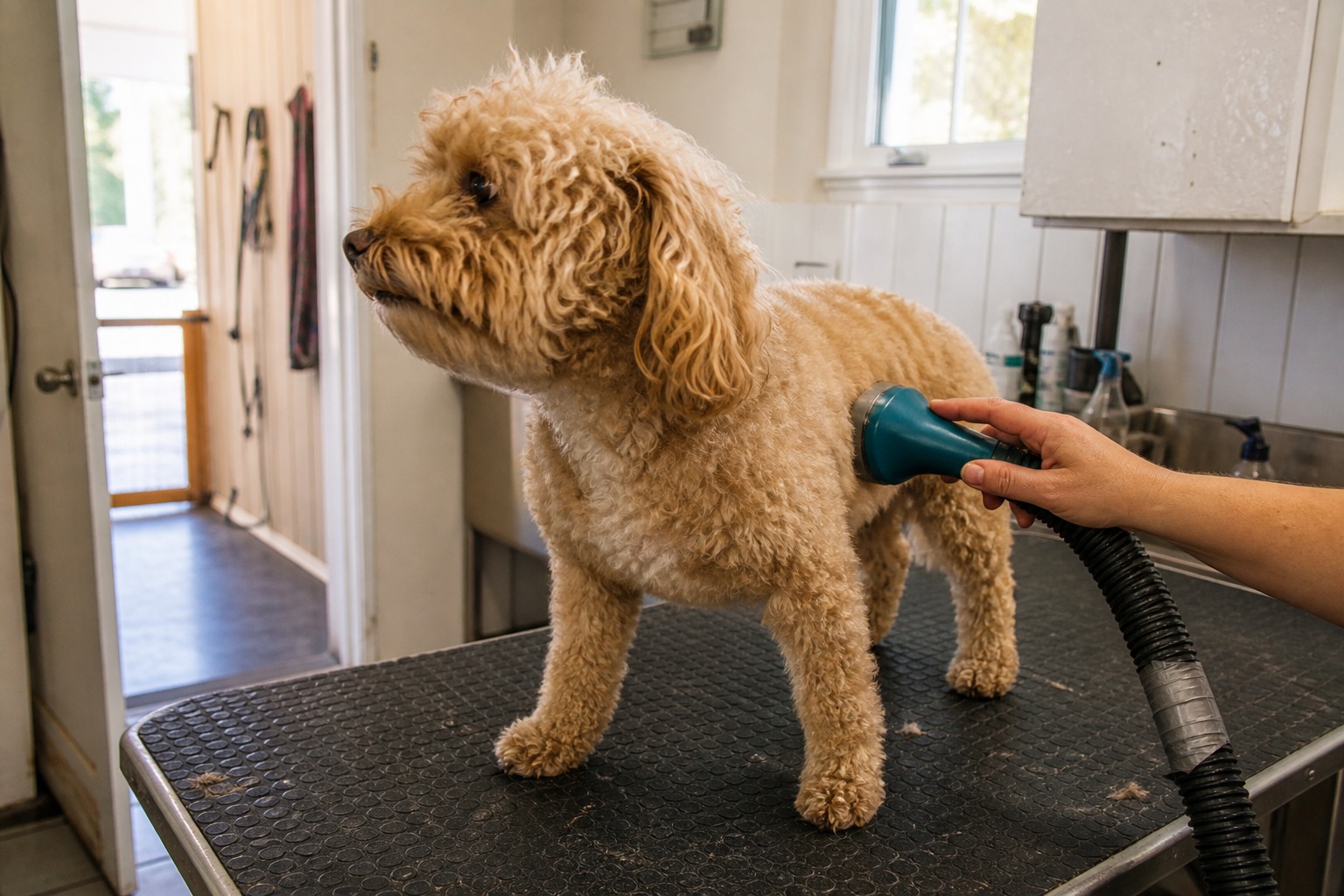
You can spend $500 on the best grooming vacuum made, and if your dog bolts the second you turn it on, you have bought an expensive way to collect dust. The machine is the easy part. Whether your particular dog will actually stand there and let it run is the part that decides if this purchase is brilliant or a closet ornament.
So before the product types, two questions matter more than any spec: how does your dog feel about noise and vibration, and what kind of coat are you grooming? Get those right, put in a little training, and a grooming vacuum genuinely changes life with a shedding dog, capturing the fur as you brush instead of broadcasting it across your home. Get them wrong and the fanciest model on the market gathers dust in a corner.
Why grooming vacuums fail (it is almost never the machine)
A grooming vacuum is a vacuum strapped to a brush, which means it asks a dog to accept three slightly scary things at once: a loud motor, a vibrating tool, and being handled. Plenty of dogs are fine with it. Many are not, at least not on day one.
The biggest predictor of success is simple: how your dog reacts to your regular vacuum. A dog who naps through household vacuuming will likely take to a grooming vacuum quickly. A dog who barks, hides, or skitters away needs either a different type of machine (one that keeps the motor far from its body) or a deliberate plan to build comfort first. Buying the wrong type for a noise-sensitive dog is the single most common way this goes sideways.
The win-over plan: desensitizing a nervous dog
If your dog is wary, do not skip this. A week or two of easy steps turns a fight into a routine, and it works with any model.
Start with the machine off and in the room. For a few days, leave the grooming vacuum out where your dog can sniff it, and feed treats nearby so its mere presence predicts good things.
Add the sound at a distance. Run the vacuum in another room while your dog gets treats and praise where it is calm. Over several sessions, move it gradually closer, always staying under the threshold where your dog gets nervous.
Introduce the brush without suction. Use the brush attachment on your dog with the motor off, so the touch becomes familiar and pleasant on its own.
Combine, briefly. Finally, run the vacuum on its lowest, quietest setting while you brush for just a few seconds, then reward and stop. Build up the duration over days. Keep every session short and end on a good note.
Done patiently, most initially scared dogs come around. Done in a rush, you can create a fear that follows the dog to every future grooming session.
Match the type to your dog
There are three formats, and the right one depends mostly on your dog’s nerves and coat.
Upright vacuum with a pet attachment, for the unbothered dog and the cramped closet
If your dog already ignores your vacuum, a brand attachment that clips onto a machine you own is the most space-efficient choice. The
Heads up. is the standout, with a slicker-style brush engineered to muffle motor noise and an extendable hose that puts distance between the dog and the sound. Two caveats: it works only with compatible Dyson models, and Dyson specifies it is for medium and long coats, not wool or tightly curly coats like Poodles, Doodles, and Bichons.
Canister or hose-based vacuum, for the hesitant dog
When the dog is unsure, distance is everything. A standalone canister model keeps the loud motor across the room while only a quiet hose and brush touch the dog, which is far less intimidating than a handheld unit buzzing against its side. For coat-and-cleaning versatility, the
Heads up. pairs a large canister (good for big or extra-furry dogs) with five attachments, including two brushes, an electric trimmer with guard combs, and floor and furniture tools for cleanup afterward. Its quiet suction makes it a strong pick for building a positive association, and unlike the Dyson kit it is rated for all coat types, including curly.
A bath-and-shed hybrid, for the dog who hates baths
Not every shedding problem is a brushing problem. The
Heads up. is a low-water bathing system that works with a no-rinse shampoo to clean and capture loose fur without a full tub bath, a relief for dogs who panic at bath time. It has no brush attachment, so it lifts fur that has already released rather than pulling fresh undercoat, but it works on all coat types and solves a different problem than the brushing vacuums.
Skip the all-in-one handheld units for any dog that is not bombproof about noise: putting the motor right in your hand next to the dog is the most intimidating configuration there is.
Keep it working
A grooming vacuum lives or dies on maintenance. Empty the canister or bag after every single session, because the oils in pet hair gunk up the chamber fast if left to sit. Clean or replace filters on the schedule in your manual, both for suction and for safety, since a clogged filter can become a fire hazard. Store the attachments in a cool, dry place away from your household cleaning supplies, and never repurpose the grooming attachments for regular floor vacuuming, where grit can ruin them.
The honest bottom line
A grooming vacuum is worth it for a heavy shedder whose fur has taken over your home, provided you buy the right type for your dog’s coat and invest the week or two it takes to win the dog over. For a calm dog in a tolerant household, an inexpensive slicker brush used outside still does most of the work. Either way, the deciding factor was never the suction rating. It was whether your dog would stand still for it.
References
- American Kennel Club. “How to Groom a Dog at Home.”
- ASPCA. “Desensitization and Counterconditioning for Fearful Dogs.”
- Fear Free Pets. “Reducing Grooming-Related Fear, Anxiety, and Stress in Dogs.”
Common questions
Will a grooming vacuum work on a dog who is scared of the regular vacuum?
Not without training first, and possibly not at all with a handheld model, which puts the motor and noise right against the dog. If your dog flees the normal vacuum, start with a canister or hose-based model that keeps the motor across the room, and spend one to two weeks desensitizing the dog to the sound and feel before you ever switch it on near them.
Can I use a grooming vacuum on a Poodle, Doodle, or other curly coat?
Check the model. Some, including the popular Dyson grooming kit, are designed for medium and long straight or double coats and are not recommended for wool or tightly curly coats, where the brush can pull. Other multi-attachment kits are rated for all coat types including curly. Match the tool to your dog's coat before buying.
Is a grooming vacuum better than just brushing outside?
It depends on your situation. For heavy shedders in homes where fur is a constant battle, a grooming vacuum captures hair at the source and is worth it, if the dog tolerates it. For a calm dog and a tolerant household, a good slicker brush used outdoors does most of the job for a fraction of the cost.
How do I keep a grooming vacuum working well?
Empty the canister after every session, since the oils in pet hair quickly gunk it up, and clean or replace filters on the schedule in your manual (a dirty filter can become a fire hazard). Store attachments in a cool, dry place and never use the grooming attachments for regular household vacuuming.
Sara Lim leads our Product Picks coverage, testing and comparing the things pets and their owners actually use. From everyday essentials to home-and-style finds, she focuses on honest, useful recommendations rather than hype.
Meet our experts ↗Keep reading
 Product PicksPick a Golden Retriever Shampoo by What Their Skin Is Actually DoingDr. Nina Kohl · 9 min
 Product PicksThat 'Fresh Groom' Smell Is the Problem, Not the PerkSasha Ford · 5 min
 Product Picks'Eco-Friendly' Pet Grooming Is Mostly a Marketing Word. This Line Actually Earns It.Sara Lim · 4 min
 Product PicksThe $350 Grooming Kit's Best Tool Isn't a ToolNina Vasquez · 5 min
 Product PicksFlea Shampoo Kills What's on the Dog. The Real Battle Is in Your HouseDr. Priya Nair · 9 min
 Product PicksYour Dog Doesn't Want a Signature Scent. Here's When DedCool's Perfume Is Fine Anyway.Sasha Ford · 4 min