


Pick a Treat-Dispensing Toy by Your Dog's Chew Strength, Then the Problem
The best treat toy isn't the highest-ranked one, it's the one that survives your dog's jaws and fixes the actual issue, whether that's a too-fast eater, a bored brain, or a dog that falls apart when you leave. Nine picks, sorted that way.

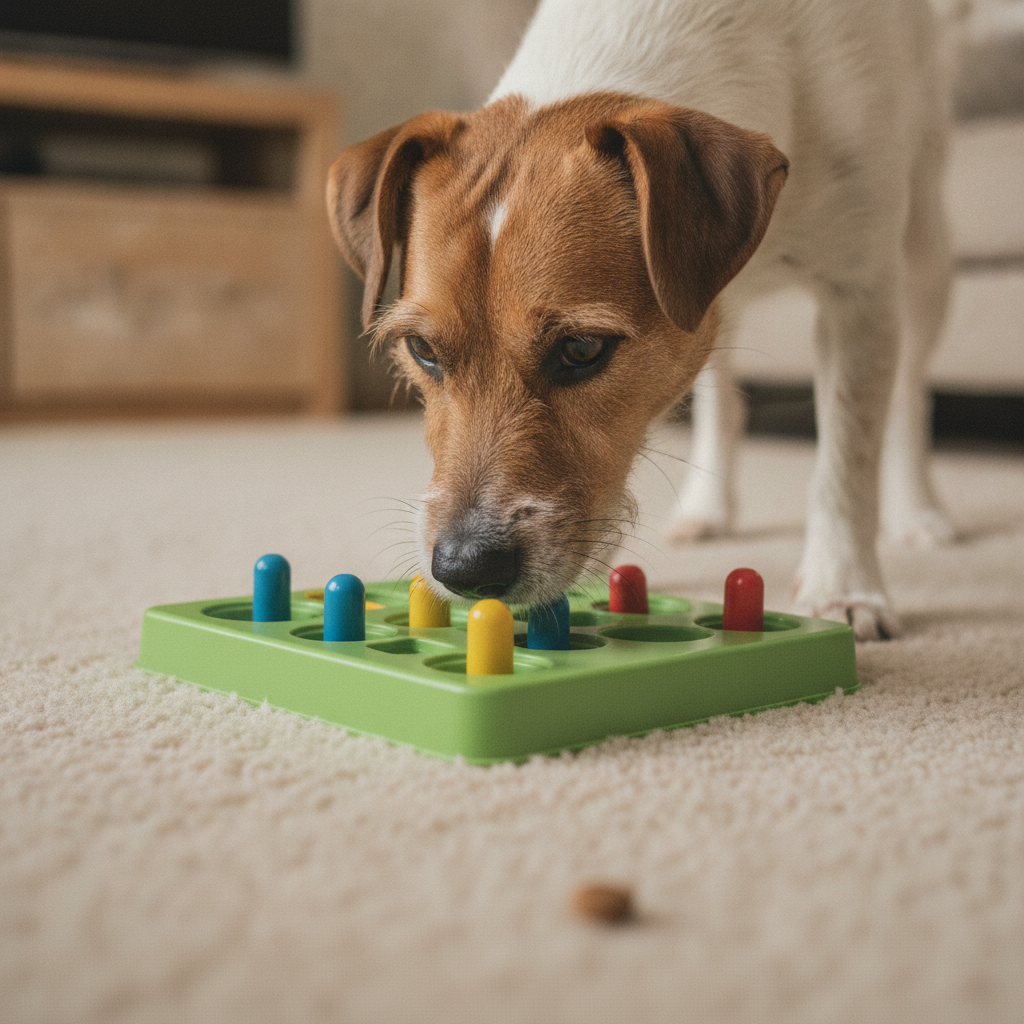
Walk into the treat-toy aisle and you’ll find a hundred options and no useful way to choose between them. Ranked “best of” lists don’t help much either, because the toy that’s perfect for a gentle senior poodle is the same toy a determined boxer will gut in ninety seconds. The right starting question isn’t “which is best,” it’s “what can my dog’s jaws not destroy,” followed closely by “what am I actually trying to fix.”
So that’s how this guide is built. First, honestly assess your dog’s chew strength, because a toy that fails that test is a choking hazard, not a toy. Then pick by the problem you’re solving: a dog that eats too fast, a dog that’s bored and destructive, or a dog that struggles when you leave. Here are nine that earn their place, sorted that way.
The number one mistake I see is buying a cute fabric puzzle for a power chewer. Within a day there’s stuffing everywhere and a vet bill. Match the material to the mouth first, everything else is secondary.
First, rate your dog’s chew strength
Be honest here, it’s the safety step. A gentle or average chewer can use rubber, most plastics, and fabric puzzles. A strong or “aggressive” chewer needs thick, one-piece rubber and should skip fabric and thin plastic entirely, and be supervised even with tough toys. When in doubt, size up the durability and watch the first few sessions. Any toy that starts shedding chunks comes away immediately.
For the dog that inhales meals (slow-feeder picks)
If your dog eats like the bowl might vanish, these turn the meal into a job and protect their digestion.
Starmark Bob-a-Lot (adjustable). A weighted wobbler with a knob that dials difficulty up as your dog gets the hang of it, and a base that rights itself so they have to keep working. It’s hard plastic, durable enough for strong chewers, holds a sizable amount of dry food, and many owners report it actually got a picky dog interested in eating. Two honest cons: the hard plastic can be rough on teeth, and it’s dry-food only and not dishwasher-safe. Comes in small and large.
KONG Classic (best overall). The benchmark for a reason. The hollow beehive shape takes anything from kibble to peanut butter, the soft natural rubber is easy on teeth, and it’s dishwasher-safe, affordable, and sized from extra-small to extra-large. KONG officially rates it for “average” chewers, but plenty of strong-jawed dogs use it for hours, one reviewer called it “almost indestructible.” The one caveat: some find the standard sizes too small for big dogs, so size up.
Outward Hound Treat-Dispenser Ball. A bouncy, BPA-free “Orbee-Tuff” ball with an indent that holds up to about half a cup of dry food, plus a mint scent for post-snack breath. Great for dogs who like to chase their food around. It’s dry-food only, and a few owners note treats can fall out too easily on the highest fill, so dial in the amount.
For the bored brain (enrichment and puzzle picks)
These exist to tire out the mind, the kind of work that settles a restless dog far better than another lap of the yard.
Snuffle mat (best for sniffers). A plush mat with fabric flaps and velcro pockets that hide treats for the dog to nose out, often with a built-in crinkle and tug rope. It’s machine washable and genuinely absorbing for scent-driven dogs. Important fit note: it’s for small-to-medium, non-aggressive chewers, a strong dog will shred it, so this is a gentle-mouth toy only, and snacks-not-meals sized.
Sliding-tile puzzle board (best puzzle). A flat board with sliding covers and a spinning treat plate that makes the dog problem-solve to uncover the food. It handles both dry and wet food, wipes clean, and is great brain exercise that also slows eating. Most are sized for small breeds and are best supervised, since a frustrated dog may try to chew the sliders rather than slide them.
Knitly twist-bone (adjustable, scent-release). A nylon bone-shaped feeder with side knobs that adjust difficulty and holes that release the food’s scent to draw the dog in. It comes apart for the dishwasher. It’s explicitly not for large dogs or rough chewers, and you should supervise, because if a hard piece cracks off it’s a hazard. For the right medium, gentle dog, it can occupy them close to an hour.
For the dog that falls apart when you leave (separation and engagement picks)
When the trigger is being alone, the goal is a toy that holds attention and, ideally, adds a little interactive reward.
PETGEEK Automatic Dispenser with button (best electronic). This teaches a cause-and-effect game: the dog presses a button, a treat drops, and a sound cue reinforces it. The button anchors in place (suction, peg, or attached to the unit), it holds up to 13.5 ounces, enough for a whole meal, and a remote lets you trigger drops or bypass the button entirely. Dry food only and battery-powered; some owners report the button-to-feeder connection drops occasionally, so test it before relying on it for alone-time.
Legend Sandy spiky treat ball (best durable). For the strong chewer who needs something that fights back: 10mm-thick rubber, a spiky texture that grips in the mouth and helps scrub plaque, and a beef-scented attractant. At about 3.5 inches it reportedly holds up to a cup of kibble, and owners routinely call it indestructible. It squeaks softly (a plus for some, a minus for noise-sensitive dogs), and the opening can be wide enough that treats escape easily, so use larger pieces.
Woof Flyball fetch feeder (best for fetch). A rubber ball that fits a launcher stick and rewards the dog with a treat once they roll it the right way, combining fetch, puzzle, and dispenser. The rubber is tooth-friendly and quiet, and it’s dishwasher-safe. It comes in one size and holds up to large dogs, though big-dog owners wish for a bigger version, the main thing keeping it off the top of the “power chewer” list.
The one rule that beats any ranking
Buy for the mouth, then the problem. A power chewer gets thick one-piece rubber and supervision; a gentle sniffer gets the snuffle mat or the puzzle board; a lonely dog gets the interactive feeder. Whatever you choose, subtract the toy’s food from the daily ration so enrichment doesn’t quietly become weight gain, and retire any toy the moment it starts coming apart. A toy your dog can’t safely use isn’t a bargain at any rating.
References
- American Veterinary Medical Association. “Enrichment and the Indoor Pet: Food Puzzles and Foraging Toys.”
- American Animal Hospital Association. “Behavioral enrichment and slow-feeding for dogs.”
- Dantas LMS, et al. “Food puzzles for cats and dogs: enrichment and welfare benefits.” Journal of Veterinary Behavior.
Common questions
Are treat-dispensing toys actually good for dogs?
Yes, and the benefits are real. Most double as slow-feeders, which eases digestion and curbs gulping; all of them deliver mental stimulation that tires a dog out as much as a walk does and taps natural foraging instincts. The catch is matching the toy to your dog, the wrong one is either destroyed in minutes or ignored.
What should I put inside one?
It depends on the material. Rubber toys handle sticky stuff like peanut butter or wet food and wipe clean; fabric and most plastic puzzles are for dry kibble only. Decide what you'll fill it with before you buy, and remember to count that food against your dog's daily total so the toy doesn't become extra calories.
How do I keep one clean?
Many rubber toys are dishwasher-safe; some plastics and all fabric pieces are hand- or machine-wash only. Check the label before the first wash, because heat can warp the wrong plastic, and a moldy peanut-butter toy is worse than no toy at all.
Sasha Ford is a certified cat behaviour consultant who has worked with shelters, catteries, and private clients across the country. They review all feline behaviour content at The Pet Times, with expertise in multi-cat households, indoor enrichment, and stress-related disorders.
Meet our experts ↗Keep reading
 TrainingYour Dog Isn't Rejecting Your Gift. They're Finishing a Hunt.Dr. Nina Kohl · 7 min
 Product PicksInteractive Dog Toys Are Enrichment, Not Entertainment: Pick by Your Dog's Drive (10 Tested)Sara Lim · 14 min
 Product PicksA Fashion Founder's Dog Shelf, Audited: 2 Are Real Buys, 1 Is a PropSara Lim · 7 min
 Product PicksThe Best Dog Toys Aren't Toys. They're Puzzles.Jordan Ellis · 6 min
 Product PicksI Bought My Dachshund a Hot Dog Toy. He Was Personally Offended.Nina Vasquez · 3 min
 Product PicksThis Montana Factory Grinds Up Your Dog's Old Toy and Makes You a New OneSara Lim · 8 min